
 Worksheets
7G review
Total questions: 50
Worksheet time: 39mins
All matter is made up of tiny _______________
energy
particles (atoms and molecules)
bits
antimatter
Particles are always moving.
True
False
Particles always ________________ each other, this gets stronger as the particles get ___________________.
attract, farther apart
attract, closer together
repel, farther apart
repel, closer together
Particles at a higher temperature, move _____________ than those at a lower temperature.
faster
slower

Solid
Liquid
Gass
These have a FIXED volume, but NOT a fixed shape, taking the shape of their container.
Solid
Liquid
Gas
In which state of matter will there be the LARGEST space between molecules?
Solid
Liquid
Gas
The particles of ___________________ are tightly packed.
solids
liquids
gases
none
The particles of liquids can:
vibrate
move past each other
both
none
The forces of attraction between particles of _________ are weakest.
solids
liquids
gases
none

Which of the following sentences are true about solids?
Solids are rigid, have a fixed shape but not a fixed volume
Solids are not rigid, have a fixed shape and no fixed volume
Solids are rigid, have a fixed shape and a fixed volume
Something that goes from liquid to gas is...
Evaporation
Melting
Freezing
Sublimation
Which image shows particles in a gas?


When we add heat to particles, we are adding:
Electricity
Energy
More Particles
As particles are exposed to colder temperatures they _____
speed up and get stronger bonds
slow down and get stronger bonds
stay the same
become ions
Pollen grains suspended in water exhibit Brownian motion. How does a particle undergoing Brownian motion move?
In smooth curves
Randomly
Orderly with a pattern
In straight lines with no change of direction

Very small pollen grains are suspended in a beaker of water. A bright light shines from the side. Small, bright dots of light are seen through a microscope. The dots move in rapidly changing, random directions. What are the bright dots?
pollen grains being hit by other pollen grains
pollen grains being hit by water molecules
water molecules being hit by other water molecules
water molecules being hit by pollen grains

A pollen grain in a beaker of still water is viewed through a microscope. Which diagram shows the most likely movement of the pollen grain?
A
B
C
D
Diffusion is...
It is the random movement of particles.
It is when particles move from a place of higher concentration to a place with lower concentration.
It is when particles move when being mixed together.
It is when the particles hit the sides of their container.
What is Brownian motion?
The movement of water molecules in a beaker
The movement of air molecules
The movement of solid molecules
The movement of smoke particles in air
A student makes an observation using a microscope. He observed some particles which were moving in a zig-zag way. What particles could these NOT be?
Smoke particles in air
Dust particles in a room
Pollen grains in water
Molecules in a solid bar of steel
Which of these is under greater pressure?


When gas particles bump into something, ...
they cause pressure
they cause density
Pressure is increased ...
when less particles hit the side
when more particles hit the side
When you blow up a balloon, it gets bigger because ...
pressure increases inside
pressure decreases inside
Passive Transport uses ____ energy
no
a lot of
a little bit of
some
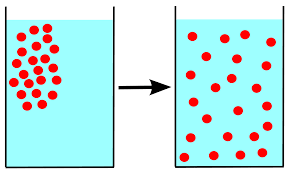
The picture below is an example of _________________.
osmosis
isotonic
diffusion
active transport

Diffusion occurs only in solids
True
False
An increase in temperature does what to diffusion?
Speeds it up
Slows it down
Stops it
No effect
What causes diffusion?
The constant, random motion of molecules
Magnetic attraction between atoms
The nuclear forces that hold atoms together
The tendency of atoms to form chemical bonds with one another
From fastest to slowest rate of diffusion, which of the following is in the correct sequence?
Solids, liquids, gases
Liquids, gases, solids
Gases, liquids, solids
Gases, solids, liquids
Which of the following will diffuse the fastest?
A tablespoon of sugar in a glass of water
Heat through a solid piece of steel
A pinch of salt in a glass of water
The smell of bacon cooking throughout a room
_____________ is air that flows from areas of high pressure to areas of low pressure.
Convection Cells
Wind
Atmospheric Pressure
Which is not a property of air?
It has volume
It is not matter
It has pressure
It can move
What is the term for the weight of air molecules pushing down on Earth?
gravity
wind
air pressure
oxygen
Cool air molecules take up
more space.
less space.
Air has no weight.
True
False
Dilcia wants to know how drinking milk affects how tall Monica grows. Which is the dependent variable?
Monica's growth
drinking milk

On a hot, humid summer day drops of water form on a can of cold soda. What process caused this to happen?
condensation
freezing
vaporization
deposition

