
 Worksheets
Enzyme Kinetics Practice
Total questions: 24
Worksheet time: 9mins
A protein is made up of:
long chain of amino acids
bilayer of lipids
long chain of nucleotides
adenine, guanine, cytosine and uracil
This is a substance that can be added to increase the reaction:
Catalyst
Buffer
Cofactor
Temperature
What does NAD stands for:
Nomenclature association disease
Nucleotide amine deoxyde
Nicotinamide adenine dinucleotide
Adenosin triphosphate
Cu 2+ and enzyme is called:
Prostetic group
Metallic enzyme
Co-enzyme
Essential metal
Specific region on the enzyme's surface where the substrate molecule binds and undergoes a chemical reaction:
Active site
Allosteric site
Binding site
Regulatory site
What EC number for ligases?
1
6
3
4
In which type of inhibition does the inhibitor binds to the ES complex:
uncompetitive
competitive
non competitive
all of them
This is the name for the series of reactions that occur within cells of living organisms to sustain life
(a)
Competitive inhibitors bind to:
Substrate
Free enzyme
ES complex
Allosteric site

This graph represents a:
Lineweaver-Burk
Michaelis-Menten
Dixon
Arrhenius

This plot represents a ______ inhibitor reaction
Competitive
Uncompetitive
Non-competitve
Mixed
Name of molecules formed in glycolisis
ATP and pyruvate
ATP and FADH2
pyruvate and glyceraldehyde
ATP and H2O2
In Krebs cycle, first pyruvate has to be transformed to:
acetyl coA
citrate
lactic acid
oxaloacetate
Electron transport chain occurs in:
cytoplasm
mitochondria
ribosome
nucleus
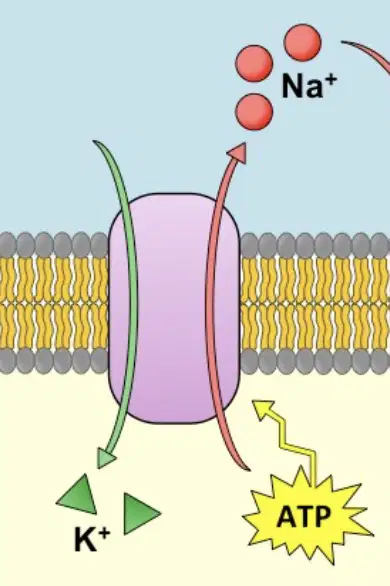
symport
antiport
uniport
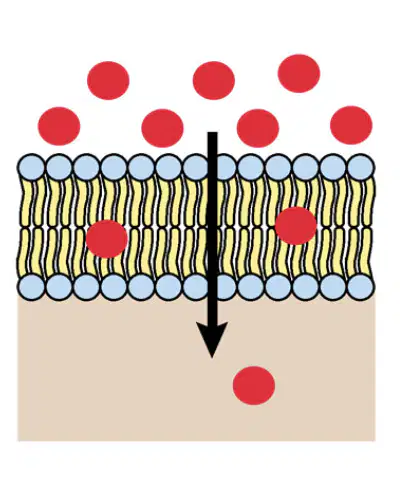
What is the name of the membrane transport that shows the image?
simple diffusion
Passive transport
Active transport
Endocytosis
This is factor does not affect enzyme rate:
pH
temperature
Substrate
Buffer
Enzymatically speaking, excessively high temperatures can lead to:
denaturation
activation
inhibition
polymerization
This equation describes the temperature dependence of the rate of a chemical reaction:
Michaelis-Menten
Kcat
Ki
Arrhenius
Most activators are:
cations
complex molecules
enzymes
substrates
What is the change in the affinity for binding of a ligand or substrate that is caused by the binding of another ligand away from the active site?
allosterism
catabolism
metabolism
competitive inhibition
This is a way to release proteins inside the cell:
sonication
osmosis
endocytosis
centrifugation
What is the name of the purification method were the proteins are prevented to form hydrogen bonds with water and the salt facilitates their interaction with each other forming aggregates that afterward precipitate out of solution
ammonium sulfate precipitation
dialysis
differential precipitation
ultracentrifugation
What it the name of this method were in mixture applied onto the surface or into the solid, and fluid stationary phase is separating from each other while moving with the aid of a mobile phase:
Chromatography
Dialysis
Ammonium sulfate precipitation
SDS page

