wayground logo

Free Printable Worksheets

Font size

S
M
L
XL
Worksheets

Sharks6B - Geometry

Total questions: 100

Worksheet time: 4hrs 47mins
Name
Class
Date
1.
What is a line? 
a)
A straight line
b)
A straight, continuos, infinite collection of points
c)
chocolate chips 
d)
A dot
2.
What is a ray?
a)
The shared end point of the sides of an angle
b)
A tool used to measure an angle
c)
Part of a line with an endpoint
d)
The shared end point of the sides of an angle
3.
What is an obtuse angle?
a)
Angles whose measures add up to 180º
b)
Angles that measures add up to 90º
c)
Angle with a measure between 90º and 180º
d)
Is the "if" part of the conditional statement
4.
What is a line segment?
a)
A geometric figure
b)
Part of a line with two endpoint
c)
A shared end point of the sides of a angle
d)
Two angles that are opposite of each other
5.
What is a vertex?
a)
Angle with a measure between 90º and 180º
b)
A statement that can be accepted without proof
c)
A statement that can be proven and that can also be used in later proof
d)
The shared end point of the sides of an angle
6.
What is a right angle 
a)
Angle measure 90º
b)
A triangle 
c)
The middle point of an angle
7.
What is a midpoint? 
a)
IDEK
b)
A thing
c)
The middle point of an angle
d)
help
8.
What is an algebraic proof? 
a)
Exp. 
b)
Proofs using algebra
c)
Proof
d)
a proof
9.
What is a theorem?
a)
A statement that can be accepted without proof
b)
A statement that can be proven and that can also be used in later proof
c)
all of the above
d)
other
10.
What is the congruent supplements theorem? 
a)
If angles are complementary to the same angle then those two angles are congruent
b)
If S in the interior angle PQR then angle SQR = angle PQR
c)
If angles are supplementary to the same angle those two angles are congruent
d)
All right angles are congruent
11.
What is perpendicular's meaning? 
a)
not sure
b)
Two angles that intersect and form a right angle 
c)
An upside down T
d)
Life
12.
What is the congruent complements theorem
a)
If angles are complementary to the same angle then those two angles are congruent
b)
If angles are complementary to the same angle then those two angles are congruent
c)
If angles are complementary to the same angle then those two angles are congruent
d)
If angles are complementary to the same angle then those two angles are congruent
13.
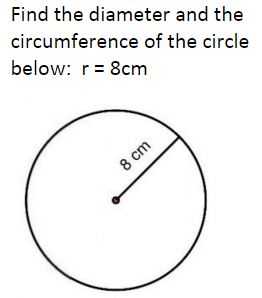
What is the diameter?
a)
8
b)
16
c)
10
d)
4
14.

What is the circumference?

a)

50.24

b)

96

c)

24

d)

16

15.

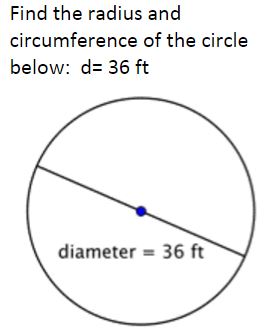
What is the radius?

a)

18

b)

72

c)

38

d)

14

16.

What is the circumference?

a)

36

b)

18π

c)

108π

d)

36π

17.
A bicycle tire has a diameter of 27 inches. What is the radius?
a)
27π
b)
13.5
c)
81
d)
25π
18.
What is the diameter?
a)
5 in
b)
10 in
c)
3.14 in
d)
15.84 in
19.
The perimeter of a circle is usually called the...
a)
radius
b)
diameter
c)
circumference
d)
area
20.
If you multiply π × r × r  then you will get the...
a)
radius
b)
diameter
c)
circumference
d)
area
21.
If you multiply π × d then you will get the...
a)
radius
b)
diameter
c)
circumference
d)
area
22.
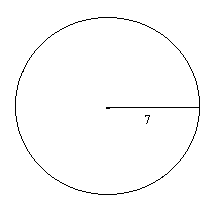
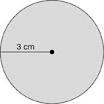
Find the area of the circle
a)
43.96
b)
153.86
c)
87.82
d)
307.72
23.
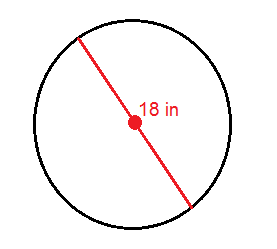
Find the area of the circle
a)
56.52
b)
254.34
c)
1017.36
d)
113.04
24.
find the area of the circle below.
a)
100 cm
b)
225 cm
c)
9 cm
d)
28.26 cm
25.
Determine the radius of the penny
a)
59.66 mm
b)
9.5 mm
c)
38 mm
d)
119.32 mm
26.
 What is the area of the shaded region?
a)
19.8 cm2
b)
25.16 cm2
c)
32.6 cm2
d)
14.96 cm2
27.
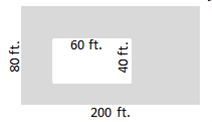
 Mr. Hubbs bought a new home and wanted to place new grass on his lawn around his house. What is the area of the shaded area shown, his lawn?
a)
13,600 ft²
b)
18,400 ft²
c)
16,000 ft²
d)
2,400 ft²
28.
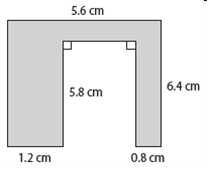
Find the area of the figure shown.
a)
34 units2
b)
960 units2
c)
220 units2
d)
480 units2
29.
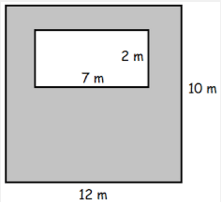
What is the area of the shaded region?
a)
14 m2
b)
120 m2
c)
106 m2
d)
134 m2
30.
Find the area of the shaded region.
a)
334 km2
b)
345 km2
c)
344 km2
d)
433 km2
31.

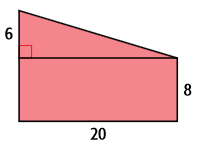
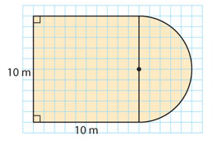
Find the area of the composite figure.

a)

100

b)

400

c)

139.25

d)

175

32.
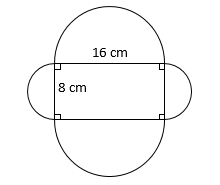
What is the composite area of the figure shown? (use 3 for pi)
a)
128
b)
96
c)
24
d)
368
33.

scale

a)

the ratio between two sets of measurements

b)

a drawing that uses a scale to make an object smaller than or larger than the real object.

c)

two angles whose measures have a sum of 180 degrees

34.

scale drawing

a)

a drawing that uses a scale to make an object smaller than or larger than the real object.

b)

two angles whose measures have a sum of 180 degrees

c)

the ratio between two sets of measurements

35.

ratio

a)

tells the relationship between two or more things

b)

geometric figures that are identical in size and shape

c)

a unit of measurement of angles. a full circle is divided into 360 degrees

d)

a two-dimensional shape made by drawing a curve that is always the same distance from a center

36.

congruent

a)

geometric figures that are identical in size and shape

b)

a unit of measurement of angles. a full circle is divided into 360 degrees

c)

a two-dimensional shape made by drawing a curve that is always the same distance from a center

d)

tells the relationship between two or more things

37.

degree

a)

a unit of measurement of angles. a full circle is divided into 360 degrees

b)

a two-dimensional shape made by drawing a curve that is always the same distance from a center

c)

tells the relationship between two or more things

d)

geometric figures that are identical in size and shape

38.

circle

a)

a two-dimensional shape made by drawing a curve that is always the same distance from a center

b)

tells the relationship between two or more things

c)

geometric figures that are identical in size and shape

d)

a unit of measurement of angles. a full circle is divided into 360 degrees

39.

angle

a)

a measurement of the amount of rotation between two lines

b)

the amount of space an object takes up

c)

more than 90 degrees

d)

a number by which all dimensions of an original figure are multiplied to produce a new figure

40.

scale factor

a)

a number by which all dimensions of an original figure are multiplied to produce a new figure

b)

a measurement of the amount of rotation between two lines

c)

the amount of space an object takes up

d)

more than 90 degrees

41.

three-dimensional

a)

having the dimensions of height, width, and depth

b)

the sum of the areas of the faces of a 3D shape

c)

the vertical distance from top to bottom

d)

distance between two points

42.

protractor

a)

an instrument for drawing/measuring angles

b)

less than 90 degrees

c)

a three-dimensional object that has six rectangular faces

d)

3.14

43.

acute angle

a)

less than 90 degrees

b)

a three-dimensional object that has six rectangular faces

c)

3.14

d)

an instrument for drawing/measuring angles

44.

figure

a)

a geometric shape

b)

perpendicular or vertical cut to the base

c)

angle cut showing the intersection of a rectangular prism and plane

d)

a solid figure that has two congruent, parallel polygons as its bases. Its sides are parallelograms

45.
1.  What is the area of a circle with a radius of 5 feet?
a)
10
b)
78.5
c)
25
d)
15.7
46.
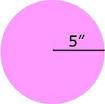
1.  Find the area of this circle.
a)
12.56
b)
50.24
c)
25.12
d)
8
47.
Solve for x and find the missing angle.
a)
28
b)
118
c)
180
d)
90
48.
Solve for x using knowledge about supplementary angles.
a)
90
b)
61.7
c)
180
d)
30
49.
A story sells tiny crystals. One of the crystals is a rectangular prism. The length is 26 millimeters, a width of 8.5 millimeters, and a height of 7 milliliters. What is the volume of the crystal?
a)
1547
b)
221
c)
182
d)
59.5
50.
Find the surface area of the triangular prism.
a)
224
b)
184
c)
3.14
d)
164
51.
Find the area of the composite shape.
a)
20
b)
32
c)
44
d)
47
52.
Find the actual base of the figure represented by the scale drawing.
a)
42
b)
72
c)
228
d)
144
53.
Mike made a scale drawing of his room. The actual room had a width of 16 feet and a length of 24 feet. His drawing has a length of 3 inches. What is the width, in in inches, of the scale drawing of the room.
a)
8
b)
3
c)
16
d)
2
54.
1.  What is the circumference of a circle with a diameter of 16.5 inches?  Round to the nearest tenth.
a)
103.62
b)
33
c)
51.81
d)
25.91
55.
Area of a square:
a)
A=½bh
b)
A=πr2
c)
A=s2
d)
A=s+s+s+s
56.
Volume of a prism
a)
V=⅓Ah
b)
V=¾πr2
c)
V=½bh
d)
V=Ah
57.
The following formula is for the volume of:
V=πr2h
a)
Cylinder
b)
Cone
c)
Triangular Prism
d)
Sphere
58.
Area of a trapezoid:
a)
A=½bh
b)
A=½b1h
c)
A=½(b1+b2)h
d)
A=πd
59.
Volume of a sphere:
a)
V=⅔πr2h
b)
V=πr2h
c)
V=¾πr3
d)
V=⅓πr2h
60.
The following formula is for the volume of:
V=⅓Ah
a)
Cylinder
b)
Trapezoidal Prism
c)
Cube
d)
Cone
61.
The following formula is for the area of:
A=½bh
a)
Rectangle
b)
Circle
c)
Triangle
d)
Trapezoid
62.
The base of a trapezoidal prism is what shape?
a)
Rectangle
b)
Circle
c)
Trapezoid
d)
Hexagon
63.
The base of a cylinder is what?
a)
Rectangle
b)
Lateral Surface
c)
Circle
d)
Oval
64.
The following formula is for the area of :
A=πr2
a)
Square
b)
Cylinder
c)
Circle
d)
Triangular Prism
65.

If you know the slant height and the radius, you can use the Pythagorean Theorem to find the:

a)

Area

b)

Height

c)

Vertex

d)

Circumference

66.

Corresponding Angles are angles that ...

a)

are across from one another.

b)

are in the same position.

c)

share a common vertex.

67.

The image above is an example of what type of angles?

a)

Complementary Angles

b)

Vertical Angles

c)

Corresponding Angles

d)

Supplementary Angles

68.

The distance around a circle is known as...

a)

Circumference

b)

Radius

c)

Perimeter

d)

Area

69.

The two lines above are known as...

a)

Perpendicular Lines

b)

Parallel Lines

c)

Congruent Lines

d)

Similar Lines

70.

A shape having three of more straight sides is called a...

a)

Quadrilateral

b)

Polygon

c)

Circle

d)

Triangle

71.

Which one of the following is a RAY?

a)
b)
c)
d)
72.

What type of triangle has two congruent (equal) sides and two congruent (equal) angles?

a)

Isosceles Triangle

b)

Equilateral Triangle

c)

Scale Triangle

d)

Regular Triangle

73.

What is the definition of diameter?

a)

the size a surface takes up.

b)

the distance around a circle.

c)

the distance from the center of a circle to its circumference.

d)

a straight line passing through the center of a circle

to touch both sides of the circumference.

74.

What type of triangle is shown above?

a)

Equilateral Triangle

b)

Right Triangle

c)

Scale Triangle

d)

Isosceles Triangle

75.

What is a solid three-dimensional shape with two identical, parallel polygon bases?

a)

Prism

b)

Cube

c)

Pyramid

d)

Cone

76.

A line is...

a)

a line of indefinite length extending from an end point in one direction

b)

a straight one-dimensional figure of infinite length extending in both directions

c)

section of a line, bounded by two endpoints

d)

a defined position in space

77.

When two or more figure have the same shape and the same size, they are...

a)

Complementary

b)

Regular

c)

Similar

d)

Congruent

78.

When a polygon has all equal sides and all equal angles, it is called a...

a)

Similar Figure

b)

Congruent Figure

c)

Regular Polygon

d)

Normal Polygon

79.

What is volume?

a)

the amount of space occupied by an object

b)

the size a surface takes up

c)

total area of the surface of a three-dimensional object

d)

distance around the outside of a shape, calculated by

adding the length of all sides together

80.

Two angles whose sum is 90º are called what?

a)

Supplementary Angles

b)

Complementary Angles

c)

Congruent Angles

d)

Vertical Angles

81.

The ratio of the circumference of a circle to its diameter,

which is approximately 3.14159 is called...

a)

Perimeter

b)

Circumference

c)

Radius

d)

Pi

82.

Lines that intersect at a 90 degree angle are what type of lines?

a)

Parallel

b)

Perpendicular

c)

Congruent

d)

Right

83.

What type of 3D figure has six congruent square faces?

a)

Cone

b)

Cube

c)

Prism

d)

Pyramid

84.

When figures have the same shape but not necessarily the same size, they are called...

a)

Congruent Figures

b)

Similar Figures

c)

Regular Figures

d)

Normal Figures

85.

The image above is a...

a)

Line

b)

Ray

c)

Line Segment

d)

Point

86.
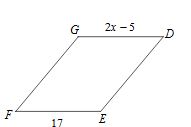
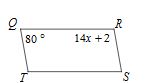
The figure is a parallelogram.  
Solve for x.  
a)
1
b)
11
c)
7
d)
6
87.
The figure is a parallelogram.  
Solve for x.  
a)
7
b)
2
c)
0
d)
4
88.
Parallelograms are ...
a)
triangles
b)
quadrilaterals
c)
pentagons
d)
hexagons
89.
What is the value of x?
a)
132
b)
66
c)
114
d)
48
90.
The opposite angles of a parallelogram are ...
a)
complementary
b)
congruent
c)
supplementary
d)
perpendicular
91.
The opposite sides of a parallelogram are...
a)
congruent
b)
perpendicular
c)
skew
d)
supplementary
92.
If ABCD is a parallelogram, what is the length of BD? 
a)
10
b)
11
c)
7
d)
5
93.
A _________ is a type of __________.
a)
rhombus, parallelogram
b)
parallelogram, rhombus
c)
rhombus, rectangle
d)
quadrilateral, parallelogram
94.
The diagonals of a rhombus bisect at________.
a)
Right angle
b)
obtuse angle
c)
acute angle
95.
Find m∠1.
a)
62
b)
28
c)
90
d)
78
96.
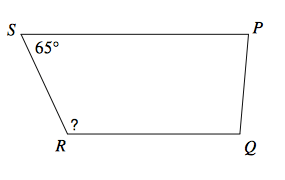
Find the missing angle of the trapezoid.
a)
65
b)
115
c)
180
d)
None of these
97.
Base angles of an isosceles trapezoid are _____.
a)
neither
b)
supplementary
c)
congruent
98.
A trapezoid is a quadrilateral with exactly one pair of _____ sides.
a)
parallel
b)
congruent
c)
perpendicular
d)
skew
99.
Solve for x in the rectangle.
a)
x=2
b)
x=7
c)
x=8
d)
x=3
100.
Given rectangle DEFG, if FD = 3x - 7 and EG = x + 5, find EG.
a)
6
b)
11
c)
7
d)
5