
 Worksheets
Electric Forces
Total questions: 16
Worksheet time: 8mins
When matter has an overall positive or negative charge, we say it has a ____________________.
neutral charge
negative charge
electric charge
positive charge
The matter is ___________if the number of positive and negative charges are equal.
neutral
negative
electric
positive
This is the word for a particle that has no electric charge.
neutral
negative
electric
positive
This is the word for when two objects push away from each other due to having the same kind of charge.
repel
attract
insulate
conduct
This is the word for when two objects pull toward each other due to having the opposite kind of charge.
repel
attract
insulate
conduct
The push or pull of charged objects on each other is _____________________.
conductor
insulator
electric charge
electric force
Brooke has an aluminum can. The electrical charges move easily through it, so it is a(n) __________________.
conductor
insulator
static discharge
electric force
Ben has a rubber balloon. The electrical charges do not move easily through the balloon, so it is a(n) ____________________.
conductor
insulator
static discharge
electric force
Eric has been sliding down the carpeted stairs in his socks. When he reaches out to touch the doorknob, he feels a little zap. This zap is an example of:
lightening
static discharge
a conductor
This word means the same as “cause” when talking about forces.
effect
static discharge
source
force
William is holding a red balloon and a blue balloon. The red balloon has more positive charged particles than negative. The blue balloon pulls toward the red balloon.
Which words correctly completes the sentence about the balloons charged particles?
The red balloon has a ______________________ electric charge. The blue balloon has a ______________________ electrical charge.
neutral,
positive
negative,
positive
neutral,
negative
positive,
negative
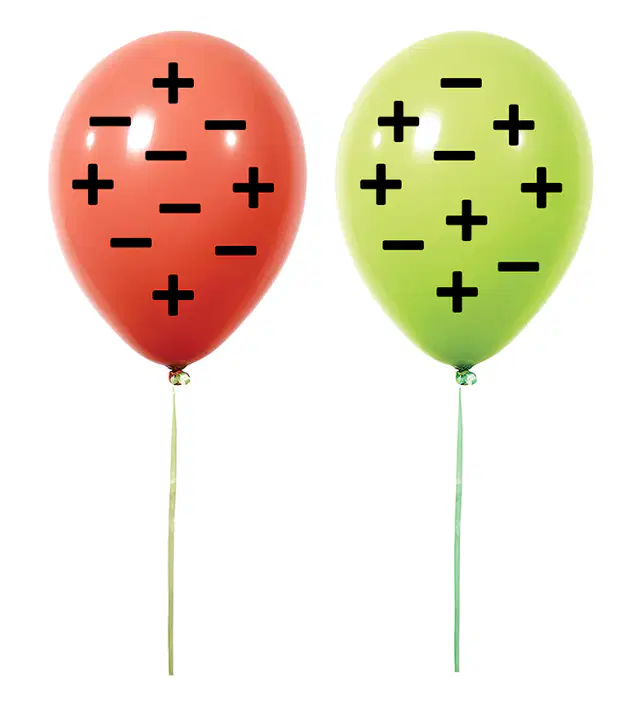
The red and green balloons have an (insulator / electric force) between them. Since the charges of the two objects are (the same / neutral / different), it causes the red and green balloon to (repel / attract).
electric force,
neutral,
attract
electric force,
the same,
attract
insulator
different,
repel
electric force,
different,
attract
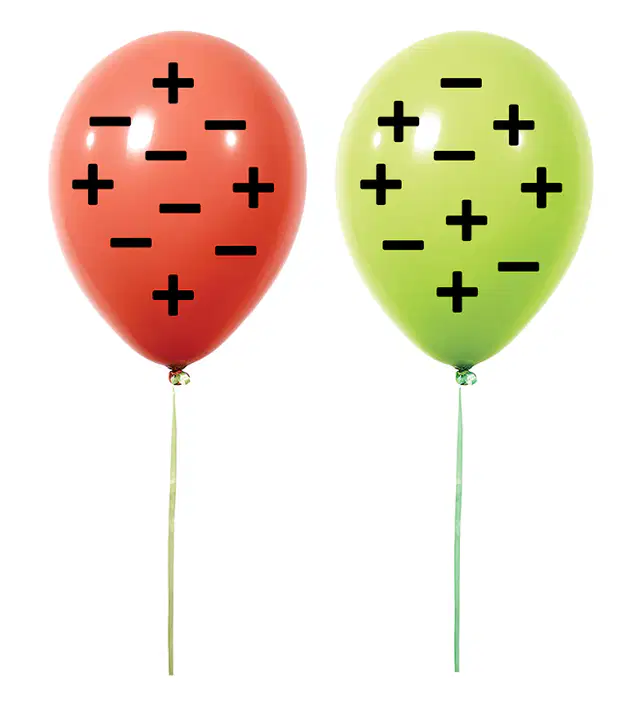
Bryce rubs a red balloon on her hair until it becomes negatively charged. He then brings the red balloon close to a green balloon that is positively charged. Bryce slowly moves the balloons farther apart and observes what happens to the force between them.
What question is Bryce most likely trying to answer?
How does the electric force change when the charge on one material changes?
How does the length of the glass rod affect electric force?
How does distance affect the strength of electric force?
How can electric force between two objects be observed?
Case has two inflated balloons. He knows that one balloon has an overall positive electric charge. He predicts that when he places the balloons next to each other, the two balloons will repel. What must be true for the two balloons to repel?
The balloons must touch each other.
One balloon must be larger than the other.
The overall charge of one balloon must be negative.
The overall charge of each balloon must be positive.

Diego carries out an investigation about electric forces.
He draws a picture of his results.
Based on the picture, which question did Diego most likely answer during his investigation?
How does the amount of electric charge affect the strength of an electric force between two objects?
How does the distance between two objects affect the strength of the electric force between the objects?
Why do two objects that have electric charges have an electric force between them?
Why do two objects that have positive electric charges attract each other from a distance?
Which of the following sequences correctly shows the order of events during Maya’s static discharge experience?
1. Maya rubs a balloon on her sweater.
2. Maya moves the balloon near her little brother’s hair.
3. Her hair begins to stand up.
4. There is a static discharge between the balloon and her hair.
1. Maya moves the balloon near her little brother’s hair.
2. Maya rubs a balloon on her sweater.
3. There is a static discharge between the balloon and her hair.
4. Her hair begins to stand up.
1. Maya rubs a balloon on her sweater.
2. The balloon becomeselectrically charged.
3. Maya moves the balloon near her little brother’s hair.
4. Her hair begins to stand up due to static discharge.

