
 Worksheets
Biology _2014_STPM_term 2 Objectives
Total questions: 15
Worksheet time: 8mins
Which statement explains the presence of myoglobin in active tissues?
It has four molecules.
It enhances the supply of oxygen.
It binds both carbon dioxide and oxygen.
It helps maintain the steepness of the pressure gradient in tissues.
The event that lead to the closing of stoma are as follows:
I. The liss of K+ ion from the cells
II. The loss of Cl- ion from the cells
III. The transfer of Ca2+ ion from the vacuole to the cytoplasm
IV.
The binding of abscisic acid to receptors on the surface of the plasma member of the guard cells.
Which sequence of events is correct for the closing of stoma?
I , II , III , IV
I , III , IV , II
IV , I , II, III
IV , III , I , II
Which are the physical characteristics and evidence that support the cohesion - tension theory?
I. Accumulation of ions causes water to move into the xylem from surrounding root cells, creating a positive pressure that forces the water up the xylem to the shoot.
II. Xylem vessels in higher plants form a continuous system from the leaves to the roots where evaporation and absorption of water occur respectively.
III. Evaporation of water from leaves increases their water potential and causes water to move by osmosis from xylem to stomata across leave tissues.
IV. Gradients in water potential are established along transpiration pathway in the xylem, pulling water column upwards from the roots to the leaves.
I and II
I and III
II and IV
III and IV
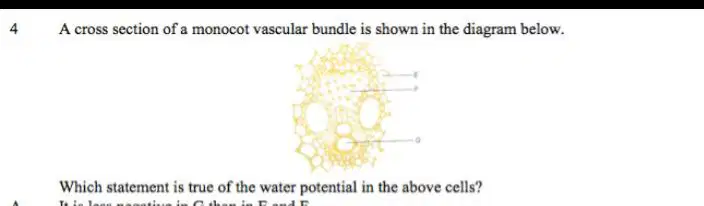
Which statement is true of the water potential in the above cells?
It is less negative in G than in E and F.
It is less negative in F than in E and G.
It is more negative in E than in F and G.
It is more negative in F than in G than in E.
The role of tropomyosin is skeletal muscle is to
hold calcium ions in place
catalyse hydrolysis of ATP
form an actin - myosin crossbridge
block myosin binding site on actin
Which statement about the mechanism of action of steroid hormones is true?
The ATP is converted to cAMP.
The adenylate cyclase is activated.
The action involves the transciption and translation of a gene.
The hormones bind to the receptor on the plasma membrane.
The umbilical blood vessels in a human are derived from the
allantois
amnion
chorion
yolk sac
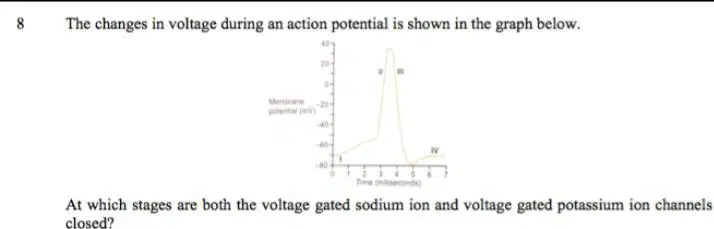
At which stages are both the voltage gated sodium ion and voltage gated potassium ion channels closed?
I and II
I and IV
II and III
III and IV
Which is true of the physiological control in thermoregulation of endotherms?
The body metabolic rate is low.
The body generates small amount of heat.
The body heat is higher than that of the environment.
The body temperature is influenced by the environment.
What happens when the osmoreceptor in the hypothalamus detects an increase in water potential of blood?
The collecting ducts reabsorb more water from the filtrate.
The posterior pituitary gland releases more ADH.
More urea is diffused out of the filtrate.
More dilute urine is produced.
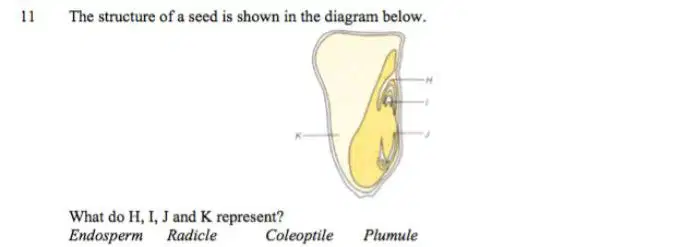
What do H, I, J and K represent?
Endosperm : H
Radicle : K
Coleoptile : I
Plumule : J
Endosperm : I
Radicle : H
Coleoptile : J
Plumule : K
Endosperm : J
Radicle : I
Coleoptile : K
Plumule : H
Endosperm : K
Radicle : J
Coleoptile : H
Plumule : I
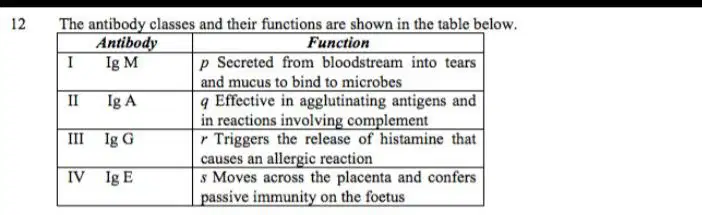
Which antibodies correspond to their functions correctly?
I : q
II : p
III : s
IV : r
I : q
II : s
III : p
IV : r
I : r
II : p
III : s
IV : q
I : r
II : s
III : q
IV : p
Foreign grafted skin will be rejected because the
recipient immunoglobulin E will stimulate allergic response
donor cells have the same class I MHC proteins as the recipient cells
Recipient cytotoxic T cell produces perforin to destroy the donated skin cell
recipient helper T cells produce interleukin - 2 to stimulate the secretion of antibodies
Which statement is not true of the dengue fever?
The RNA virus is the causative agent.
The virus replicates inside the erythrocytes.
The virus is not contagious from one person to another.
The virus is often transmitted by Aedes aegypti mosquitoes.
Which causative agent corresponds to its mode of transmission of the tuberculosis disease correctly?
Causative agent : Bacteria
Mode of transmission : Airborne
Causative agent : Bacteria
Mode of transmission : Waterborne
Causative agent :
Virus
Mode of transmission : Airborne
Causative agent : Virus
Mode of transmission : Waterborne

