
 Worksheets
Unit 5 "The Three Agricultural Revolutions" Exam
Total questions: 30
Worksheet time: 23mins
Which of these is an example of agriculture?
Selling baskets at a market
Offering to help a neighbor build his house
Growing wheat to make bread and feed my family
More than enough resources
After the Agricultural Revolution, what happened to the human population?
It increased
It stayed the same
It decreased
Which of these is NOT a domesticated animal?
A wolf that lives in a pack in Montana
A dairy cow
A horse that is used to pull a carriage
A parrot that is trained to do tricks at the zoo
What is one negative effect of the Agricultural Revolution?
There was a greater variety of food for people to eat
People started wars to take over land and goods
Governments were created to keep order
There were fewer oxen being used in farming
On what continents did agriculture FIRST develop?
North America and South America
Europe and North America
Asia and Africa
Antarctica and Australia
the last period of the Stone Age. Also the time when farming was invented and when people started taming animals
Neolithic Age
Stone Age
Paleolithic Age
Ancient Age
When did the Neolithic Age begin?
about 8000 BCE
about 100 BCE
about 8000 CE
2.5 million years ago
What is the meaning of domesticate?
to tame, or bring animals under the control of humans
to raise crops and animals for food
train for a particular job
to move from place to place in search of food
Because the conditions for farming were good, the first civilizations arose
The Mountains
In river valleys
In the desert
On the sea
Taking specific jobs related to talents
adapt
systematic agriculture
domesticate
specialization
The organized growing of food on a regular basis is ______________________________.
domesticate
growing agriculture
systematic agriculture
monarchy
Which of the following is a result of the change from subsistence farming to cash crops in the farming communities?
Farm products were more diversified and sold for high profits at farmers' markets
Farmers turned from cooperation between farms to competition for markets
Government subsidies provided for a university education for all members of a farm family
Farm women increased sales of farm products, such as eggs and cheese, to the local market
Which of the following is a result of the change from subsistence farming to the production of cash crops by farmers and their families?
Farmers moved from producing for the farm family to producing for a non-farm market
Industrialized countries purchased surplus food from economically less developed countries
Farmers moved out of the village and bought new farms closer to urban areas
Farmers hired immigrant laborers to plant the field and harvest the grain
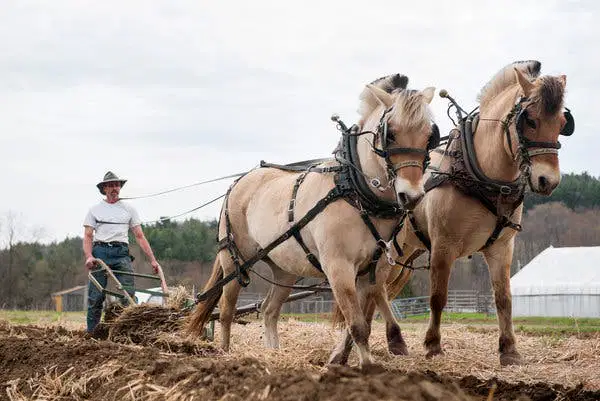
What agricultural activity is shown in the following image?
Planting seeds
Plowing the ground
Spreading fertilizer
Harvesting the crop
About 5000 years ago, early farmers in the Indus Valley invented an agricultural tool that was pulled by oxen to break up the soil before farmers planted their crops. Which of the following explains the importance of the improvements to this innovation during the Second Agricultural Revolution?
The seed drill invented in England in the early eighteenth century was the first agricultural machine with moving parts
The agricultural scythe that cut wide swaths of grain during harvest time provided work for farm laborers
The steel plow invented in the United States in the mid-nineteenth century was the first commercially successful plow in the world.
The mechanical reaper invented in the United States in the early eighteenth century was the first agricultural innovation that was pulled by a tractor rather than by horses
Which of the following describes the importance of the invention and diffusion of the seed drill in the early eighteenth century?
It increased a farmer's grain yields by a multiple of at least 10
It was instrumental in adding efficiencies and decreasing waste when farmers planted their crops
It increased efficiency by helping farmers prepare large fields for planting grain crops.
Deforestation has resulted in
more farmland in some places but more desertification in others
less farmland in some places but more desertification in others
no noticeable change in the amount of farmland or desertification
less farmland in some place and less desertification in others
Southwest Asia, Southeast Asia, East Asia, Mesoamerica, and the Sub-Saharan regions were all
hearths of plant domestication
leaders in starting the Columbian Exchange
areas noted for widespread terracing
regions where the Third Agricultural Revolution failed
Between 1950 and 1990, wheat production in India in average pounds per acre more than tripled, which allowed India to meet its population's need for food. Which of the following best explains this change?
The elimination of poverty in India's rural regions
The increase of microloan programs that provide farmers with credit
The use of improved plant hybrids and agricultural chemicals.
The use of genetically modified seeds
In which of the following world regions has the Green Revolution had the least impact on agriculture?
East Asia
Southeast Asia
Sub-Saharan Africa
The Americas
Green Revolution technology has resulted in which of the following in modern
agriculture?
The development of high-yield grains and the expansion of cultivated areas
An increase in the circulation of investment capital to help the poorest farmers
The end of famine in the world
In less developed countries, pesticides are typically applied by hand, whereas pesticides are typically applied by tractors or aircraft in more developed countries. Which of the following best explains the risks associated with pesticide applications?
Crop dusters are at risk when applying pesticides with aircraft in more developed countries, whereas environmental pollution is a risk in less developed countries.
Farmers' health is at risk in less developed countries, whereas environmental pollution is a risk in more developed countries.
Crops are at risk in more developed countries, whereas environmental pollution is a risk in less developed countries.
Industrial/modern commercial agriculture refers to
large scale agriculture using machines to produce large amounts of crops for sale
small scale, intensive agriculture
small scale, extensive agriculture
large scale agriculture using machines to produce small crops for individual families
A positive impact of industrial/commercial agriculture is
a decrease in amount of crops produced
increased water and air pollution
decrease in the amount of machinery used
an increase in amount of crops produced
Define: MDC
Define: Subsistence Agriculture
Define: LDCs
All of the following developments have INCREASED amount of crops produced in the last 100 years EXCEPT
mechanization or new machines
the Green Revolution
new technology (GMOs, chemical pesticides and fertilizers)
an increase in the number of farmers in the world
The First Agricultural Revolution refers to
the invention of agriculture
the application of science and new chemicals to agriculture (GMOs, fertilizers, pesticides)
the application of new machines and industrialization to agriculture
the diffusion of agriculture after the Spanish made contact with the Americas
Who was Carl Sauer?
Astronaut
Politician
Geographer
Farming Scientist

