
 Worksheets
Plant biology S&C
Total questions: 109
Worksheet time: 3620secs
Selective breeding is...
a process to create an organism with desired traits from parents with those desired traits
natural method of producing offspring with desired traits
creating a new species
making organisms reproduce during times of stress
An example of selective breeding is
a dog breeder mating 2 dogs to make more dogs
a farmer grows bees to pollinate the plants on his farm
a person pollinates 2 white rose plants to only create white roses
One problem with selective breeding is
creating a new species
gene variety is lost
extinction of a species
Which of these is the first step in selective breeding flowers.
Repeat the process only with the offspring with the desired traits
watch the seeds grow
Choose plants that have the desired trait to pollinate
chose which trait is desirable

"Survival of the fittest" describes which theory
Natural selection
Selective breeding

The long and sharp beak of a woodpecker is an example of
natural selection
selective breeding

Natural selection is where ___________ decides which traits should be passed on.
nature
a human
traits
evolution

How can farmers best use selective breeding to increase apple production?
By limiting the number of trees growing so they can have more space.
By choosing trees that are the largest in size.
By increasing the amount of water and fertilizer the trees receive.
By choosing trees that consistently have the most apples.
Selective breeding is...
a process to create an organism with desired traits from parents with those desired traits
natural method of producing offspring with desired traits
creating a new species
making organisms reproduce during times of stress
An example of selective breeding is
a dog breeder mating 2 dogs to make more dogs
a farmer grows bees to pollinate the plants on his farm
a person pollinates 2 white rose plants to only create white roses
One problem with selective breeding is
creating a new species
gene variety is lost
extinction of a species
Increasing helpful traits to an organism is one way a breeder may use selective breeding.
True
False
Which of these is the first step in selective breeding flowers.
Repeat the process only with the offspring with the desired traits
watch the seeds grow
Choose plants that have the desired trait to pollinate
chose which trait is desirable
Which of these is the second step in selective breeding flowers.
Choose which trait is desirable
Watch the seeds grow
Choose plants that have the desired trait to pollinate
Repeat the process only with the offspring with the desired traits.
Which of these is the third step in selective breeding flowers.
Choose which trait is desirable
Watch the seeds grow
Choose plants that have the desired trait to pollinate
Repeat the process only with the offspring with the desired traits.
Artificial Selection is
making a new species
making varieties of the same species
only occurs in a laboratory
A mutation
is always bad for an organism
is always good for an organism
is a change in an organism's DNA
never changes an organism
A dog breeder breeds a german shepherd dog with a poodle to create a dog that has traits of both varieties of dogs. This is an example of...
artificial selection
selective breeding
A dog breeder breeds a black poodle with another black poodle to hopefully get only grey poodles. This is an example of
artificial selection
selective breeding
In planting the same variety of crops , if a plant gets a disease then
............................................................................
All the others will
only few will be affected
No thing will happen to the rest of the plants
In planting the same variety , one disease can wipe out the whole crop
Correct
Incorrect
The carbon stored inside the plants can go back to the atmosphere by
all of the above
burn and use the plant as fossil fuel
being food for animals
The amount of carbon dioxide in the atmosphere has been increased because of
Deforestation
Burning the fossil fuel
All of the above
Sustainable development
Developing the things we need without destroying habitats
Developing the things we need by destroying habitats
Farming and raising livestock for profit is called
Subsistence farming
Commercial farming
Arable farming
Growing crops and raising live stock to meet family needs is called
Commercial farming
Mixed farming
Subsistence farming
When only crops are grown, we refer to this as _______
Arable farming
Subsistence farming
Commercial farming
Raising livestock provides people with meat, egg, milk products and leather
True
False
Which of these is a physical factor affecting farming?
Amount of rainfall
Amount of machinery
Availability of workers
Amount of capital
Which of these is a farming input?
Tractor
Ploughing the fields
Milk
Harvest
Which of these is a farming process?
Tractor
Milking
Cows
Rainfall
Which of these is a farming output?
Tractor
Milk
Milking
Investment
What is the most basic form of farming, usually run by a family who work their own land?
Subsistence farming
Commercial farming
What is the main aim of commercial farming?
Sell everything the farm produces
Feed the farmer's family
Reduce the number of outputs
Protect the local environment
What are economies of scale?
Operating on a large scale to reduce costs
Reducing costs by minimising production
Spending money on cows and tractors
Reducing the number of employees on the farm
Why is temperature a factor that affects farming?
Each type of crop requires specific conditions for growth
Crops can grow in a wide range of conditions
Farmers prefer working in warmer conditions
Cows don't like the rain
Farming that involves low input of capital, material and labour with large amounts of land is...
Extensive farming
Intensive farming
Subsistence farming
Shifting cultivation
Farming that involves high inputs of capital, fertilisers and labour is known as...
Intensive farming
Extensive farming
Organic farming
Subsistence farming
Arable farming is...
growing crops
raising livestock
Inputs into a farm are...
things put into the farm, such as seeds
activities or changes, such as irrigating the fields
items produced by the farm, such as crops
none of these options
True or False? Intensive farming uses fewer workers than extensive farming.
False
True
True or False? Extensive farms are usually larger than intensive farms.
True
False
True or False? Most subsistence farming takes places in LICs.
True
False
Flowers, animal waste and lambs are all examples of...
Outputs
Inputs
Processes
Farms
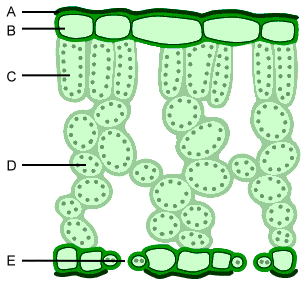
What is letter "A" pointing to?
cuticle
upper epidermis
lower epidermis
palisade mesophyll
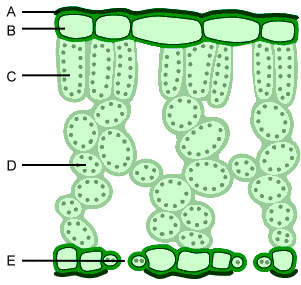
What is letter "D" pointing to?
upper epidermis
palisade mesophyll
spongy mesophyll
bundle sheath
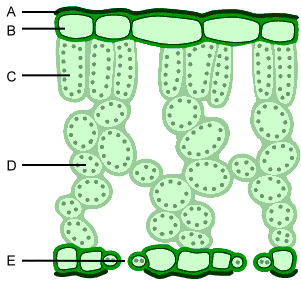
Which of the following is pointing to the "guard cell"?
B
C
D
E

How does most of the water needed by the plant get into its leaves?
It enters through the stomata
The roots absorb it and then it travels up the stem
It's made during a chemical reaction in the leaf
The flowers capture water and deliver it to the leaves
Exit: Carbon dioxide
Exit: Glucose
Exit: Oxygen
Exit: Water vapor
Which of the following is the correct equation for PHOTOSYNTHESIS?
light + carbon dioxide + water --> glucose + oxygen
carbon dioxide + sugar + water --> oxygen + light
oxygen + light + water --> carbon dioxide + sugar
carbon dioxide + oxygen + water --> Light+ Sugar
Why do leaves need a large surface area?
To absorb as much water as possible.
To absorb as much sunlight as possible.
To absorb as much food as possible.
To absorb as much chlorophyll as possible.

Identify structure 3 in the diagram
Waxy cuticle
Palisade mesophyll
Upper epidermis
Guard cell
Why do plants need sunlight for photosynthesis?
The light creates heat needed for photosynthesis to occur
The light provides the energy needed to power photosynthesis
Plants can't absorb carbon dioxide in darkness
Plants can't absorb water in darkness
Why are plants usually green?
Because the chlorophyll reflects green light
Because the chlorophyll absorbs green light
Because the accessory pigments combine to make green
Because the accessory pigments only absorb green light


Do plants with adaptations have more or less competition?
Less
More
What is a trait or characteristic that make an organism better suited to live in an environment.
Mutation
Change
Adaptation
What two ways do we study plant adaptations?
Pollination & Population
Structure & Function
Colors & Predators
Plant adaptations are usually modifications to what?
Stem
Roots
Leaves
All of the above
Conifer trees are usually found in what type of climate?
Cold & Dry
Dry & Warm
Cold & Damp
Warm & Damp
Why do conifer trees have needles?
Needles also shed snow more easily and less likely to lose water in dry environments.
Needles can be harmful to many predators that feed on the bark of these leaves.
Needles create more surface area in order to create more photosynthesis.
Cacti are adapted to thrive where?
hot and dry areas
Hot and Damp areas
Hot and humid areas
cold and dry areas.
Why do cacti have deep large roots?
The deep root of the cacti allows it to resist rainfall.
In order to help the cacti to be stable in windy conditions.
absorb water that is deep in the ground.
Some flowering plants survive year after year, these plants are called.
Annuals
Biannual
Perennials
Why do perennials become dormant in the winter months?
To conserve energy
To avoid predators
To survive the frost
Some plants have the ability to survive in or near aquatic environments: which of the following is not one of these plants.
Coconut and palm trees
Aquatic plants
Deciduous Trees
Nonvascular plants, such as moss, can survive in the
Warm & damp environment of the rainforest
Cold and barren environment of the tundra

