
 Worksheets
Motion & Design Lesson 6-8
Total questions: 10
Worksheet time: 5mins
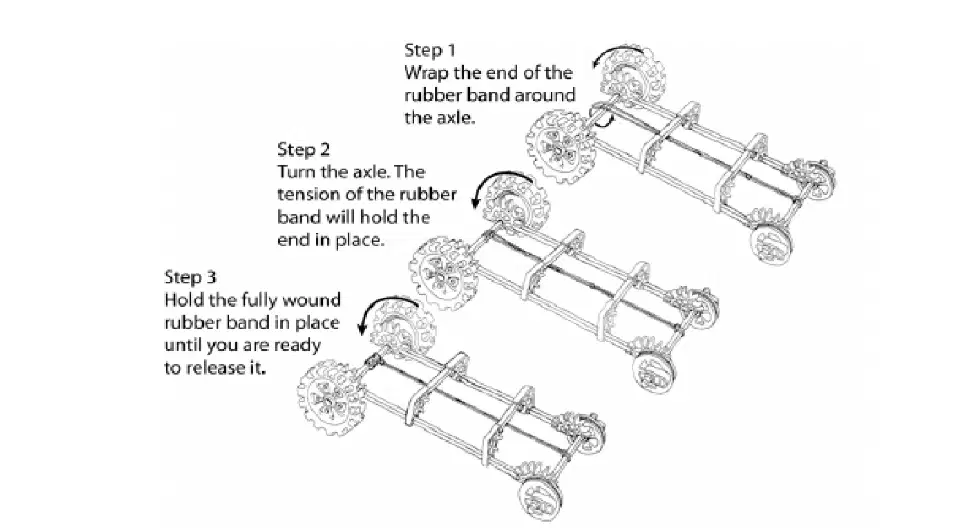
What direction will the wheels turn after the rubber band is released in step 3?
The same direction of the arrow.
The opposite direction of the arrow.
The wheels will not turn.
First in the opposite direction of the arrow, then in the same direction.
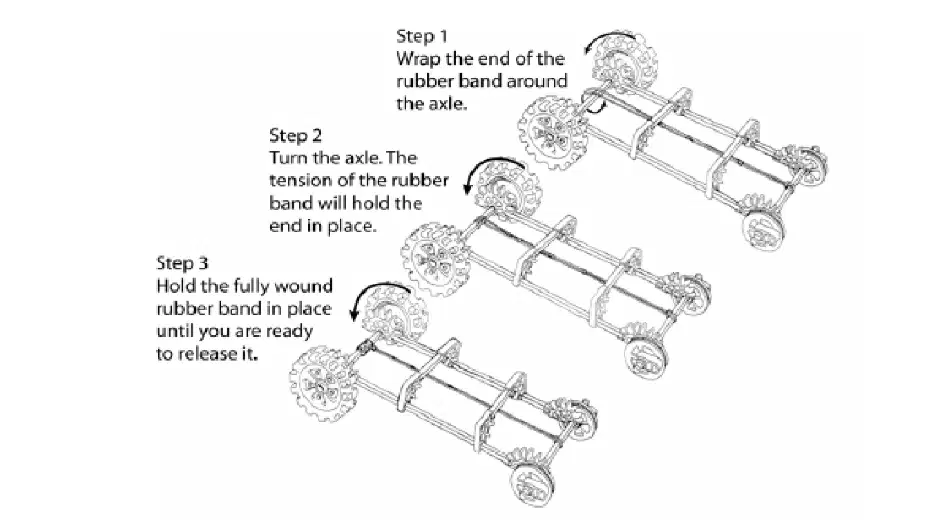
How does the rubber band apply force to the axel?
It pulls the top of the axle toward the front of the car.
It pushes the underside of the axle toward the front of the car.
It pulls the two back wheels in opposite directions.
It pushes the top and bottom of the axle equally toward the front of the car.
In lesson 6, the rubber band has the potential to move the vehicle because of its stored energy. However, there is no motion until…
the vehicle stops
the wheels stop
the rubber band is released
When the rubber band completely unwound in lesson 6, it had no more ________ to give the vehicle.
energy
force
speed
friction
When the rubber band completely unwound in lesson 6, the vehicle continued to roll while _____________ slows it down.
motion
energy
friction
speed
The more the rubber band is wound over the axle, the vehicle's _____ will increase.
energy
speed
distance
all of the above
The more tension is on the rubber band, the more potential energy it has.
true
false
What was the independent variable in lesson 7?
the vehicle
the number of rubber bands
the size of the rubber bands
the turns of the rubber bands
In lesson 7, why did we do 3 trials for each turn of the rubber band?
to give everyone a turn
for more accurate data
to test different locations
to test different vehicles
When the rubber tires in made contact with the floor in lesson 8, it was an example of _______.
negative friction
inertia
positive friction
potential energy

