
 Worksheets
Earth Science SOL 2007 Part 1
Total questions: 20
Worksheet time: 10mins
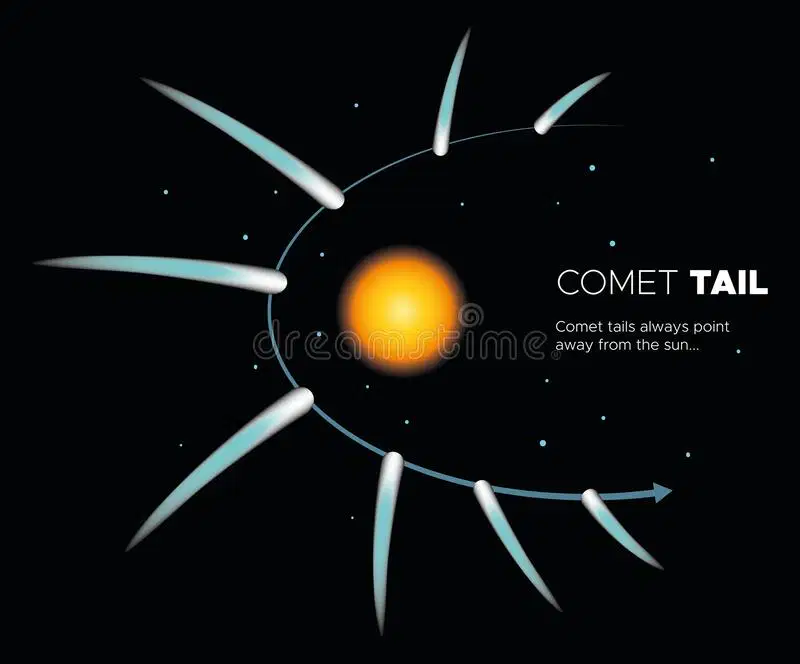
Why does a comet's tail point away from the Sun?
The solar winds blows the tail away from the Sun.
It is being pulled by a nearby black hole.
The Moon's light only shines on part of the comet.
The comet's tail is following the path of Jupiter.
Cloudy nights can be warmer than clear nights because clouds trap heat -
generated from tropical winds
produced by the friction of air particles
released from Earth's interior
absorbed by Earth during daylight hours
In gold rush of 1849, prospectors found a yellow mineral that appeared to be gold, but was harder and more brittle than gold. What is this mineral that came to be called "fool's gold"?
Calcite
Copper
Sulfur
Pyrite
What recent geologic processes commonly occur in the Coastal Plain region of Virginia?
Crust uplift and rock deformation
Rifting and intrusion
Erosion and deposition
Subduction and metamorphism
Which provides the best evidence for the theory that faults and volcanoes are the results of tectonic plate interactions?
Faults on tectonic places are in constant motion, but volcanoes may not erupt for many years.
Faults and volcanoes existed long before there were tectonic plates.
Tectonic plates that have many faults do not usually have volcanes.
Faults and volcanoes are often found on tectonic plate boundaries.
Which of these is likely to occur after moist air is cooled below its dew point?
Water condenses.
Evaporation increases.
Ice crystals melt.
Winds are generated.
The breakdown of rocks and minerals into smaller particles without a change in composition is called -
Igneous intrusion
chemical precipitation
mechanical weathering
metamorphic foliation
Metamorphic rocks with layered or banded look are called -
foliated
unfoliated
striated
evaporated
Dramatic variations in the polar ice caps most likely suggest changes in _
the Moon's orbit
Earth's climate
ebb and flow of tides
global water consumption
Rocky objects, measuring millimeters to kilometers in diameter, generally orbit the Sun in a region located between -
Mercury and Venus
Earth and Mars
Mars and Jupiter
Neptune and Pluto
Which of these best describes forest soil?
More rock fragments in the humus layer than in deeper layers
More organic matter in the humus layer than in deeper layers
More clay in the humus layer than in deep layers
Most sand-sized particles in the humus layer than in deeper layers
All of the following may be found deep in a natural cave EXCEPT-
groundwater
mineral deposits
photosynethetic
organisms
stalagmites
Identical rock types, identical fossils, and very similar mountain ranges are found on different continents that are separated by a wide ocean. Which of these best explains these observations?
Organisms traveled between these continents on land bridges.
The same forces erode mountains in different locations.
These continents were joined together at one time in the past.
Some rock types are very common and are found everywhere
Which of these provides the best estimate of how long it took a thick layer of sedimentary rock to form?
Using a microscope to closely examine the size of particles that make up the rock layer
Making a model that creates a sedimentary rock layer at a constant rate
Calculating the age of the top and bottom of the layer
Measuring then rate at which similar layers of sediments collect
Which of theses planets has the smallest diameter and the greatest average density?
Neptune
Jupiter
Saturn
Mercury
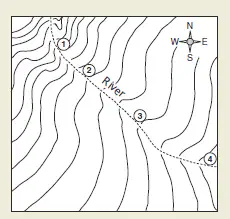
The river shown on the topographic map flows fastest at point -
1
2
3
4
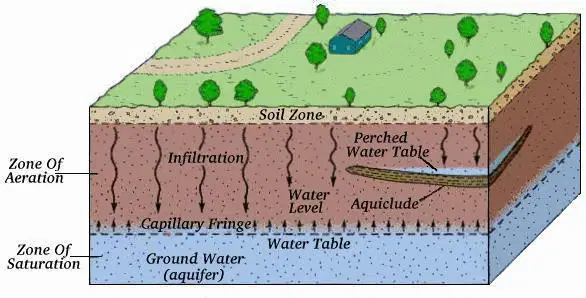
Which of these describes the area immedidiately below a water table?
Zone of aeration
Capillary
Recharge zone
Zone of saturation
The folding and faulting found in the Blue Ridge Mountains of Virginia were created by -
collisions of continental plates
wave action of prehistoric ocean
the Coriolis effect
heating and cooling of the prehistoric atmosphere
The streak test that is used to identify minerals involves studying the -
mineral's crystals with a microscope
heated mineral's color as it cools
appearance of the mineral under fluorescent light
color of the powdered form of the mineral
Seawater is typically denser than freshwater due to seawater's
high salinity
lower freezing point
smaller mass
greater depth

