
 Worksheets
EAP A2 U9C (1) and (2)
Total questions: 15
Worksheet time: 44mins

Read the text.
A. Which paragraph has a historical perspective? (a)
B. Which paragraph has a scientific perspective? (b)

Look at the verbs in the text. Complete the information.
Paragraph (a) is about the inventor. The verbs are in the (b) form.
Paragraph (c) is about the invention. The verbs are in the (d) form.
Choose the correct verb form for each space.
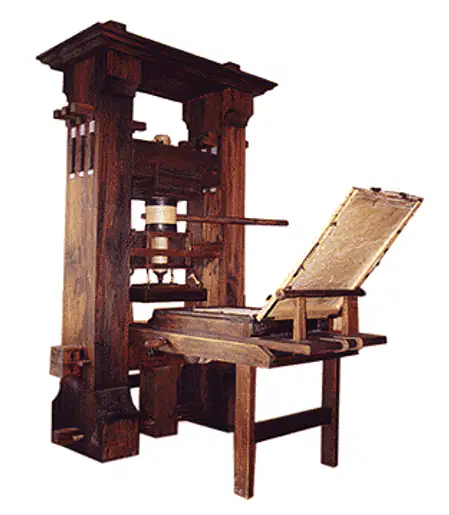
In the west, Johannes Gutenberg (a) the first printing press with moveable letters in the 15th century. However, the world's earliest printing press wasn't invented in Europe, but in China, around four centuries earlier. The inventor Bi Sheng (990-1051) (b) the letters of his printing press from clay. The clay was put on an iron plate. This (c) before ink was put on. Paper (d) . Bi Sheng's clay letters were not strong enough for large-scale printing, but later, in the 12th and 13th centuries, new types of printing presses were also developed in China. These (e) from wood and metal.
Choose the correct verb form for each space.
In the west, Johannes Gutenberg invented the first printing press with moveable letters in the 15th century. However, the world's earliest printing press (a) in Europe, but in China, around four centuries earlier. The inventor Bi Sheng (990-1051) made the letters of his printing press from clay. The clay (b) on an iron plate. This was heated before ink (c) . Paper was then applied. Bi Sheng's clay letters were not strong enough for large-scale printing, but later, in the 12th and 13th centuries, new types of printing presses (d) in China. These were made from wood and metal.
Rewrite the second sentence to mean the same as the first. For passive sentences, add by + agent if necessary.
The wheel was used over 7,000 years ago.
Humans (a) over 7,000 years ago.
Rewrite the second sentence to mean the same as the first. For passive sentences, add by + agent if necessary.
Archimedes calculated the number π.
The number π (a) .
Rewrite the second sentence to mean the same as the first. For passive sentences, add by + agent if necessary.
Galileo Galilei (1564-1642) discovered Jupiter's moons.
Jupiter's moons (a) .
Rewrite the second sentence to mean the same as the first. For passive sentences, add by + agent if necessary.
Chess was played in ancient India before it spread across the world.
People (a) in ancient India before it spread across the world.
Rewrite the second sentence to mean the same as the first. For passive sentences, add by + agent if necessary.
Paper was produced in China by the inventor Cai Lun.
The inventor Cai Lun (a) .
Rewrite the second sentence to mean the same as the first. For passive sentences, add by + agent if necessary.
Antonie van Leewenhoek observed bacteria with a microscope in the early 18th century.
Bacteria (a) with a microscope in the early 18th century.
Rewrite the second sentence to mean the same as the first. For passive sentences, add by + agent if necessary.
Persians invented the earliest windmills around the seventh century.
The earliest windmills (a) in Persia.
Rewrite the second sentence to mean the same as the first. For passive sentences, add by + agent if necessary.
The first satellite in space was launched by the Soviet Union in 1957.
The Soviet Union (a) .
Read the Paragraph. In what order (1-3) does it give this information?
1. the inventor's main invention
2. the inventor's biographical information
3. the impact of the invention on people's lives
Johannes Gutenberg was a printer and publisher in the 15th century. Gutenberg also became famous for his inventions; his inventions included a printing press with moveable wooden or metal letters in 1448. Before 1448, books were written and copied by hand. As a result of Gutenberg's press, books could be printed in large numbers and for the first time the average person could buy a book and read a book.
1, 2, 3
1, 3, 2
2, 1, 3
2, 3, 1
3, 1, 2
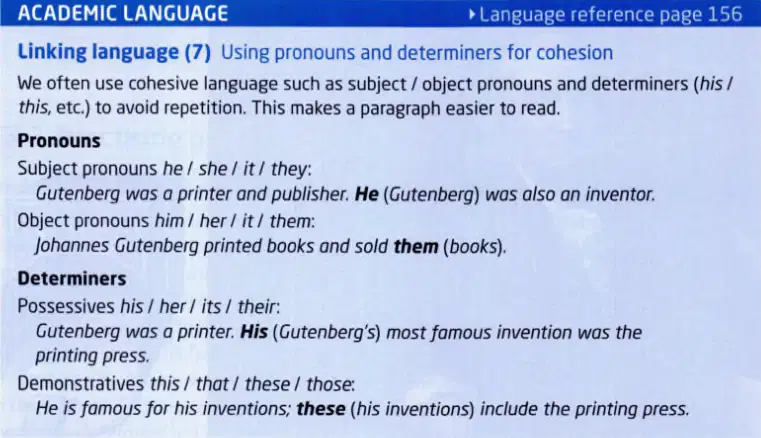
Find these words in the paragraph below. What do they refer to?
Example: he Gutenberg
1. his (a)
2. these (b)
3. this (c)
4. they (d)
5. it (e)
Johannes Gutenberg was a printer and publisher in the 15th century. He also became famous for his inventions; these included a printing press with moveable wooden or metal letters in 1448. Before this, books were written and copied by hand. As a result of Gutenberg's printing press, they could be printed in large numbers and for the first time the average person could buy a book and read it.
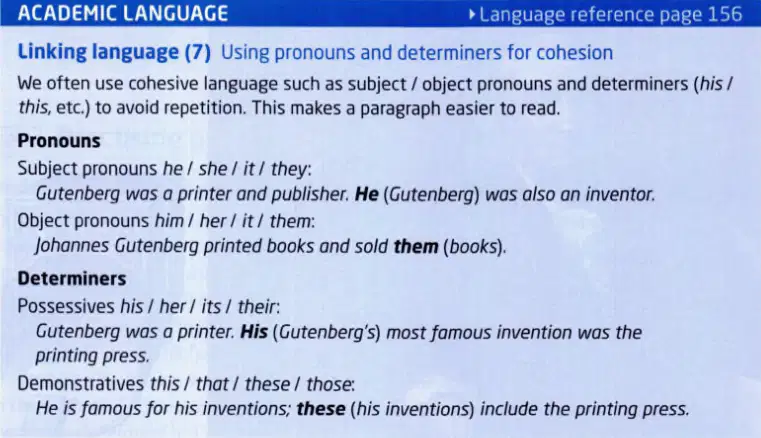
Complete the text with the words in the drop down list.
Percy Spencer (1894-1974) was an engineer and inventor. During the Second World War, he specialized in radar technology and worked for the US army. Hie is remembered for (a) invention of the microwave oven. Spencer accidentally discovered that microwaves could cook food. One day he was ear a radar which melted a chocolate bar in (b) pocket. This interested (c) , so he put popcorne near the machine and cooked (d) . Over the next two years, Spencer developed the invention and sold the first microwave oven in 1947. As a result of Spencer's discovery, microwave ovens have become common in kitchens, because more families can afford (e) .

