
Font size
 Worksheets
Solar System Unit Test Review
Total questions: 48
Worksheet time: 24mins

A rover is a vehicle that can drive on rocky surfaces, and has been used to drive on the surface of our moon and on the surface of Mars.
Based on this information, what can rovers do that most space exploration tools cannot do?
A. Collect rocks from the surface of moons and planets
B. Take pictures of distant stars and galaxies
C. Orbit distant planets and observe their moons
D. Drive on the surface of the Sun and measure the temperature

There is a recorded list of more than 40,000 stars today. Long ago, there were only a little more than 1,000. Why have modern astronomers recorded so many more stars?
A. Ancient astronomers had little knowledge.
B. Modern astronomers can use Rover to find new stars.
C. Modern astronomers have powerful telescopes that help them see more stars.
D. Ancient astronomers made their counts before many of the stars were formed

How can this model help us learn about our Solar System? What are two strengths?
A. It has the correct order of the planets
B. It has the correct distances between the planets.
C. It has the relative sizes of the planets
D. It has the correct distance between the sun and Mercury.

Jamal is constructing a scale model of our solar system. First, he compares the sizes of the Sun, the rocky planets, and the gaseous planets. Which answer choice lists the three objects in order from smallest to largest?
A. rocky planets, gaseous planets, Sun
B. gaseous planets, rocky planets, Sun
C. Sun, gaseous planets, rocky planets
D. Sun, rocky planets, gaseous planets
What are the 4 rocky planets of our solar system?
A. Mercury, Neptune, Jupiter, and Mars
B. Saturn, Mars, Earth, and Moon
C. Mercury, Venus, Earth, and Mars
D. Earth, Jupiter, Neptune, and Venus
What are the 4 gaseous planets?
A. Neptune, Jupiter, Venus, and Mercury
B. Mars, Venus, Neptune, and Uranus
C. Venus, Earth, Uranus, and Mars
D. Jupiter, Saturn, Uranus, and Neptune

Look at the following model. What is one of the limitations of this type of diagram when trying to model our solar system?
A. The diagram does not show the relative sizes of the Sun and planets accurately.
B. The diagram does not show all of the stars in our solar system.
C. The diagram does not show the planets in the correct order of distance from the Sun.
D. The diagram does not show all of the planets in our solar system.
In what ways are stars different from planets?
A. Stars twinkle in the sky.
B. Planets shine by reflected light, while stars generate their own light.
C. Stars appear to be still.
D. All of the above

Michelle made a scale model of the solar system. What did she notice about the inner planets----Mercury, Venus, Earth, and Mars?
A. They are all the same size.
B. They are all larger than the sun.
C. They are all larger than the outer planets.
D. They are all smaller than the outer planets.

Why is the Moon easier to see than stars in the night sky?
A. The Moon is smaller than the stars, but it is closer to Earth.
B. The Moon burns much hotter than the stars do.
C. The Moon produces more light energy than the stars do.
D. Moon looks biggest because moons are bigger than stars.

Earth is one of the inner planets. Jupiter is one of the outer planets. How does each planet compare to the other planets in the group?
A. Both are the largest planets in their group.
B. Both are the smallest planets in their group.
C. Both are the closest planets to the sun in their group.
D. Both are the farthest planets to the sun in their group.
In what ways are planets different from stars?
A. They are large, round objects with dull bright
B. They orbit around a star.
C. They are made of rocks and gases.
D. All of the above
True or False. Has space technology advanced over the years.
True
False
An object that orbits a planet or star.
Telescope
Asteroid
Satellite
Hubble
An object used to make objects in the sky appear closer.
spy glass
telescope
model
binoculars
Who invented the very first telescope?
Charles Hubble
Galileo Galilei
James Webb
Neil Armstrong
Which of the following does space exploration benefit?
weather forecasting
advancements in technology and medicine
safety and security
all the above
What is the name of the first large space telescope launched into space?
Galilean Telescope
Hubble Telescope
Gamma Telescope
James Webb Telescope
Largest spacecraft that orbits the earth.
NASA
Falcon 9
International Space Station
Satellite

What telescope is pictured here?
Spitzer Telescope
James Webb Telescope
Subaru Telescope
Hubble Telescope

What telescope was used to capture the image on the left?
Charles James Telescope
James Webb Telescope
Hubble Telescope
Granat Telescope

What object is pictured here?
Space Probe
Orion
James Webb Telescope
International Space Station
True or False. Space exploration allows us to learn ways to better protect the earth and the atmosphere.
True
False
Which of the following is true about the James Webb telescope?
uses infrared cameras
can see past 200 million years ago
tall as a three story building
all of the above
An agency designed and funded by the goverment with the purpose to explore space.
International Space System
NASA
BES
Hubble
This place serves as a "home" for astronauts in outer space.
NASA
International Space Station
Satellite
Model
When was the James Webb telescope lauched into space?
1610
1890
1990
2021
When was the first telescope invented?
1610
1890
1990
2021
What are satellites used for?
weather predictions
radio
television communications
all of the above
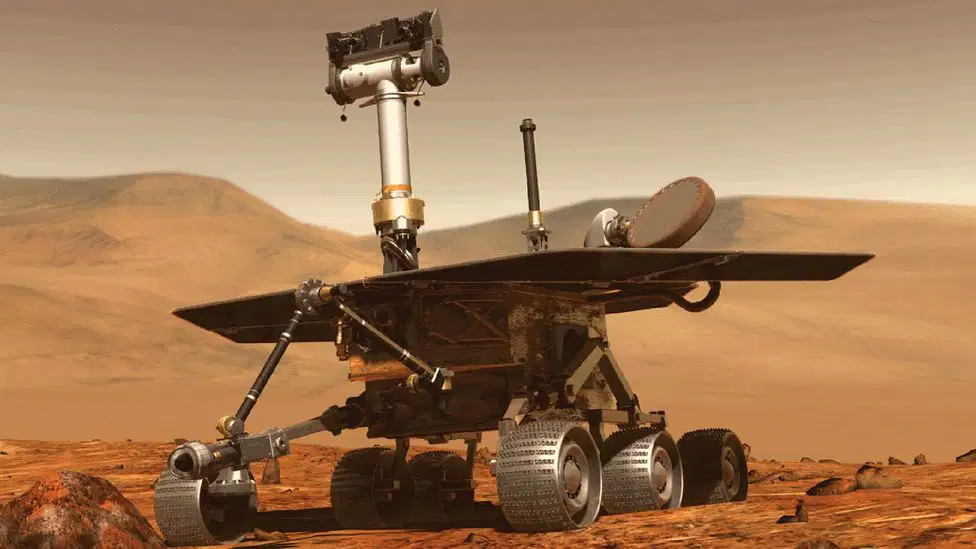
The following picture is an example of space technology. What is the following device?
Satellite
Rover
Space station
UFO

The Sun is a ________, a huge ball of glowing gases.
planet
asteroid
star
comet

The hottest stars are __________.
green
red
yellow
blue

The following is true about stars: (Click ALL that apply.)
The color of a star tells us how hot it is.
Patterns of stars form constellations.
Planets are a special type of star.
There are billions of stars in the universe.

The Sun looks like the largest and brightest star in our galaxy because _________.
It is the largest and brightest star.
It is billions of light-years away.
It is the closest star to us.
The Sun is not a star, it is a planet.
Large objects that are made of gas or rocks are called
asteroids
comets
stars
planets
The Inner Planets are: (Check all that apply.)
Mercury
Jupiter
Earth
Mars
Venus
The Inner Planets are made of:
gases
rubber
rocky material
Hydrogen
The inner planets are ___________ than the outer planets because they are closer to the Sun.
hotter
colder
____________ is the only planet that can sustain life; however, some scientists believe that Mars might also be able to sustain life.
Mercury
Saturn
Uranus
Earth
The Outer Planets are: (Click all that apply.)
Jupiter
Neptune
Saturn
Mars
Uranus
The Outer Planets are made of gasses and are called the __________.
Gigantic Rocks
Gas Giants
Gas dwarfs
Dwarf Planets
The planets __________ around the Sun on their orbit.
rotate
revolve
flip
twist
Space tools astronomers use to learn more about the universe are: (Check all that apply).
telescopes
Space Stations
Space probes
scales
The moon is a natural satellite of the Earth.
True
False
Why do some stars appear to be smaller than the sun?
They are farther away from the Earth than the Sun
The Sun is the largest star.
They are closer to Earth than the Sun.
They are made out of rock.
What star does our Solar System revolve around?
North Star
Moon
Sun
Mars

Which of the following separates the outer planets from the inner planets?
A.
the Asteroid Belt
B.
the Milky Way
C.
the Kuiper Belt
D.
the scattered disc

The diagram shows a simple model of Earth's solar system.
Which planet takes the shortest amount of
time to go around the Sun?
A. R
B. S
C. T
D. U

