
NEW
Font size
 Worksheets
light
Total questions: 20
Worksheet time: 11mins
How do you call objects that emit light?
luminous
non-luminous
opaque
transparent
Which of the following items best describes the nature of light?
current and wave
mass and particle
point and wave
wave and particle
The following are natural sources of light in the surroundings, EXCEPT__________
fire
flashlight
sun
lightning
According to Louis de Broglie, why is light said to have a dual nature?
It shows the properties of wave only.
It exhibits the properties of reflection.
It has both interference and polarization effect.
It displays the properties of both wave and particle.
Who among the scientists below formulated the wave theory of light?
Isaac Newton
Louis de Broglie
Christian Huygens
James Clerk Maxwell
Which of the following is NOT a property of light?
Direction
Frequency
Intensity
Width
Which of the following materials would reflect light the most?
black rock
dark brown carpet
flat sheet of aluminum foil
piece of red construction paper
The distance of an observer from two identical kinds of light sources varies. Light
source A is 200 centimeters away while the light source B is 300 centimeters away
from the observer. Does light source A give higher light intensity than light source B?
Yes, because it is away from the observer
Yes, because it is much closer to the observer
No, because the distances of light source vary
No, because its distance is closer from the observer
The intensity of light is inversely proportional to the distance from the eye of the
observer. Which of the following statements explain the relationship between
intensity and distance?
I. As the distance increases, the intensity of light decreases because it spreads out
over a larger surface area.
II. When the distance increases, the intensity of light increases because the light
rays compressed in larger surface area.
III. If the distance increases, the intensity of light decreases because light waves
spread out more in its surrounding.
I, II, and III
I and II only
I and III only
II and III only
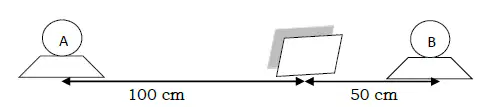
refer to the illustration below. Suppose two identical kinds of light
sources, A and B, shines on a surface of a board when placed 100 cm to the left and 50
cm to the right of the board, respectively.
Will the light intensity measured on the cardboard facing light source A is higher than the side facing light source B?
No, because light source A is farther from the cardboard than light source B.
Yes, because light source A is farther from the cardboard than light source B.
Yes, because light source B is much closer to the cardboard than light source
A.
No, because the distance of light sources has no effect on their light intensities.
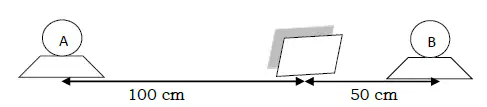
refer to the illustration. Suppose two identical kinds of light
sources, A and B, shines on a surface of a board when placed 100 cm to the left and 50
cm to the right of the board, respectively.
How does the amount of light intensity of light source B compare to light source A
as measured on the surface of the cardboard?
They have equal light intensities
They have varying light intensities per time.
The side facing light source A has greater light intensity
The side facing light source B has greater light intensity.
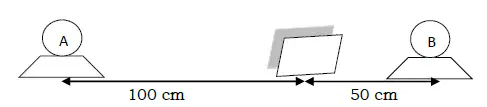
Which of the following statements correctly describes the brightness of light sources
A and B?
I. Light source A is brighter than light source B.
II. Light source B is brighter than light source A.
III. Light sources A and B produce unequal brightness.
IV. No differences in brightness between light sources A and B.
I, and II only
II and III only
III and IV only
I, II, and III only
Which of the following terms best describes an object that emit energy in the form of light?
Fluorescence
Incandescence
Luminous
Phosphorescence
What color of the visible spectrum has the highest energy?
orange
green
red
violet
The following statements are related to the frequency and wavelength of visible
light. Which of the statements are TRUE?
I. Red light has the longest wavelength among visible lights
II. Violet light has highest frequency compared to green and blue light.
III. Yellow light has shorter wavelength compared to red and orange light.
VI. Red light has longer wavelength but lower in frequency, while violet light
has shorter wavelength but higher in frequency.
I and II only
I, II.III, and IV
I, II, and IV only
I, II, and III only
What is the color of light with the shortest wavelength in the visible spectrum?
Red
Green
Blue
Violet
Which scientist proposed the particle theory of light?
Isaac Newton
Albert Einstein
Thomas Young
Max Planck
How does the speed of light in a vacuum compare to the speed of light in other mediums?
Light travels faster in other mediums than in a vacuum
Light travels at the same speed in all mediums
Light travels slower in other mediums than in a vacuum
Light speed varies depending on the medium
What is the color of light with the longest wavelength in the visible spectrum?
Red
Green
Blue
Violet
How does the frequency of light relate to its energy?
Higher frequency light has lower energy.
Lower frequency light has higher energy.
Frequency and energy of light are not related.
Higher frequency light has higher energy.

