
 Worksheets
SSA Hierarchal Organization Plus
Total questions: 10
Worksheet time: 5mins

In the diagram, which circle would contain the planet Earth and its moon?
Sun
Solar System
Galaxy
Universe
The universe contains galaxies, planets, stars, and solar systems. Which of the following is most true?
Not all galaxies contain stars
Not all stars are part of the universe
Our solar system includes several stars
Our solar system only contains one star
The universe contains many galaxies, and each galaxy contains many stars. Which of the following is true?
Each galaxy has at least one star identical to the Sun
Sirius is in the same solar system as Earth
Andromeda is in the same solar system as Earth
Sirius is in the same galaxy as Earth

Object X is made of layers of solid and liquid rock and metals. Its outermost layer is a water ice shell. It is larger than the smallest planet, but does not orbit the Sun. Which type of object is it?
a moon
an asteroid
an inner planet
an outer planet
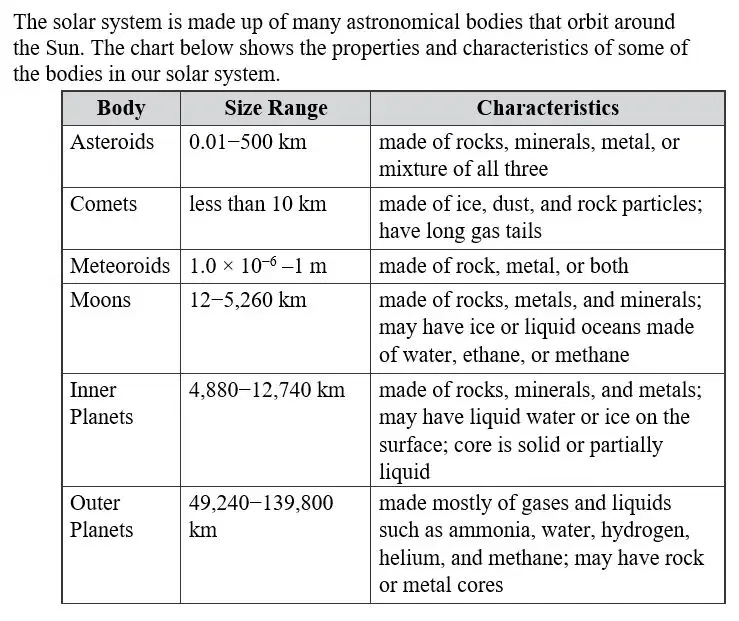
The object 4 Vesta has a diameter of 329 km. Its surface is made of different minerals and orbits the Sun. Based on the information in the table, how should 4 Vesta be classified?
a moon
a comet
a planet
an asteroid

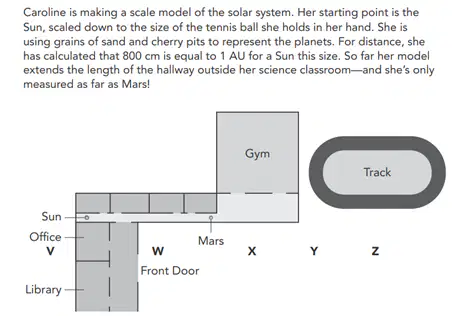
Mars is about 1.5 AU from the Sun. Caroline has realized she needs to move her model outside if she wants to include Saturn. Saturn is about 9.54 AU from the Sun. Where should the Sun be located if she places Saturn at the spot marked Z on the diagram?
Spot V
Spot W
Spot X
Spot Y
From Earth what is the relationship between size and distance to our nearest neighbors?
Scientists have no way of accurately measuring the size of space bodies
Larger objects tend to be closer while the smaller ones are farther away
There does not seem to be a predictable relationship between size and distance
We are nearby the smaller objects and farther away from larger objects

Even at extremely small scales, distances between objects in space are enormous. Caroline has stopped with the placement of Neptune. Outside of our solar system the next closest star is Proxima Centauri. At the same scale, this would mean approximately 1,420 miles. (Roughly the same as from Orlando, FL to Acapulco, Mexico.) Which statement about how distances are expressed is accurate?
Astronomical units refer to the distance between the Sun and the Oort Cloud at the edge of our solar system
A light year is how far light can travel in a year. It is most useful for objects that are close together or in the same solar system
An astronomical unit denotes the distance from the Sun to the Earth. It is commonly used for the distances between the planets in our solar system
The Parsec is the shortest space distance of all. It refers to 3.26 light years

Hierarchical relationships are typically based on levels. The subordinate or lower-level objects are then all contained in the next category in the hierarchy. Which of the following correctly organizes astronomical bodies from largest to smallest?
stars, solar systems, galaxies, planets
universe, planets, solar systems, stars
galaxy, planets, comets, stars
universe, galaxy, solar system, stars
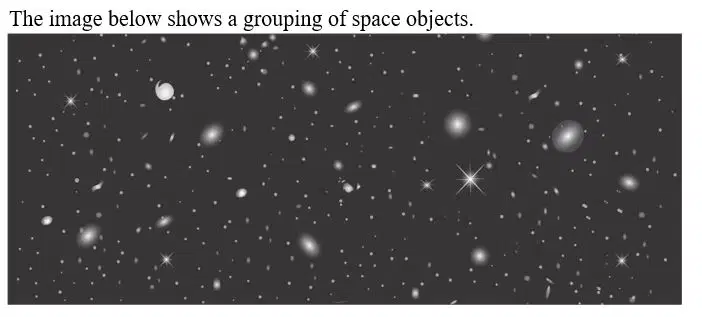
Which of the following is the most accurate?
There are hundreds of galaxies with hundreds of stars
There are millions of galaxies with millions of stars
There are billions of galaxies with billions of stars
There are millions of galaxies with billions of stars

