
 Worksheets
Tooth form and function
Total questions: 10
Worksheet time: 6mins
The arrangement of the teeth within the dental arches is known as:
Occlusion
Alignment
Articulation
Arrangement
The relationship of the dental arches when tooth contact is made is :
Alignment
Articulation
Occlusion
Retrusion
Which dental arch is wider, larger and has more esthethics embedded in it ?
Maxillary arch
Mandibular Arch
Both dental arches
When arches are in occlusion
From the proximal aspect in maxillary teeth, the least deviation in tooth alignment as compared the longitudinal axis is :
Central incisor
First premolar
Lateral incisor
Second premolar
From the proximal aspect in mandibular teeth, the least deviation in tooth alignment as compared the longitudinal axis is :
Lateral incisor
Central incisor
First premolar
Canine
An imaginary line that extends from the cusp tip of the mandibular canine along the facial cusp tips of the posterior teeth resulting in an anteroposterior curve is:
Curve of Jaffar
Curve of Spee
Curve of Wilson
Curve of Monson
From the frontal view, an imaginary curved line connecting the facial and lingual cusps of the posterior teeth is known as:
Curve of Monson
Curve of Anderson
Curve of Wilson
Curve of Spee
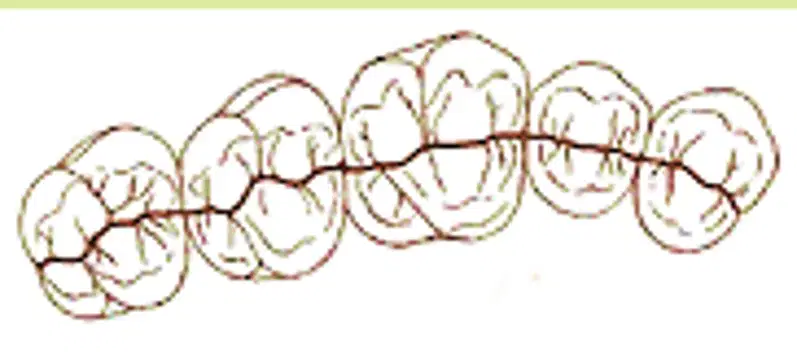
Which groove here is continous in all the teeth?
Central groove
Marginal ridge
Central fossa
Central pit
What is the primary function of the Plane of Occlusion?
To maintain a flat surface for tooth contact
To permit simultaneous functional contact in more than one area of the dental arch
To align the teeth in a straight vertical line
To ensure that teeth contact their namesakes in the opposing arch
In terms of tooth contact areas, what tends to happen as you move posteriorly in the mouth?
Contacts appear at the same level on each tooth
Contacts appear higher on each tooth
Contacts appear lower on each tooth
There are no significant changes in contact areas

