
 Worksheets
NACS Quiz
Total questions: 20
Worksheet time: 10mins
A Circuit having neither any energy source nor e.m.f. source is called the .........circuit
Unilateral
Bilateral
Passive
Active
To neglect a voltage source, the terminals across the source are
Open-circuited
Short-circuited
Replaced by some resistance
Replaced by inductor
According to Kirchhoff's voltage law, the algebraic some of all IR drops and e.m.fs. in any closed loop of a network is always
Negative
Positive
Determined by battery e.m.fs
Zero
In nodal analysis, if there are N nodes in the circuit then how many equations will be written to solve the network ?
N - 1
N + 1
N
N +2
The theorem that enables a number of voltage (or current) sources to be combined directly into a single voltage (or current) source is the ........theorem
Norton's
Reciprocity
Milliman's
Maxwell's
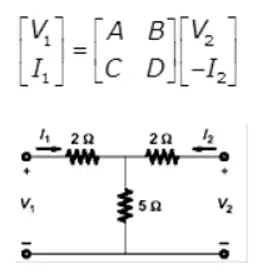
The ABCD matrix of two port network is defined by
The parameter B in the network is ____________
3.8
4.8
2.3
3.2


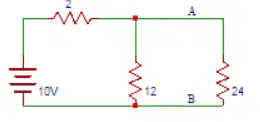
Consider the circuit shown below. Find the equivalent Thevenin’s voltage between nodes A and B
8
8.57
9.25
7.9
In Superposition theorem, while considering a source, all other current sources are
short circuited
change its position
open circuited
removed from the circuit
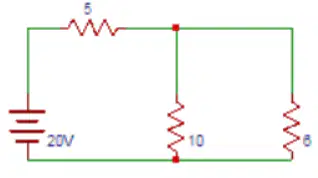
Find the current flowing between terminals A and B of the circuit shown below.
1
2
3
4
m?The transfer function of a linear system is given by:
The ratio of the output Vo(t) and the input Vi(t) of the system.
The ratio of the derivatives of the output dVo(t)/dt and the input dVi(t)/dt of the system.
The ratio of the Laplace transforms of the output Vo(s) and the input Vi(s) of the system with all initial conditions zeroes.
The ratio of the Fourier transform of the output Vo(s) and the input Vi(s) of the system.
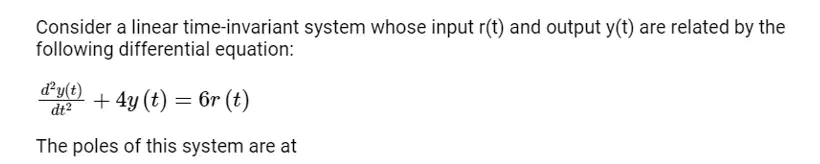
+2j, -2j
-2j, +2j
2, 2
4, 4
The type of system denotes the number of:
Zeroes at the origin
Poles at the origin
Poles at infinity
Finite poles
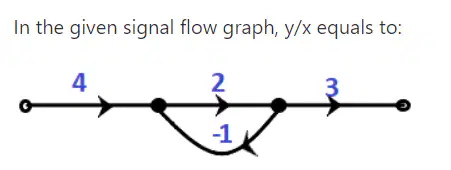
3
8
6
4
If the characteristic equation of the closed loop system is s^2 + 2s + 2 = 0, then the system is:
Over damped
Critically damped
Undamped
Underdamped
The step error coefficient of a system G(s) = 1/ (s+2)(s+3) with unity feedback is:
0
infinite
1
1/5
The number of roots in the left half of the s-plane of the given equation s^3 + 3s^2 + 4s + 1 = 0 is:
1
2
3
4
A system with the polynomial s^4 + 5s^3 + 3s^2 + 6s + 5 = 0 is
Unstable
Marginally stable
In equilibrium
Stable
The centroid in the root locus is a point where
The branches of the root locus intersect with the imaginary axis.
The branches of the root locus tend to infinity.
The asymptotes cross the real axis.
The branches of the root locus terminate on the real axis.
In a bode-plot of a unity feedback control system, the value of phase of G(jw) at the gain cross over frequency is -115 degrees. The phase margin of the system is:
115 degrees
-57.5 degrees
-65 degrees
65 degrees

