
 Worksheets
Motion & Pressure Practice / Study guide
Total questions: 40
Worksheet time: 44mins
On a distance time graph, the distance is plotted on the
x-axis
y-axis
On a distance time graph, the time is plotted on the
x-axis
y-axis
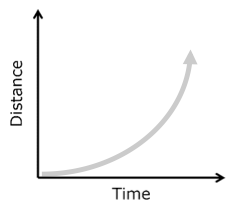
Increasing speed
At a constant speed
Decreasing speed
Stationary
Which of the following are correct ways to calculate speed?
Speed =
Distance X Time
Distance / Time
Time / Distance
seconds
miles
m/s
km
What is the standard unit of speed used in science?
m/s
Kph
mph
Km/s
miles/hr
miles
seconds
minutes
Km/hr
Km
Kilometer per hour
Kilometer/Hour
Average speed =
(total distance) ÷ (total time)
(total distance) x (total time)
(total time) ÷ (total distance)
Speed x time

Albert
Bob
Charlie

Which is faster?
walking
skating
biking

Segment A-B The bus is _________________.
at rest
returning (to original position)
moving forward
Match the description to the graph:
"The car is coming back."


What happens when you squash the volume of a gas into a smaller volume? (Select 3 answers)
There will be more molecules because of a higher pressure
There will be more collisions between the molecules and the walls of the container
The pressure increases because there are more collisions
The temperature increases because there are more collisions

What happens when you blow a balloon and place it inside the fridge to decrease its temperature? {4 answers}
The molecules move more slowly
The pressure goes down
There are fewer collisions
The balloon will collapse
The balloon will keep its shape

How come we do not feel the atmospheric pressure pushing on us from all directions around us?
{Select two answers}
It cancels itself out
Its cancelled out by the gasses
Its cancelled out by the pressure of the gases and liquids in your body pushing out
It's balanced by our body's internal pressure
In all directions
In no direction
there is no pressure

The reason gases can be compressed is because:
The particles are very close together.
The particles are merely vibrating.
The particles are unable to move.
The particles are very far apart.
Why are liquids incompressible?
(Select two answers)
The particles in a liquid are touching each other
There is very little space between the particles
Liquids are similar to solids
They have no where to go
What is "upthrust"?
The force that keeps things afloat
The force than pulls you down in water
The force of the water
The upward current in a lake
What produces upthrust?
Gravity
liquid pressure
Liquid temperature
All of these

Where is water pressure the lowest on the dam?
D
C
B
A

which hole has the longest distance?
highest one
the middle one
the deepest one
all of them have the same distance
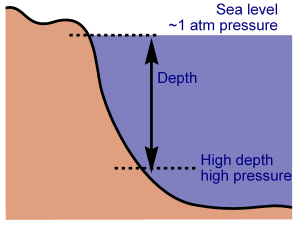
When you increase your depth under water, the water pressure on your body
increases
decreases
stays the same


A metric ton excavator in this picture is able to operate on the muddy ground without sinking. How is this possible?
It has strong tyres
Humans are not made of metal
It has a large surface area
It has a large mass
If an object's surface area is smaller does it create more or less pressure?
More
Less
The same
State the direction at which pressure acts?
420o
180o
90o
How do you calculate pressure?
Preesure = ForceXArea
Pressure = Force/Area
Pressure = Area/Force
Pressure = Weight
What are the Standard (Internationale) units of pressure?
Newtons
Metres
Newtons/Metres
newtons per metre squared
How do you Calculate Pressure
Force(N)/Area(m2)
Force(kg)/Area(mi2)
Area(m2)/Force(N)
A fat cow with big feet
A fat cow with small feet
A calf with big feet
A calf with small feet
Which situation produces more pressure on the floor?
standing on one foot
standing on two feet
standing on four feet
all produce the same pressure
Which situation produces more force on the floor?
standing on one foot
standing on two feet
standing on four feet
all produce the same force
Newtons
m/s
Pascals
Moles

Can you figure out the mass of the mystery object?
30 Kg
15 Kg
25 Kg
20 Kg
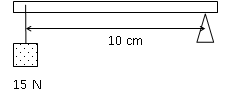
15 Nm (clockwise)
150 Nm (anti - clockwise)
1.5 Nm (anti - clockwise)
0.15 Nm (clockwise)

Where should this dad sit to balance his son?
0.25 metre mark, right of the pivot
0.25 metre mark, left of the pivot
0.5 metre mark, right of the pivot
0.5 metre mark, left of the pivot

1.6Nm
15Nm
16N
4Nm
Moment can be calculated using the equation:
M = F × d
M = F / d
M = F2 × d
M = F / d2

