
Font size
 Worksheets
S1_5.7 Characteristics of Tropical Mangroves [Quiz]
Total questions: 33
Worksheet time: 32mins
Tropical mangroves are found between the Tropic of Cancer and the Tropic of Capricorn.
True
False
Which of the following describes the tropical climate?
High annual temperature at an average of 27°C
High total annual rainfall of 2000mm on an average
High annual temperature range
No distinct wet and dry season
Mangroves are found along sheltered coastal areas.
True
False
Mangroves required (a) water conditions to accumulate nutrients and grow seedlings.
Tropical mangroves are EVERGREEN because:
Do not shed all of their leaves at particular times of the year.
They don't shed leaves.
Continuously grow new leaves to replace older ones that die and fall off, maintaining a constantly green appearance.
The mangrove forests have a larger biodiversity as compared to the tropical rainforests.
True
False
There are only 60-70 species of mangrove trees species worldwide because not many plant species have evolved to survive in waters with high salinity.
True
False
Tropical rainforests are less dense and less luxuriant as compared to mangroves forests.
True
False
There is less competition for sunlight for trees in the tropical mangrove forests.
True
False
Mangrove trees found in the different zones are the same.
True
False
There are different mangrove tree species in the different zones with different types of roots.
True
False
Label the zones:
Both the topical rainforest and mangrove forests have THREE LAYERS.
True
False
The mangrove forest have 3 horizontal zones: Coastal, Middle and (a) zone
Mangrove trees in the COASTAL zone have (a) roots.
Plant species in the COASTAL zone are able to tolerate HIGHER salinity levels and SHORTER periods of flooding.
True
False
Plant species in the COASTAL zone are able to tolerate HIGHER salinity levels and LONGER periods of flooding.
True
False
Aerial roots look like pencils sticking out of the ground.
True
False
Aerial roots in the coastal zone are submerged during high tide.
True
False
Aerial roots in the coastal zone are just above the water to absorb (a) .
Prop roots in the middle zone are long and they branch out from the ______ of the trees.
top
middle
bottom
Rhizophora have PROP roots for the following purpose(s):
Anchor trees firmly to the ground
Take in oxygen
Provides shelter to aquatic life
The inland zone is the furthest away from the sea.
True
False
Trees in the inland zone are the MOST resistant to salty water.
True
False
The duration of flooding in the inland zone is the shortest.
True
False
Salt crystals are rarely found on the leaves of the Avicenna plant.
True
False
The salt-secreting leaves of the Avicenna plants enabled them to survive in area with high salinity.
True
False
Which of the following describes the characteristics of the Sonneratia tree?
They are not able to secret salt through their leaves
They deposit excess salt in older leaves
They will shed the older leaves with excess salt.
They will also store salt in the roots.
Match the following roots:
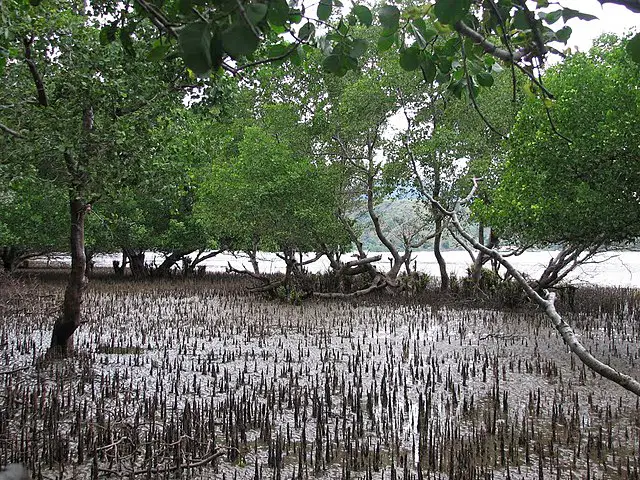
Aerial roots

Prop roots
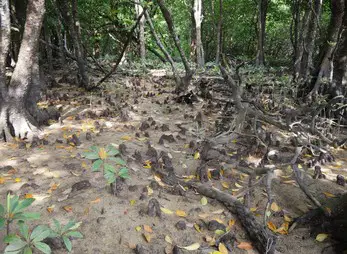
Knee-bend roots
Which mangrove species is commonly found in each of the zones?
Coastal
Sonneratia
Middle
Rhizophora
Inland
Bruguiera
Identify the mangrove species:
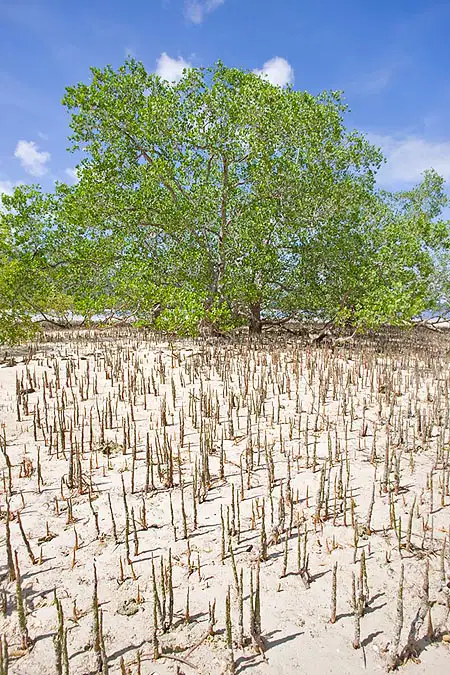
Sonneratia

Rhizophora
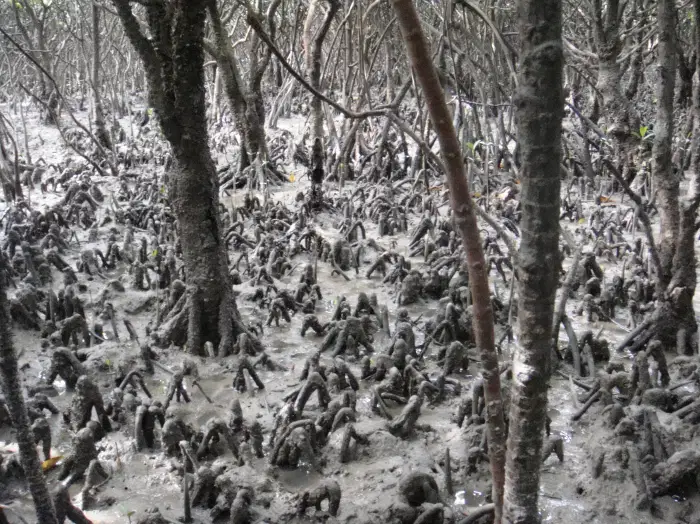
Bruguiera
Which is NOT a characteristic of mangroves?
Have buttress roots that help anchor them to the soil
Have a lower diversity of plants
Have a horizontal zonation structure
Grow on waterlogged, unstable soil
Which is NOT an example of a mangrove root?



