
Font size
 Worksheets
Year 11 Easter Term Revision Book Economics
Total questions: 135
Worksheet time: 2hrs 15mins

What does point B represent?
Production at greater than the country's minimum potential
Production is less than the country's minimum potential
Production is greater than the country's maximum potential
Production at the country's maximum potential
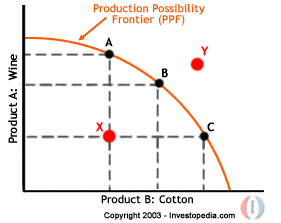

What is the Opportunity Cost of moving from C to A? (Think in the terms of what do we have to forgo in the process.)
(a)
What does PPC show? Select Multiple options.
Describes the production of only two products in economy.
It explains the production when there is full and efficient utilisation all resources in economy
It explains the consumption pattern in economy
It is the combination of all possible output points of two goods given that technology and resources are fixed.

Which of the following are the choices in case the technology is fixed and all resources are efficiently employed. Choose the correct option/s.
G
C
A
E
B

Which coordinate(s) is/are inefficient to produce both products? Choose the correct option/s.
B
F
G
E

Which scenario contributes towards the shifting of the curve in the picture above?
When a country is struck by a natural disaster, natural resources are either exhausted or reduced due to the incident.
Huge reduction in Construction Expenses and equipment manufacturing
Economic decline due to Covid 19
None of the above

The following diagram shows the production possibility frontier for an economy that produces bread and honey.
If the economy is initially at point W, then the opportunity cost of moving to point X is
6 units of honey.
8 units of honey.
12 units of bread.
23 units of bread.

The table shows the production possibilities for a country. Based on the table, which of the following production combinations is a possibility?
5 pairs of shoes and 28 pizzas
3 pairs of shoes and 23 pizzas
2 pairs of shoes and 20 pizzas
4 pairs of shoes and 15 pizzas

What does the red line represent?
Fixed Costs
Variable Costs
Total Costs
Direct Costs

What does the red line represent?
Fixed Costs
Variable Costs
Total Costs
Indirect Costs

What does the red line represent?
Fixed Costs
Variable Costs
Total Costs
Total Revenue
Revenue
Q x P
Total Costs
FC + VC
Profit
R - TC
Per Unit Cost
FC + VC / Q
Profit is the amount of money that a business gets to keep after (a) have been subtracted from (b)
The income that a firm gets from any of its specific business activities.
Revenue Stream
Profit
Per Unit Income
Indirect Income
What is paid by the business for resources, materials, labor - any amount spent by the firm to create or get something of value.
Costs
Per Unit Costs
Opportunity costs
Start up Costs
Labor costs
Costs of physical or mental effort
Capital Costs
The cost of a good that is used by firm to produce other goods
Transportation costs
Costs incurred when getting a firm's products to consumers
Production costs
Costs incurred to manufacture goods or services
Running Costs
Costs incurred from day to day operations
(a) costs are any benefits that a firm misses out on by choosing another option. (b) costs are the costs of missing out on the alternative option PLUS the (c) cost of the choice that was made.
Costs that are specifically related to an individual project or the output of a particular product.
Indirect Costs
Direct Costs
Total Costs
None of the answers are correct
Costs that cannot be clearly traced to the production or sale of any single product.
Direct Costs
Indirect Costs
Variable Costs
Total Costs
Another name for Indirect Costs:
Capital Costs
Running Costs
Overheads
None of the answers are correct
CMR Ltd sells each product it produces for $10 each and has average variable costs of $4 per unit. CMR Ltd’s Fixed costs are $5,000 per month and the monthly sales volume is 1,500 units. Calculate the profit per month for CMR Ltd.
Provident is a manufacturer of hammers. They have monthly fixed costs of $3,000 and unit variable costs of $2. Its current level of demand is 3,000 units each month. The average unit price is $6. Calculate the firm’s current average costs each month.
A firm's fixed costs are $100,000 and variable costs are $50,000. If the firm sells 300 units, what are the average costs per unit?
This is the term given to how many products/services a business produces.
Output
Cost
Fixed Cost
Variable cost
The things a business has to pay for in order to start-up and operate on a daily basis.
Output
Costs
Profit
Revenue
Costs that do not change depending on output
Variable costs
Fixed costs
Total costs
Output
These are the costs that change based on output.
Fixed costs
Variable costs
Output
Rent is...
variable cost
fixed cost
total cost
Advertising is...
output
fixed cost
variable cost
Raw materials are...
fixed cost
variable cost
Insurance is...
fixed cost
variable cost
Salaries are...
fixed cost
variable cost
Loan repayment is...
fixed cost
variable cost
Packaging is...
fixed cost
variable cost
Wages are...
fixed cost
variable cost
Utilities are...
fixed cost
variable cost
All the fixed costs added together with all the variable costs.
output
fixed costs
variable costs
total costs
The formula for total costs is:
fixed costs+variable costs= total costs
output+fixed costs=total costs
output+variable costs=total costs
Revenue is...
Sales revenue – total costs
Selling price x number of units sold
Fixed costs + variable costs
cost that is independent of output
Profit/Loss...
Sales revenue – total costs
Selling price x number of units sold
Revenue =
Costs - Profit
Costs + Profit
Costs x profit
Costs / Profit
When MR is zero, then,
TR is minimum
TR is 0
TR is maximum
TR is equal to MR
Average revenue is equal to
Price
Total revenue
Total cost
Total revenue curve in perfect market is
Upward sloping
Downward sloping
Both
Which of the following statements is appropriate in case of monopoly?
AR curve slopes upward while MR curve slopes downward
Slopes of both AR and MR curves is upwards
Slope of both AR & MR curve is downwards & MR curve is below AR curve
Slope of both AR & MR curve is downwards & MR curve is above AR curve
Under perfect competition:
MR curve is below AR curve
Price = AR = MR
AR remains constant
AR is zero
When a firm is able to sell more quantity of output at the same price, then:
AR>MR
AR=MR
AR<MR
none of these
Write T or F with a reason: AR = 0, when TR is maximum
Write T or F with reason: Under perfect competition, AR & MR curves tend to slope downwards
A balloon seller has decided that he will sell all his balloons at a fixed price of Rs.10/- each. In such a case, TR curve will be
horizontal straight line parallel to x axis
Vertical straight line parallel to Y axis
Positively sloped straight line passing from the point of origin
Downward sloping straight line




A ____ economy is an economic system in which people, families, clans, or tribes produce and distribute goods according to customs.
command
market
traditional
A ____ economy is an economic system in which the government plans and makes all economic decisions.
traditional
market
command
A ____ economy is an economic system in which individual choice and voluntary exchange without government regulations direct economic decisions.
traditional
market
command

Adam Smith's The Wealth of Nations (1776) describes the benefits of a _____ economic system.
command
traditional
market

In 1949, Albert Einstein wrote a long essay defending and promoting the economic system of _______.
socialism
communism
capitalism
authoritarianism
A centrally-planned economy is an example of a ____ economy.
command
market
traditional
Socialism and communism are examples of _____ economies.
command
market
traditional

The Communist Manifesto was written in 1848 by Friedrich Engels and ______.
Vladimir Lenin
Fidel Castro
Joseph Stalin
Karl Marx
____ is an economic system in which the government owns some of the industries (centrally planned) and other industries are privately owned.
capitalism
socialism
communism

In a _____ economic system, the government owns ALL of the factors of production.
communism
capitalism
socialism
According to Karl Marx, tensions between workers and owners was inevitable in a capitalist system. This is because factory owners, according to Marx, look at ____ as just another commodity that could be bought and it was in the interest of greater profits to keep wages low.
labor
machines
healthcare
markets
_____ is an economic system based on private ownership of factors of production.
capitalism
socialism
communism
Laissez-faire is a French term loosely meaning "leave things alone" that means the government should ______.
not interfere in the economy at all
regulate the economy when needed
strictly regulate the economy
be lazy at the fair

Capitalism and market economies are characterized by the concept of _______, which means fair prices naturally set themselves due to multiple people/businesses producing the same product/service.
profit
competition
exchange
Capitalism and market economies are also characterized by ____, which is the financial gain that a seller makes from a business transcation.
taxes
competition
profit
exchange
_______ is the concept in a market economy (capitalism) that a person will naturally concentrate their efforts in the economy on ways in which they have advantages or skills.
Sovereignty
Consumerism
Specialization
Voluntary Exchange

This is called the _____.
Production Possibilities Chart
Circular Flow Model
Free Market Table
Capitalism Model Graph
An advantage of the market economy is that it ______.
provides more economic freedom and choice as well as profit as an incentive
provides essential public goods such as healthcare and national defense
spreads economic wealth relatively equally
Most economies in the world today are a _______ economy.
capitalist
communist
mixed
free market
Workers will be more willing to work in an industry if: (multiple correct answers)
overtime is available.
they place a high value on leisure time.
there are opportunities to advance.
there are lots of training schemes on offer.
The demand for labour in an industry has decreased. This could be because
The economy has entered a recession.
The economy is recovering from a recession.
The price of capital has risen.
The price of capital has fallen.
The wage rate in substitute occupations has fallen.
An oligopoly market is more likely to be collusive if: (multiple correct answers)
there is a large number of firms.
firms have similar costs.
there is high degree of consumer inertia.
new entry is possible.
there is an effective competition policy.
The demand for labour is said to be
Derived
in excess of supply
Infinite
Direct
Which statement about the supply of labour is the most accurate
Trade unions only seek to raise the wages of their members
The supply curve of labour of an economy can be affected by the migration policy of the country
The supply of an individual unit of labour slopes upward continuously
The supply of skilled is not greatly affected by barriers to entry into the market
A monopsonist is
A single supplier to the market
A supplier of labour in a competitive market
A monopolist in the labour market
A single buyer in a market
As the wage rate increases the quantity __________ ____ labour increases.
supplied of
demanded for
As the wage rate decreases the quantity __________ ____ labour increases.
supplied of
demanded for
What is a trade union?
a business organisation in which all workers share ownership
an area where there are no barriers to trade
an organisation of employers from an industry
an organisation that represents the interests of workers
What could affect the size of the labour force in an economy?
the existence of a trade union
the government’s immigration policy
the quality of university graduates
the ratio of male to female employees
What might cause an increase in the earnings of a doctor in a government health service?
an increasing number of doctors graduate from university each year
an increasing number of people need health care
the government spends less on the nation’s health services
the population becomes more aware of healthy eating
The demand for labour is a 'derived demand', meaning that ...
the demand for labour is dependent on the supply of the inputs in the production process
the demand for labour is completely independent of the demand for the product
the demand for labour is dependent upon the demand for whatever the labour produces
the demand for labour is greater than the demand for the product that the labour makes
All of the following are likely to increase the supply of labour EXCEPT:
an increase in migration
an increase in the retirement age
an increase in the school leaving age
an increase in the female working population
The demand for labour is said be
Derived
Infinite
Direct
Elastic
Demand for labour will shift outwards if: (select all that apply)
there is a boom in the economy
if there is a recession
if demand for goods and service increases
business confidence rises
What is a trade union?
a business organisation in which all workers share ownership
an area where there are no barriers to trade
an organisation of employers from an industry
an organisation that represents the interests of workers
What is most likely to increase the occupational mobility of labour?
building more houses
increased spending on re-training schemes
increased total government spending
increasing the information on job availability
What is the most important factor that affects how much a family saves?
the income of the family
the level of taxation
the rate of inflation
the reliability of banks
What could affect the size of the labour force in an economy?
the existence of a trade union
the government’s immigration policy
the quality of university graduates
the ratio of male to female employees
When is a trade union likely to have more power to increase its members’ wages?
When imports are increasing
when labour supply is increasing
when output is increasing
when unemployment is increasing
All of the following are essential characteristics of a perfectly competitive industry EXCEPT:
All products produced by the firms in the industry are homogeneous.
All firms in the industry are price takers.
Price is equal to marginal revenue for every firm in the industry.
There are barriers to entry into and exit from the industry.
Perfect competition is best described as a market with
few firms producing essentially the same product
many firms producing essentially the same product
many firms producing very different products
few firms producing very different products
In a perfectly competitive market, a firm
commands a large share of a very small market
can only control how much it decides to produce at the prevailing market price
has some market power due to high barriers to entry into the market
can influence demand across the market through advertising
Total Revenue (minus) Explicit and Implicit cost =
Accounting Profit
Economic Profit
Economic Cost
Total Profit
All of the following are essential characteristics of a perfectly competitive industry EXCEPT:
All products produced by the firms in the industry are homogeneous.
All firms in the industry are price takers.
Price is equal to marginal revenue for every firm in the industry.
There are barriers to entry into and exit from the industry.
Perfect competition is best described as a market with
few firms producing essentially the same product
many firms producing essentially the same product
many firms producing very different products
few firms producing very different products
In a perfectly competitive market, a firm
commands a large share of a very small market
can only control how much it decides to produce at the prevailing market price
has some market power due to high barriers to entry into the market
can influence demand across the market through advertising
The demand curve for a perfectly competitive firm is:
perfectly inelastic at the market quantity
downward sloping just like the industry demand curve
perfectly elastic at the market price
relatively but not perfectly elastic
The nature of a product under conditions of monopolistic competition is …?
Homogenous
Differentiated
Static
Environmental friendly
A market structure where only a few sellers operate is …?
Perfect market
Monopoly
Perfect competition
Oligopoly
In a normally functioning monopoly, if the firm's total revenue is falling, it marginal revenue must be
positive
negative
zero
greater than TR
Market is
place where buyers meet sellers
Mandi /bazar
Is a situation where optimum customers meet optimum sellers
online market
Perfect competitive market is
price taker
huge no. of buyer and huge no.f sellers
single seller and single buyer
marginal revenue is more than marginal cost
perfect market has
homogeneous product
heterogeneous goods
special goods
only industrial goods
from the following ________________________market is an example of perfect competitive market .
vegetable market
fruit market
panipuri market
All the above
_______________________ is a type of monopoly market .
Railways
postal service
Reserve bank of India
All the above
Duopoly is a type of
perfect competitive market
monopolistic competition
monopoly market
oligopoly market
oligopoly is a market which has
few large firms
huge number of sellers
limited product to be sold
firms with huge usp
Monopolistic competition means
its features are similar to oligopoly market
its features are similar to imperfect market
its features are similar to monopoly market
its features are similar to duopoly market
oligopsony has
huge buyers
a few buyers
specified buyers
single buyers
______________is a factor to determine type of market
income of consumer
quantity of goods produced
size of business firm
freedom of entry and exit of the firm
there is absence of transportation cost in
monopolistic competitive market
monopsony
oligopsony
perfect competitive market
They are known as price takers
Monopoly market
perfect market
imperfect market
duopoly