Worksheets
Study Guide: Air Masses
Total questions: 37
Worksheet time: 51mins
What do continental air masses form over?
Land
Water
Poles
Equator
What do maritime air masses form over?
land
water
poles
equator
What does cP stand for?
contential arctic
contential Polar
maritime Polar
maritime tropical
What does cT stand for?
Contential Tropical
Contential Arctic
Contential Polar
Maritime Polar
What does mP stand for?
Maritime Tropical
Maritime Polar
Contential Arctive
None of these
What does mT stand for?
maritime Tropical
maritime polar
Continental arctic
Continental polar
A _____________ is a large body of air in the lower atmosphere that has similar temperature, humidity, and air pressure.
Front
Air Mass
Continental
Jet Stream
What type of air mass is warm, forms in the tropics, and has low air pressure?
Tropical
Polar
Maritime
Continental
What type of air mass is cold, forms over the poles, and has high air pressure?
Tropical
Polar
Maritime
Continental
What type of air mass is warm, humid, and forms over oceans?
Maritime Tropical
Maritime Polar
Continental Tropical
Continental Polar
What type of air mass has cool, dry air and forms over land?
Maritime Tropical
Maritime Polar
Continental Tropical
Continental Polar
Maritime air masses will contain more moisture than continental air masses?
True
False
Tropical air masses tend to be colder than polar air masses.
True
False
What type of air mass would form over the Atlantic Ocean and bring warm, humid air to the United States?
Maritime Tropical
Maritime Polar
Continental Tropical
Continental Polar
Differences in air pressure cause wind.
True
False
Which two processes cause clouds to form?
precipitation and runoff
transpiration and precipitation
evaporation and condensation
evaporation and ground water
The weather of an area is affected by the air mass that is passing over it.
True
False
Air pressure is measured using a(n) ________.
hygrometer
anemometer
barometer
thermometer

Which best explains why the Gulf Stream tends to bring warmer air to the east coast of Florida?
The Gulf Stream brings water from the equator
The Gulf Stream is the result of the Earth’s Rotation
The Gulf Stream changes direction each year
. The Gulf Stream is a deep ocean current
What is caused by differences in air pressure/temperature?
Time
Precipitation
Clouds
Wind


What does this symbol represent?
Low Pressure
High Pressure
Always freezing cold temperatures
Always extremely hot temperatures

What does this symbol represent?
Low Pressure
High Pressure
Always freezing cold temperatures
Always extremely hot temperatures

What air pressure system does this image represent?
Low Pressure
High Pressure
Warm Front
Stationary Front

What air pressure system does this image represent?
Low Pressure
High Pressure
Warm Front
Stationary Front

What is the initial source for global winds and convection in the atmosphere?
heat from the Earth's core
the rotation of the Earth
Moon's gravity
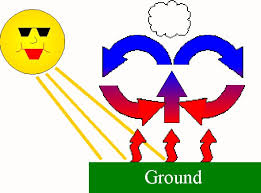
unequal heating of the Earth by the sun