
 Worksheets
Sem#2 Final Review
Total questions: 45
Worksheet time: 29mins

Explain why the liquid atoms have shorter arrows attached to them compared to the gas atoms in diagram posted below.
The liquid atoms have shorter arrows because they move faster than gas atoms
The liquid atoms have shorter arrows because their movement is limited sliding past each other
The liquid atoms have shorter arrows because they have less energy than gas atoms
Both B & C

What's the atomic composition of alcohol?
1 Carbon Atom, 1 Hydrogen Atom, & 1 Oxygen Atom
2 Carbon Atoms, 6 Hydrogen Atoms & 1 Oxygen Atom
2 Carbon Atoms 4 Hydrogen Atoms, & 1 Oxygen Atom
All of these

The______is defined as the number & type of atoms a molecule is made of?
Atomic Weight
Atomic Mass
Atomic Composition
All of these
The most basic building block of matter (smallest part of an element) is called a(n) __________.
Product
Reactant
Atom
Molecule

The elements on the periodic table of elements are organized by there _______________
Number of electrons
Number of orbital shells
Properties
All of these
All matter is made of what?
energy
atoms
electrons
compounds
What happens to the molecules inside your Coke can when the temperature drops from 40 Celsius to 2 Celsius?
The molecules speed up
The molecules move slow & group together
The molecules move further apart in
The molecules disappear entirely inside the can

What happens to the odor molecules inside your refrigerator when it breaks down & experiences an increase in temperature?
The atoms/particles totally disappear & nothing happens
The atoms/particles are slowed down & begin to gather
The atoms/particles move faster & spread further out.
All of these could occur when the temperature increases.
A popsicle has just been placed on the table outside in the sun. Explain what occurs to the popsicle overtime.
The popsicle turns to gas & disappears
The popsicle turns to a liquid & eventually a gas
The popsicle stays the same
None of these

T/F___An odor is stronger smelling when particles are in a solid form compared to particles in a gaseous state.
True
False
2 H2O gives us life! How many total atoms are represented here?
2
4
6

T/F___ Gold & silver are elements made of the same atoms.
True
False
T/F___Properties of matter allow scientists to identify unknown substances found.
True
False
T/F___Color, hardness, mass, volume, & malleabilty are all properties of matter that are observable & help us identify unknown substances (elements) found on Earth.
True
False

Evidence: Zoos cannot perfectly copy the animal's natural habitat. Zoos don't allow animals to think and problem solve like they would in their natural habitat. Which claim best matches the evidence?
Zoos are harmful to the well-being of the animals.
Zoos only exist as entertainment for humans.
Zoos are good for animals because many of the animals were endangered in their original habitats.

Nickel & Aluminium have similar properties of matter but are made of ___________.
The same atoms or molecules
Nothing because they are metals
The different atoms or molecules
All of these


Which of these items on a food label IS NOT food?
fat
calories
carbohydrates
protein

6) Your mom is making macaronic & cheese. She begins by boiling water in a pot on the stove. Once the pot begins to boil a lid is placed over it. Water droplets form inside the lid. Why do the water droplets appear on the pot?
The steam cooled & water molecules moved close together because of the difference in temperature between the pot & lid
Steam combined with hot air from the kitchen wetting the inside of the lid
The elements found inside the pot caused a chemical reaction producing water under the lid
Water from outside the pot spilled into it

Moving from a solid to liquid to gas requires.
Removing thermal energy
Thermal energy disappears entirely
Adding thermal energy
No change in thermal energy occurs
What is evaporation?
Solid to gas
Liquid to solid
Liquid to gas
Gas to solid

What happens to the molecules inside your Coke can when the temperature drops from 40 Celsius to 2 Celsius?
The molecules speed up
The molecules move slow & group together
The molecules move further apart in
The molecules disappear entirely inside the can
_______occurs because molecules on the surface of the liquid collide with fast moving molecules in the air (absorbing) enough energy for a change of state.
Sublimation
Condensation
Evaporation
Melting

A popsicle has just been placed on the table outside in the sun. Explain what occurs to the popsicle overtime.
The popsicle turns to gas & disappears
The popsicle turns to a liquid & eventually a gas
The popsicle stays the same
None of these

Explain what happened to the balloon with the dry ice inside of it when it was heated.
The atoms moved closer together
The atoms bounced into each other very slowly
The atoms disappeared entirely inside the balloon
The atoms in the dry ice moved faster & the balloon expanded

Explain what happened to the gas molecules inside the school bus tire during the snow storm.
The gas molecules move faster & the tire expands
The gas molecules move faster but nothing changes
The gas molecules move slower & the tire deflates
The gas molecules move slower & the tire expands

You have just entered a room with an overwhelming smell. Based on the strength of the smell, what can you assume about the amount the odor molecules in the air.
There are no odor molecules in the air
There are some odor molecules in the air
There is a tremendous amount of odor molecules in the air
Odor molecules have no affect on what you smell with your nose

When matter changes from a gas, to a liquid, to a solid, energy is_________.
Absorbed
Not needed for the change
Released
None of these


The scientist claims that when a pin goes through a balloon it pops. The best evidence to support this claim is...
The balloon is red.
The balloon popped in each of the three trials.
The balloon is 1/2 way inflated at the start of the experiment
It is easy to push the pin through the balloon

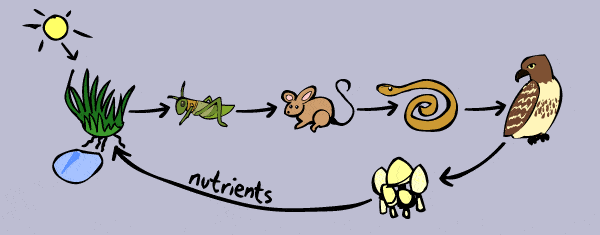
What substances are found in foods?
carbohydrates, calories, fat
fat, protein, calories
starch, sugar, fat
carbohydrates, fat, protein
What evidence supports the claim that plants make their own food for energy and building materials?
Milk turned light purple with Biuret solution.
Rice water turned orange with Benedict solution.
Potato and lima beans turned black with iodine indicator.


Which of the following is a long-term effect on the removal of the redfish from the ecosystem represented by the food web above?
The osprey population will increase.
The amphipod population will increase.
The clam worm population will increase.
The phytoplankton population will increase.


What could make a population change?
other organisms
environment
reproduction
food
all of the choices

Which statement describes the trend on the graph?
The parrot population is increasing.
The human population is increasing.
The parrot population does not change.
The human population is decreasing.
This happens when 2 organisms need the same resource.
predator/prey relationship
stable ecosystem
fluctuation
competition

