
 Worksheets
TN Ready Review Quiz 10
Total questions: 34
Worksheet time: 17mins
Which statement best describes why the Mormons left Illinois?
They wanted to live where they could safely practice their religion.
They were looking for a milder climate and better farmland.
They had split away from their leader Brigham Young.
They sought to convert Native Americans to Christianity.

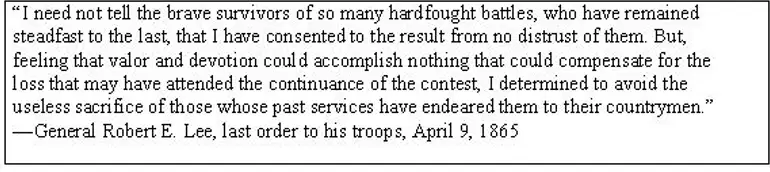
5According to the quotation, why is Lee surrendering? (8.63)
Lee was tired of fighting and the Confederate armies had suffered very heavy losses.
Ammunition and other supplies for the Confederate troops had run out and could not be replaced.
Further fighting could not accomplish anything useful and losses would be heavy.
The Confederate armies were weary and would not continue to fight any more.
The following passage is from the Gettysburg Address:
"It is for us the living, rather, to be dedicated here to the unfinished work which they who fought here have thus far so nobly advanced. It is rather for us to be here dedicated to the great task remaining before us—that from these honored dead we take increased devotion to that cause for which they gave the last full measure of devotion—that we here highly resolve that these dead shall not have died in vain—that this nation, under God, shall have a new birth of freedom—and that government of the people, by the people, for the people, shall not perish from the earth." —Abraham Lincoln, November 19, 1863
What was the purpose of this section of Lincoln's Gettysburg Address?
to remind people that the Civil War was not yet over
to thank the people who voted to elect him president
to make people regret the Battle of Gettysburg had happened
to inspire people to see the Confederates as brothers
President Lincoln issued the Emancipation Proclamation which went into effect on January 1, 1863. What was the significance of this proclamation?
It only set slaves free who were in the Northern states.
It said all slaves in the Confederate states must be freed.
It said slaves must work for their masters until death.
It said that all slaves in the United States are legal citizens.
What were two of Sam Houston's accomplishments during the Texas War for Independence?
He kept the army together and defeated the Mexican forces at the Battle of San Jacinto.
He served in the Texas legislature and helped to create a constitution for the new republic.
He met with Mexican leaders as president of the new republic and avoided open conflicts.
He helped to negotiate with Great Britain for weapons and created a Texas merchant fleet.

In this passage, O’Sullivan describes “manifest destiny” as the right of
Texas to become part of the United States.
New Mexico and California to become independent republics.
the United States to expand its territory across North America.
other nations to oppose the actions of the United States.
Which of the following was a goal of the Mexican War? (check all that apply, 3)
Take Mexico City
Force Mexico out of Texas
Control California and New Mexico
Control Oregon
Why did many Americans travel the Oregon Trail? (2)
Economic problems in the east
Fertile land in Oregon
They were protesting Indian Removal
They were trying to become wealthy from the discovery of gold at Sutter's mill
Which of these was the result of enforcement of the Fugitive Slave Act?
compromise on the slavery question
anger in the North
resolution of the slavery question
recognition of states' rights
What was the main topic of the Lincoln-Douglas debates?
war with Mexico
slavery
admission of Illinois to the Union
economic issues

Which "property of this kind" is being referred to in Tancy's decision?
United States territories
the Missouri Compromise
Dred Scott and his family
an Act of Congress
What was the significance of the Gadsden Purchase of 1853?
It established a neutral territory between the United States and Mexico.
It allowed several western territories to achieve statehood as slave states.
It provided the land necessary for a southern transcontinental railroad.
It established a permanent border between Arizona and New Mexico.
How did the Mexican War contribute to feelings of sectionalism in America?
There was disagreement over whether land gained as a result of the war would be agricultural or industrial.
The North felt they contributed more to the war effort than the South.
The South felt their slaves should not be used to help fight wars.
There was disagreement over whether land gained as a result of the war would be free or slave.
Manifest Destiny is the belief that the United States...
should stretch from the Pacific to the Atlantic Ocean.
should conquer Canadian lands occupied by the French.
should force Native Americans to become legal citizens.
should use naval power to try to conquer England and Europe.
In 1854, Senator Stephen Douglas of Illinois introduced the Kansas-Nebraska Act which would allow the territories of Kansas and Nebraska to decide on the issue of slavery by popular sovereignty. Douglas proposed this bill as a compromise so that he would get support from Southerners on which issue?
the repeal of the Fugitive Slave Act that required northerners to return escaped slaves to their owners
the implementation of the Homestead Act which would allow setters to have free land in the West
the removal of Native Americans onto reservations in order to make more room for white settlers
the construction of a transcontinental railroad that would start in Chicago, Illinois
Which of the following best explains how popular sovereignty was related to slavery?
Settlers of some new territories were able to decide about slavery for themselves.
There was an attempt to abolish slavery in the U.S. by its centennial in 1876.
Each state's legislature was given the authority to decide the status of slavery within the state.
There was a federal law that stated there would be an equal number of slave and free states in the Union.
"I've agreed to sell Tom." "What! our Tom?—that good, faithful creature!—been your faithful servant from a boy! O, Mr. Shelby!—and you have promised him his freedom, too,—you and I have spoken to him a hundred times of it. Well, I can believe anything now,—I can believe now that you could sell little Harry, poor Eliza's only child!" said Mrs. Shelby, in a tone between grief and indignation. "Well, since you must know all, it is so. I have agreed to sell Tom and Harry both; and I don't know why I am to be rated, as if I were a monster, for doing what every one does every day." "By why, of all other, choose these?" said Mrs. Shelby. "Why sell them, of all on the place, if you must sell at all?" "Because they will bring the highest sum of any,—that's why. I could choose another, if you say so. The fellow made me a high bid on Eliza, if that would suit you any better," said Mr. Shelby. "The wretch!" said Mrs. Shelby, vehemently.—Harriet Beecher Stowe, Uncle Tom's Cabin, Chapter V
The author's perspective in this excerpt helped the abolitionist movement by illustrating...
the hatred of slaves toward harsh masters.
the cruelty of treating human beings as property.
the day to day life of plantation owners
the faithfulness of masters toward their slaves.
What occurred after the raid on Harper's Ferry?
Brown and six followers were pardoned and allowed to go free.
Slavery was immediately abolished, and all slaves were freed.
The armory was shut down and destroyed by another group of abolitionists.
Southern slaveholders became more fearful of a slave rebellion.
Slave Dred Scott sued for his freedom on the basis that his owner had taken him to live in a free state and then a free territory. His case was argued in front of the Supreme Court in 1857. What was the Supreme Court's ruling in the Dred Scott v. Sandford case?
The court ruled that Dred Scott should be freed because he had been taken to areas in which slavery was illegal
The court ruled that Dred Scott should be freed because slavery was unconstitutional.
The court ruled that Dred Scott was the property of his owner and that the owner's rights were protected by the Constitution, therefore Dred Scott would not be freed.
The court ruled that Dred Scott should not be freed because he had not proven that he had been taken to a free state.
In the 1850s, why was the territory of Kansas known as "Bleeding Kansas?"
Many slaves rebelled violently against their owners.
Many settlers fought against each other in disputes over land.
White settlers attacked Native Americans who were living there.
Pro-slavery and anti-slavery forces battled for control of the state.

Presidential Election of 1860
Image courtesy of U.S. National Atlas
Based on the map, what can be concluded about the presidential election of 1860?
The vote was divided but helped solve sectional differences.
The vote was divided and based largely on sectional differences.
Voters in the East voted to support increased protective tariffs.
Voters in the West voted to support slavery in the territories.
Why was Sam Watkins' service as a soldier during the Civil War important to American history?
He wrote a detailed memoir about his experience.
He died in action while saving his fellow soldiers.
He received a medal of honor for his heroism.
He served as a spy for the Confederacy.

Before the Civil War, the economies were very different. After looking at the information in the chart above, which of the following statements is probably true about the South?
Blacks were paid for their work.
Slaves built the southern railroads.
Slavery was important to the South.
There were no slaves in the South.
Which of the following is one reason that the election of 1860 resulted in a win for Abraham Lincoln?
The Constitutional Union Party carried the West Coast states.
Stephen Douglas gave his electoral votes to Abraham Lincoln.
The Democratic Party ran two candidates in the election.
Abraham Lincoln won the electoral vote even though he lost the popular vote.
What is significant about the Battle of Antietam?
It was the last battle to be fought in the North.
It was the bloodiest day of battle in U.S. history.
It was the only sea battle of the Civil War.
It was the first major battle on southern soil.
The 15th Amendment to the U.S. Constitution, ratified in 1870, deals with what issue?
free speech
prohibition of alcohol
voting
declaring war
Following the Civil War, Southern states passed laws severely restricting the rights of African-Americans. These laws varied from state to state and included the prohibiting of interracial marriages and restrictions on land ownership. These laws served as a way for white Southerners to control the recently freed African-Americans. These laws were known as
Civil Rights Acts.
Reconstruction laws.
Black Codes.
the Fourteenth Amendment.
• The Thirteenth Amendment
• The Fourteenth Amendment
• The Fifteenth Amendment
The three items listed above are called the Reconstruction Amendments. What was the main purpose of these three amendments?
to rebuild cities that the war had destroyed
to punish the southern states for seceding
to free and grant basic rights to slaves
to admit three more states into the Union

In which way were Johnson’s plan and Congress’s plan different?
Johnson wanted to be tougher on the Confederate leadership.
Johnson wanted freed slaves to have civil rights in the South.
Congress wanted freed slaves to migrate to states in the North.
Congress wanted to charge Confederate officials with treason.

Which plans for Reconstruction had the goal of uniting the South with the Union, instead of punishing the South for its actions?
Johnson's plan and Congress's plan
all three Reconstruction plans
Lincoln's plan and Johnson's plan
Congress's plan and Lincoln's plan
What was the result of the 13th Amendment to the U.S. Constitution, which was ratified in 1865?
Slavery was officially abolished in all areas of the United States.
All citizens were granted the right of free speech.
Women were given the right to vote.
The production and consumption of alcoholic beverages was prohibited.
During Reconstruction of the South, the Fourteenth Amendment was passed by Congress. What did the Fourteenth Amendment do?
gave women the right to vote
gave citizenship to African Americans
gave voting rights to men of any race
gave slaves their freedom
Which of the following amendments prohibited denial of the right to vote because of race, but not gender?
Twelfth Amendment
Fifteenth Amendment
Thirteenth Amendment
Fourteenth Amendment

