
NEW
Font size
 Worksheets
World War I
Total questions: 40
Worksheet time: 20mins
Nationalism is best defined as...
Belief in private property
Desire for territories overseas
Strong devotion to one's country
Support for a strong army
Which countries made up the Triple Entente in 1907 and became known as the "Allies" during the war?
Austria-Hungary, Sweden, and Russia
The United States, Germany, and Russia
Great Britain, France, and Russia
Belgium, Germany, and France
Why were the Balkans known as the "powder keg" of Europe in the early 1900s?
Several large explosions had take place in its factories.
It had endured more than 400 years of ethnic and political unrest.
It produced both weapons and gunpowder.
It had an unusual geographic shape that others wished to change.
The assassination of which leader led to the outbreak of WWI?
Otto von Bismark
Georges Clemenceau
Archduke Franz Ferdinand
Kaiser Wilhelm II
What did Russia, a largely Slavic Nation, do after Austria-Hungary declared war on the Slavic nation of Serbia?
Declare war on Austria-Hungary
Pledge to remain neutral
Prepare to send troops to support Serbia
Try to negotiate a settlement
"Serbia must learn to fear us again." This quote was spoken to the U.S. president in 1914 after the archduke was assassinated by a Serbian student. The quotation was spoken by a diplomat from:
France
Italy
Great Britain
Austria-Hungary
The members of the Triple Alliance (that became known as the "Central Powers") were:
Germany, Italy, and France
Germany, Italy, and Austria-Hungary
Italy, Austria-Hungary, and France
Britain, Germany, and Russia
What was the result of militarism?
Disarmament
Neutrality
An arms race
Economic rivalry
Who was the Kaiser of Germany during the last decade of the 1800s and most of World War I?
Otto von Bismarck
Adolf Hitler
Wilhelm II
Georges Clemenceau
Why did Germany have da geographic disadvantage at the start of World War I?
It was a landlocked nation.
It was bordered by enemies on two fronts.
Its inland mountain ranges were nearly impassable.
Its major rivers blocked the movement of troops.
Germany's Schlieffen Plan for military attack was to...
First attack Russia with lightning speed before facing France in the west.
Engage both France in the west and Russia in the east at the same time.
Try to get the United States to align itself with Germany.
Attack France in the west before Russia in the East had a chance to mobilize.
After the Battle of Marne in 1914, German forces realized that victory...
would be theirs, as long as they stuck to the plan.
on the Western Front would not be quick.
against the west could only be won through trench warfare.
in the east could only be achieved before the harsh Russian winter began.
Trench warfare in World War I was characterized by...
a series of Russian victories.
swift invasions and decisive attacks.
heavy casualties and little territorial gain.
tremendous German victories in the East.
The unprotected area between the trenches was referred to as...
No-man's land
Death Zone
Over the Top
Armistice
During World War I, Russia's main strength was its...
control of the seas.
industrial production.
large number of soldiers.
military technology.
Which of the following was a goal of the Allies' Gallipoli campaign?
to gain access to Africa.
to capture Sarajevo.
to destroy Germany's U-boat fleet.
to establish a supply line to Russia.
What did the policy of unrestricted submarine warfare refer to?
Britain's policy to sink any ship in German waters without warning.
Germany's policy to sink any ship in British waters without warning.
The U.S. Navy's warning of the type of warfare the Central Powers could expect.
Germany's decision to focus its resources on the waters surrounding Europe.
The Zimmerman note, which helped to push the United States to enter the war, exposed the German plan to...
make a truce with Russia.
help Mexico regain territories lost to the U.S.
sink passenger ships without warning.
plant German spies in the United States.
By the time the the United States entered World War I, fighting was focused on...
the Eastern Front
the Western Front
former Russian territory
the seas around Great Britain
After entering World War I, the United States most helped the Allies by...
fighting Germany in the sea around Britain.
negotiating with the Central Powers.
sending the Allies supplies, troops, and monetary loans.
trying to convince the Russians to return to fighting.
What action on November 11, 1918, brought World War I to an end?
An armistice was signed.
A promise was given.
A propaganda campaign was waged.
The allies won a major battle.
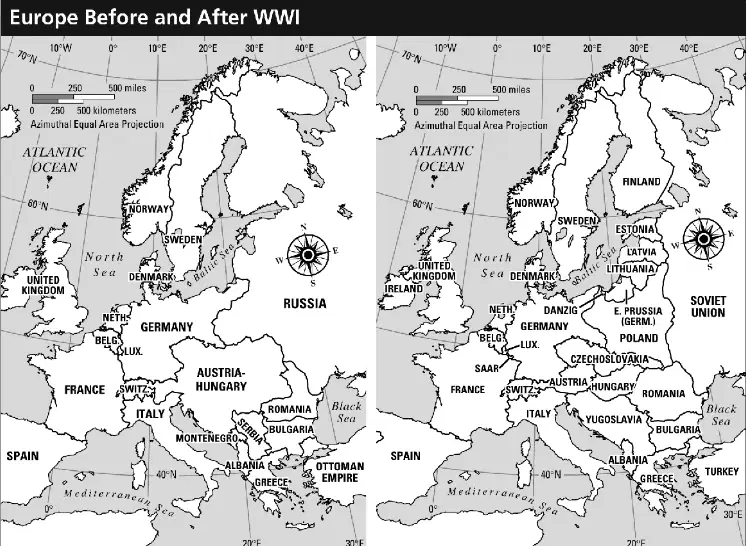
Which of the following countries completely changed its name after World War I?
Germany
Romania
United Kingdom
Ottoman Empire
How did the United Kingdom change after World War I?
Ireland gained self-rule.
Ireland was annexed by the United Kingdom.
The United Kingdom established Poland and Finland.
The United Kingdom was isolated from the rest of Europe.
From which country did Czechoslovakia, Poland, and Yugoslavia gain independence?
Germany
Austria-Hungary
Bulgaria
Ottoman Empire
Around which body of water did the greatest number of new countries emerge after World War I?
North Sea
Mediterranean Sea
Black Sea
Baltic Sea
After the war, which country had a province separated from it by states that had gained independence?
Poland
Germany
Russia
Italy
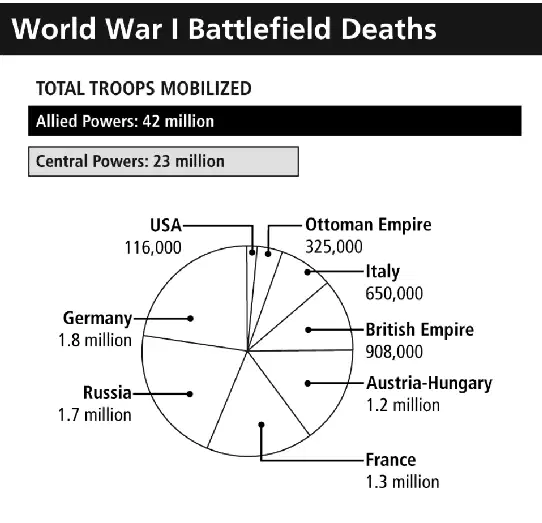
How many more troops did the Allied Powers have than the Central Powers?
19 million
23 million
42 million
65 million
Which nation lost the most troops?
Russia
France
Italy
Germany
Which countries each lost more than a million troops from battlefield deaths?
USA, British Empire, France, Russia
Austria-Hungary, France, Russia, Germany
Ottoman Empire, Italy, France, Germany
All of the above
Which country lost the smallest number of troops from battlefield deaths?
Ottoman Empire
British Empire
USA
France
This country likely would have had the most troop deaths if they did not surrender early in the Treaty of Brest-Litovsk:
Germany
Austria-Hungary
France
Russia
Governments during the war used propaganda to...
Supply the troops with cigarettes.
Finance the peace treaty negotiations.
Control public opinion and raise money.
Keep the public informed about important war facts.
New weapons used during World War I include...
Poison gas, tanks
Airplanes, submarines, and flamethrowers.
Machine guns.
All of the above.
The Big Four who negotiated the Treaty of Versailles represented Italy, ______, Great Britain, the United States, and what other nation?
Germany
France
Russia
Spain
Which of the following did the Treaty of Versailles require of Germany?
Payment of damages to its overseas colonies.
A public apology to the Allies.
Acceptance of the sole responsibility for the war.
Division into two states: West Germany and East Germany.
How did the Treaty of Versailles affect post-war Germany?
It left a legacy of bitterness and hatred in the hearts of the German people.
It stabilized the German economy and gave monetary aid to the nation.
It left Germany in much the same state as it was before the war.
It gave the Germans the drive to rebuild their nation on a stronger foundation.
US President Woodrow Wilson’s Fourteen Points were...
the basis for determining German reparations.
a charter for the League of Nations.
an outcome of the Treaty of Versailles.
a plan for postwar peace.
Stories of German atrocities in Belgium were used as propaganda, meaning that the stories were used to...
encourage Belgium to support the war.
make the Germans look worse than they were.
convince neutral nations to fight for the German army.
show that the Germans treated civilians humanely.
The Armenians in Turkey were a minority group partly because they were...
Atheist
Christian
Jewish
Muslim
At the time of the Armenian Genocide, the Ottoman Empire was ruled by...
The Armenians
The Germans
The Turks
a European coalition (group).

