
NEW
Font size
 Worksheets
POP Quiz 04.06.26
Total questions: 12
Worksheet time: 5mins

What would the author, John Maynard Keynes - "the father of Macroeconomics", most likely agree will be a result of the economic provisions imposed on Germany?
These actions would doom the next generation, who will likely turn to extremism.
The next generation of German would be more humble and less likely to act aggressively.
Germany would improve their economic systems for the better.
Germany would forever be dependent on the United States for support.

What economic punishments were imposed on Germany by Article 231 known as the 'War Guilt Clause' of the Treaty of Versailles?
Germany would receive large amounts of financial aid from the Allied forces.
Germany must pay full reparations to the Allied forces to pay for the damages caused by war.
Germany was required to return all stolen wealth taken from the opposing sides.
Germany could no longer print their own currency and had to accept foriegn bills of excange.

In addition to financial sanctions, what other steps were taken by European nations against Germany?
Germany borders were reduced to create new countries and they would be stripped of their imperial territories.
More land would be added to Germany to increase its size and production capabilities.
Key German cities would be split between the victorious allies to be governed under their own respective forms of government.
Germany would have to share space with the victorious allies to improve relations.
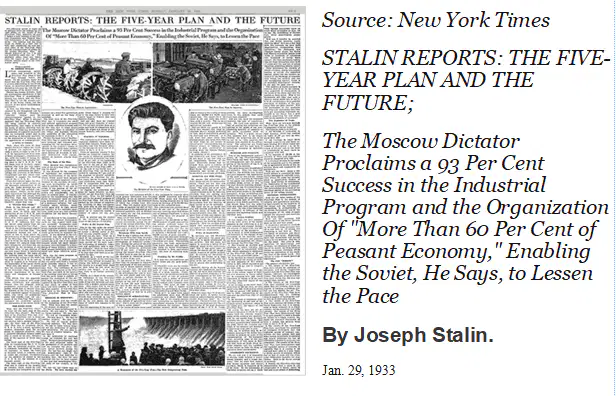
Which of the following directly enabled the establishment of the government that produced this newspaper article?
The collapse of the Russian Empire under the stress of the First World War
Redrawn national boundaries as a result of peace treaties ending the First World War
The abolition of serfdom and other forms of coerced labor in Russia during the nineteenth century
Increased ethnic violence in Russia due to imperial expansion in the nineteenth century
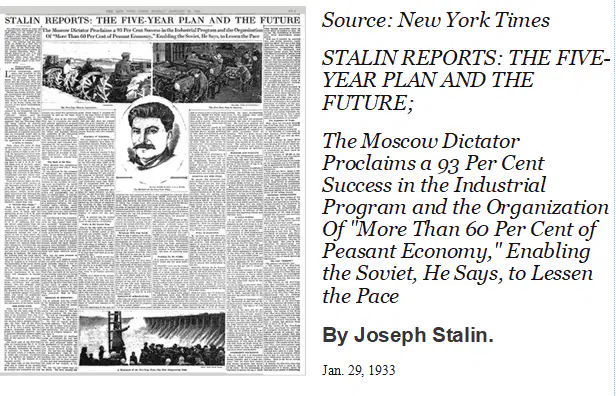
The ideology reflected in the newspaper was most directly the result of which of the following developments in the nineteenth century?
Growing discontent with traditional forms of government following disasterous global conflicts and rising economic depression.
Enlightenment philosophers and writers who increasingly turned denounced the role of religion in political life.
Demands for expanded rights which challenged existing royal political hierarchies.
Rebellions against serfdom and demands for better pay, quality of life, and safety standards.
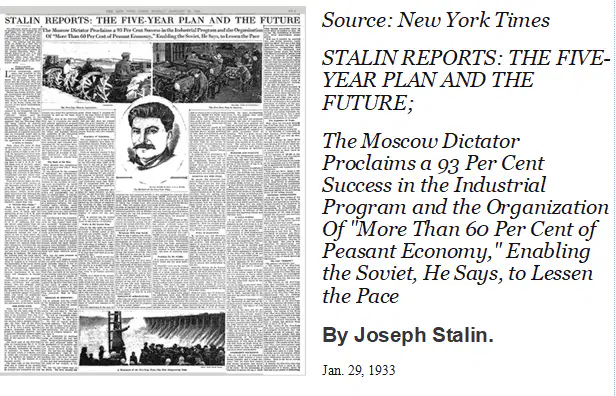
Which answer best summarizes Stalin's "5-Year Plan" to address their economic and developmental issues?
Create a 'New Deal' for workers by supporting Public Works funded by the government.
Rapid industrialization and the collectivization of farms, means smaller farms would be joined together to speed up Russia's development.
Force the people to work on planatations and farms to produce large amounts of cash crops for sale to the international markets.
Explore the science and arts in both public and private schools to promote humanist understanding and improve educational standards.

Which answer best describes Ottoman 'Devshirme'?
Ottoman practice of forcibly recruiting soldiers and bureacrats from among the children of their Balkan Christian subjects.
Attempts by the Ottomans to blend different religions to create peace amongst their religious majority and minority.
Steps taken by ruling imperial states to redefine Ottoman Nationality, by including all religious ethnicities not previously included.
The application of science to technology following the expansion mass-producing factories.

Which event in Ottoman history might experts identify as a high point of Ottoman military success?
The Battle of Paniput where only a few dozen cannons defeated the much larger forces of the Sultan of Delhi.
The Sacking of Constantinople in 1453, whose walls were thought to be impregnable.
The destruction of the House of Wisdom in Baghdad following resistance from local leaders.
The succession of victories by Seljuk Turks against Christian crusaders over control of the holylands.
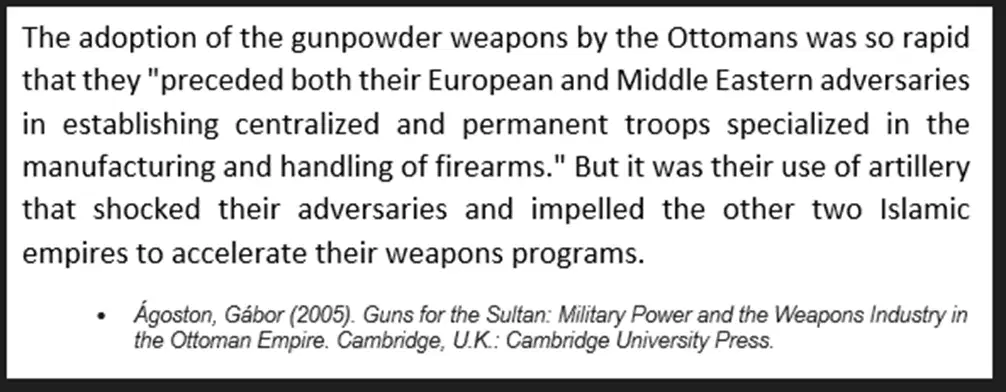
While some 15th century empires used intimidation and offensive superiority to maintain their power, how else did other Islamic Empires legitimize their rule?
Through adopting and incorporating other faiths into their society and culture.
By capturing prominent tribal leaders and forcing official proclaimation.
Through the selling of parchment indicating personal salvation with each purchase.
By developing new forms of proselytizing including rhythmic dances to convert someone from one religion to another.
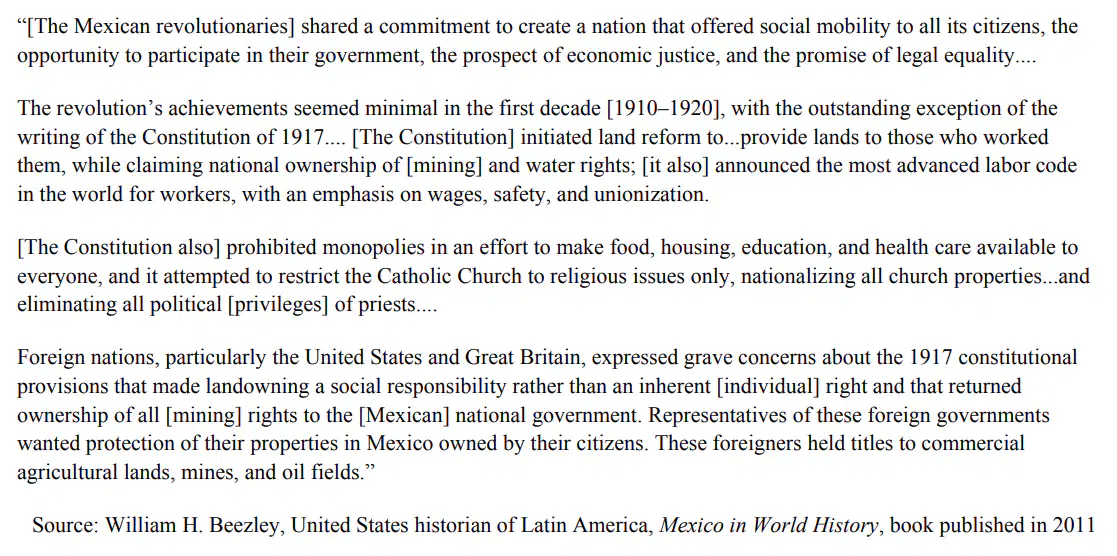
The Mexican Revolution (1910–1920) arose partly from Mexico's severe economic problems, including land inequality, foreign ownership of Mexican resources, and exploitation of workers. Which of the following best describes how Mexican revolutionary leaders attempted to address these economic issues?
They invited foreign investors to increase foreign control of Mexican industries and resources.
They utilized Mesoamerican systems to force all able individuals to work as part of a 'community service'.
They eliminated all forms of commerce and trade to create a completely isolated economy.
They implemented land reforms to redistribute land to peasants and sought to break the power of wealthy landowners and foreign corporations that had dominated the Mexican economy.
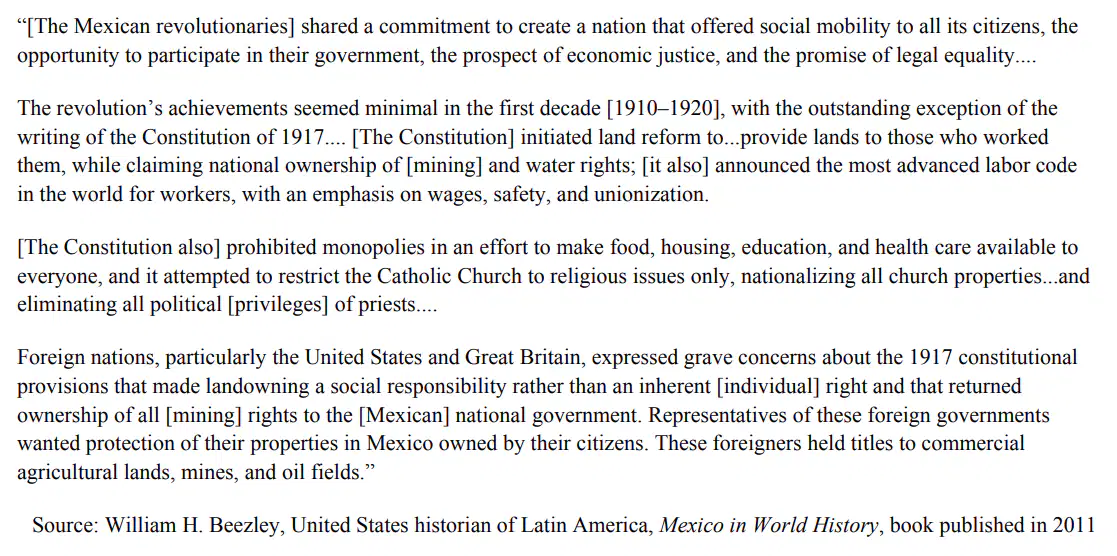
The Mexican Constitution of 1917 included radical provisions such as Article 27, which allowed the government to expropriate land and redistribute it to peasants, and restrictions on foreign ownership of Mexican resources. These constitutional reforms reflected the revolutionaries' attempt to:
Strengthen foreign control over Mexican economy and politics by imposing strict laws supported by military strength.
Restore Mexico to colonial-era economic systems under New Spain's Casta System.
Address Mexican economic dependency on foreign powers by reclaiming national control over land and resources.
Eliminate all forms of private property and individual wealth.
How Many Days until our World History AP Exam?
30 days
31 days
35 days
40?

