
NEW
Font size
 Worksheets
Nervous System
Total questions: 10
Worksheet time: 5mins
1. What are the three types of neurone?
Sensory, reflex, and motor neurones
Sensory, relay, and motor neurones
Sensory, relay, and effector neurones
Sensory, connector, and afferent neurones
What makes up the central nervous system (CNS)?
The spinal cord and all the neurones in the body
The brain and all the neurones in the body
The brain and spinal cord
The brain and cranial neurones
Which of the following represents the order during a neurone response?
Receptor – stimulus – coordinator – effector – response
Response – receptor – coordinator – effector – stimulus
Stimulus – receptor – coordinator – effector – response
Coordinator – stimulus - receptor – effector - response
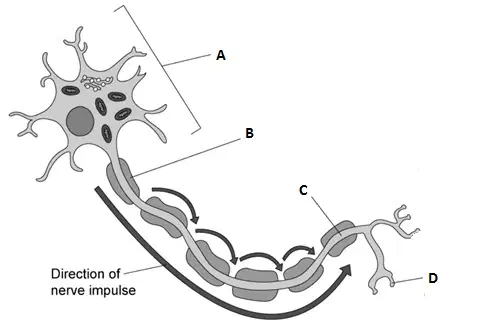
Which structure is functioned to speed up the conduction of nerve impulses?
A
B
C
D
Which of the following tables correctly summarizes the main types of neurones and their functions?


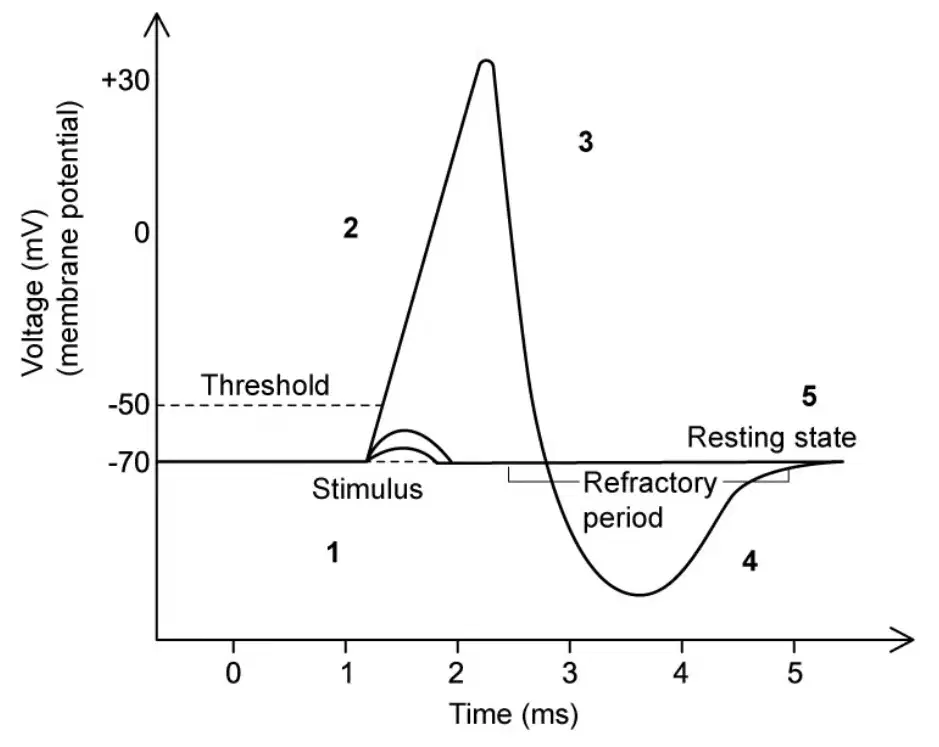
Which of the following option describe the event that bring about the changes in membrane potential shown in point 2?
Voltage-gated sodium ion channels open allowing more sodium ions to enter the axon.
Voltage-gated potassium ion channels open allowing more potassium ions to exit the axon
Both of the voltage-gated sodium ion channels and voltage-gated potassium ion channels closed preventing the next action potential to be generated.
Both of the voltage-gated sodium ion channels and voltage-gated potassium ion channels closed allowing sodium ions to enter the axon from sodium leak channels.
Depolarization occurs because...
Potassium ions continue to diffuse out of the cell after the inactivation gates of the voltage-gated sodium ion channels begin to close.
The extra of potassium ions causes the membrane potential to become slightly more positive than the resting value.
The increased potassium ion permeability lasts slightly longer than the time required to bring the membrane potential back to its resting level.
More sodium ions diffuse into the cell than potassium ions diffuse out of it.
Repolarization occurs because...
Potassium ions continue to diffuse out of the cell after the inactivation gates of the voltage-gated sodium ion channels begin to close.
The extra efflux of potassium ions causes the membrane potential to become slightly more positive than the resting value.
The increased potassium ion permeability lasts slightly longer than the time required to bring the membrane potential back to its resting level.
More sodium ions diffuse into the cell than potassium ions diffuse out of it.
Hyperpolarization occurs because...
Potassium ions continue to diffuse out of the cell after the inactivation gates of the voltage-gated sodium ion channels begin to close.
The extra efflux of potassium ions causes the membrane potential to become slightly more positive than the resting value.
The increased potassium ion permeability lasts slightly longer than the time required to bring the membrane potential back to its resting level.
More ions diffuse into the cell than potassium ions diffuse out of it.
After the passage of the action potential, the sodium-potassium pump reestablishes the resting membrane potential.
True
False

