
 Worksheets
Circuit Isolation
Total questions: 25
Worksheet time: 13mins
How should you store electrical test instruments?
They are very robust, so no specific storage requirements are needed.
Store then with dangerous substances.
Store test instruments carefully so they don't get knocked around or damaged.
Chuck them in your bag as they are very robust and will be alright.
Which of the following best describes Prove-Test-Prove?
Process of proving your meter on a known isolated supply, testing the circuit for isolation and then re-proving your meter on a known live supply
Process of proving your meter on a known live supply, testing the circuit for isolation and then re-proving your meter on an isolated live supply
Process of proving your meter on a known live supply, testing the circuit for isolation and then re-proving your meter on the known live supply
Process of proving your meter on a known isolated supply, testing the circuit for isolation and then re-proving your meter on an isolated live supply
Which three values can be measured by a multimeter?
Resistance, Lux, Voltage
Current, Past, Future
Voltage, Current, Resistance
Voltage, Potential Difference, EMF
Which of the following best describes DC?
Current flow that is continuous
The energy used in a circuit
The pressure driving electricity around a circuit
Current flow that alternates
Which of the following best describes analogue and digital meter displays?
Both use a pointer that physically moves to display the value being measured
A digital display uses a pointer that moves, and an analogue uses a screen (often LCD) to display the value being measured
Both use a screen(often LCD) to display the value being measured
An Analogue meter uses a pointer that moves, & a digital meter uses a screen (LCD) to display the value being measured
What is the purpose of the mirror on an analogue meter?
To help you position your eye in the right place to get an accurate reading
To help you see the back of the needle to get a more accurate reading
To help you see the movement of the needle and get a more accurate reading
To help you see that there are no obstructions behind the needle that could affect the reading
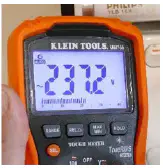
What is shown in the picture?
Multi-meter displaying DC voltage
Multi-meter displaying low resistance
A non-contact voltage detector
A multi-meter displaying AC voltage
When using a multimeter to test voltage - In which order should the tasks be carried out?
A. Carry out functional checks
B. Check the condition of the meter and the leads
C. Choose the voltage type and meter range (if not auto-ranging)
D. Take the reading
E. Install the leads
B – A – D – E – C
B – E – C – A – D
B – E – D – C – A
B – A – E – C - D
Which of the following best describes Resistance?
The flow of electrons in a circuit
The pressure driving electricity around a circuit
The opposition to electron flow
The energy used in a circuit
What does it tell you if the display on a multi-meter (set to Ohms scale) turns from OL to a low ohm reading when the leads are touched together?
One of the leads is faulty
Both leads are faulty
The leads are in working order
The meter is faulty
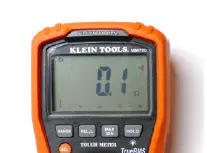
What is shown in the picture?
Multi-meter displaying DC voltage
Multi-meter displaying low resistance
A non-contact voltage detector
A multi-meter displaying AC voltage

What is shown in the picture?
Multi-meter displaying DC voltage
Multi-meter displaying low resistance
A non-contact voltage detector
A multi-meter displaying AC voltage
Which of the following would not be required when isolating live equipment?
Protective Clothing
Protective Footwear
Eye Protection
Earmuffs
Which of the following best describes AC?
Current flow that is continuous
The energy used in a circuit
The pressure driving electricity around a circuit
Current flow that alternates
Which of the following best describes Current?
The opposition to current flow
The flow of electrons in a circuit
The pressure driving electricity around a circuit
The energy used in a circuit
Are non-contact voltage detectors suitable to rely on for testing for isolation?
Yes
No
Which of the following are not part of the procedure for the safe re-livening of circuits?
Confirm that the required circuit tests have been carried out
Communicate with customers and/or other people on site
Ensure all equipment is turned on to test it is working
Check that it is safe to liven
Isolation consists of 6 main steps. Put these 6 steps in the correct order.
A-Secure the isolation,
B-Prove the isolation,
C-Remove the load,
D-Tag the isolation point,
E- Communicate with the customer,
F-Find the isolation point.
E - C - F - A - D – B
E - C - A - F - B – D
A - B - C -F - E – D
D - C - A - B - F – E
What type of meter should you use to test for isolation of a DC circuit?
Ammeter
Voltmeter
Ohmmeter
Wattmeter
Which of the following would not be required when isolating live equipment?
Protective Clothing
Protective Footwear
Eye Protection
Earmuffs
According to AS/NZS 4836, which of these options is not a recommended option?
A lock on an Isolator
Lockout/Permit System
Note saying "do not turn on"
Additional lock arrangements...
You are testing what you presume to be an isolated circuit and the voltmeter says 230V. What does this tell you?
The circuit is isolated
The circuit is not isolated
The circuit has been switched off but not isolated
The circuit has been isolated but not switched off
Which of the following best describes Voltage?
The flow of electrons in a circuit
The pressure driving electricity around a circuit
The opposition to current flow
The energy used in a circuit
Which of the following best describes "Test before Touch"?
Test your meter before touching
Test your knowledge of AS/NZS 3000 before touching circuits
Test your padlock before touching Isolators
Test all conductors before touching them
Which of Standards reference relates to the danger of charged capacitors?
AS/NZS 4836 3.2.5
AS/NZS 4836 3.9.2
AS/NZS 4836 3.2.1 (a) and 3.2.2
AS/NZS 4836 3.2.3 – 3.2.4

