
 Worksheets
MacroEcon MCQ
Total questions: 110
Worksheet time: 56mins
The stage of the business cycle that immediately follows the peak is
recession
expansion
trough
none of these are correct
Keynesian economics is premised on the concept that
taxes should be reduced during expansionary periods.
government spending should be curtailed to reduce budgetary deficits.
government should maintain a laissez-faire policy with regards to the economy.
government intervention in the economy can help moderate extreme peaks and troughs in the business cycle.
Fiscal policy is controlled by _________; whereas monetary policy is controlled by ___________.
Federal Reserve; Congress
Elected institutions; the Fed
. Congress; Department of Treasury
. Congress; Department of Treasury
When imports are greater than exports the economy is experiencing a
budget deficit
budget surplus
trade deficit
trade surplus
MACROeconomics studies which of the following concepts?
Inflation
b. Unemployment
Aggregate supply and aggregate demand
All of the above and more!
Which of the following best explains why transfer payments are not included in the calculation of gross domestic product?
Transfer payments are used to pay for intermediate goods, and intermediate goods are excluded from gross domestic product
Transfer payments are a government expenditure, and government expenditures are excluded from gross domestic product.
Recipients of transfer payments have not produced or supplied goods and services in exchange for these payments.
Recipients of transfer payments are usually children, and income earned by children is excluded in gross domestic product.
. Recipients of transfer payments are sometimes not citizens of the United States.
Which of the following can be considered a leakage from the circular flow of economic activity?
a. Investment
b. Government expenditures
c. Consumption
d. Exports
e. Saving
Which of the following is an example of fiscal policy?
a. Increasing government expenditures to build highways
b. Increasing the money supply to increase income
c. Decreasing the discount rate to lower unemployment and inflation
d. Decreasing the federal funds rate to stimulate investment
e. Decreasing the reserve ratio to increase bank reserves
Which of the following is included in the computation of gross domestic product?
a. Government transfer payments, such as unemployment benefits
a. Government transfer payments, such as unemployment benefits
b. Purchases of used goods, such as used cars
c. Child care tasks performed by househusbands
d. Total value of business inventories
e. Additions to business inventories
The major difference between real and nominal gross domestic product (GDP) is that real GDP
a. excludes government transfer payments
b. excludes imports
c. is adjusted for price-level changes using a price-index
d. measures only the value of final goods and services that are consumed
e. measures the prices of a market basket of goods purchased by a typical urban consumer
Which of the following is included in the computation of gross domestic product?
a. Government transfer payments, such as unemployment benefits
b. Purchases of used goods, such as used cars
c. Child care tasks performed by househusbands
d. Total value of business inventories
e. Additions to business inventories
In the measurement of gross domestic product, investment includes spending by
a. businesses on capital goods and changes in inventories
b. businesses on stock, bonds, and other financial assets
c. individual households on stocks, bonds, and other financial assets
d. the federal government to purchase bonds issued by the Federal Reserve
e. the Federal Reserve to buy government bonds
The value of of which of the following is counted in the United States gross domestic product?
a. Clean air
b. Child care a father provides for his child
c. An automobile produced in Sweden by a United States firm
d. A car produced in the United States and sold in Europe
e. Medical services not provided due to preventative health care
An increase in which of the following will increase aggregate demand?
a. Taxes
b. Government spending
c. The federal fund rate
d. Reserve requirements
e. The discount rate
Which of the following statements about the simply circular flow model of a market economy is correct?
a. Households are on the demand side of the product market and the supply side of the resource market.
b. Business firms are on the supply side of both the product market and the resource market.
c. Households receive income in the form of wages, and business firms receive income in the form of investment.
d. Exports and investment expenditures are examples of leakage from the circular flow, whereas imports and savings are injections.
e. Circular flow models are used primarily to explain why money is necessary in any economic system.
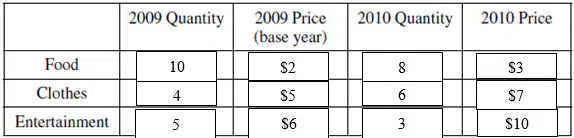
The outputs and prices of goods and services in Country X are shown in the table above. Assuming that 2009 is the base year, calculate the real GDP in 2010.
a. $64
b. $96
c. $70
d. $108
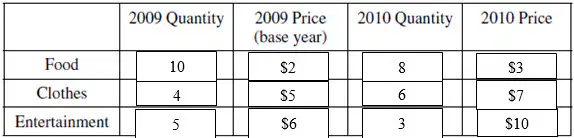
The outputs and prices of goods and services in Country X are shown in the table above. Assuming that 2009 is the base year, calculate the nominal gross domestic product (GDP) in 2010.
a. $64
b. $96
c. $70
d. $108
If in one year the price index is 50 and in the next year the price index is 60 what is the rate of inflation from one year to the next?
a. 5%
b. 10%
c. 20%
d. 15%
Assume that next year’s wage rate will be 4 percent higher than this year’s because of inflationary expectations. The actual inflation rate is 2 percent. At the beginning of next year, will the real wage be higher, lower, or the same as today?
a. lower
b. unable to determine
c. same
d. higher
Assume that Sara gets a fixed-rate loan from a bank when the expected inflation rate is 3 percent. If the actual inflation rate turns out to be 2 percent, who benefits from the unexpected rate of inflation: Sara, the bank, neither, or both?
a. bank
b. both
c. Sara
d. unable to determine
An increase in government spending with no change in taxes leads to a
a. lower income level
b. lower price level
c. smaller money supply
d. higher interest rate
e. higher bond price
Assume that a perfectly competitive financial market for loanable funds is in equilibrium. Which of the following is most likely to occur to the quantity demanded and quantity supplied of loanable funds if the government imposes an effective interest rate ceiling?
Quantity Demanded | Quantity Supplied
a. Increase Increase
b. Increase Decrease
c. No change No change
d. Decrease Increase
e. Decrease Decrease
If investors feel that business conditions will deteriorate in the future, the demand for loans and real interest rate in the loanable funds market will change in which of the following ways in the short run?
Demand for Loans Real Interest Rate
a. Increase Increase
b. Increase Decrease
c. Decrease Increase
d. Decrease Decrease
e. Decrease Not change
Crowding out is best described as which of the following?
a. The decrease in full-employment output caused by an increase in taxes
b. The decrease in consumption or private investment spending caused by an increase in government spending
c. The decrease in government spending caused by a decrease in taxes
d. The increase in the amount of capital outflow caused by the increase in government spending
e. The increase in the amount of capital inflow caused by the increase in government spending
In the country of Agronomia, banks charge 10 percent interest on all loans. If the general price level has been increasing at the rate of 4 percent per year, the real rate of interest in Agronomia is
a. 14%
b. 10%
c. 6%
d. 4%
e. 2.5%
Which of the following is true of the quantity of money demanded?
a. It rises when interest rates rise, because the return from holding money increases.
b. It falls when interest rates rise, because the opportunity cost of holding money increases.
c. It remains constant when interest rates rise, as long as inflation remains constant.
d. It rises when interest rates rise, as long as inflation is declining.
e. It falls when the money supply increases, as long as inflation remains constant.
In an economy with lump-sum taxes and no international sector, assume that the aggregate supply curve is horizontal. If the marginal propensity to consume is equal to 0.8, which of the following will necessarily be true?
a. The average propensity to consume will be less than the marginal propensity to consume.
b. The government expenditure multiplier will be equal to 5.
c. A $10 increase in consumption spending will bring about an $80 increase in disposable income.
d. Wealth will tend to accumulate in the hands of a few people.
e. The economy will be running a deficit, since consumption expenditures exceed personal saving.
An increase in the marginal propensity to consume causes an increase in which of the following?
a. Marginal propensity to save
b. Spending multiplier
c. Savings rate
d. Exports
e. Aggregate supply
Which of the following changes would cause an economy's aggregate demand curve to shift to the right?
a. An increase in spending on imports
b. An increase in autonomous spending
c. An increase in interest rates
d. A decrease in the money supply
e. A decrease in the overall price level in the economy
If the marginal propensity to consume is 0.9, the government increases purchases by $100, and net exports decline by $60, the equilibrium level of real gross domestic product will
a. decrease by up to $400
b. increase by up to $400
c. increase by up to $600
d. decrease by up to $1,600
e. increase by up to $1,600
Assume that a perfectly competitive financial market for loanable funds is in equilibrium. Which of the following is most likely to occur to the quantity demanded and quantity supplied of loanable funds if the government imposes an effective interest rate ceiling?
Quantity Demanded Quantity Supplied
a. Increase Increase
b. Increase Decrease
c. No change No change
d. Decrease Increase
e. Decrease Decrease
An increase in the marginal propensity to consume causes an increase in which of the following?
a. Marginal propensity to save
b. Spending multiplier
c. Savings rate
d. Exports
e. Aggregate supply
Which of the following changes would cause an economy's aggregate demand curve to shift to the right?
a. An increase in spending on imports
b. An increase in autonomous spending
c. An increase in interest rates
d. A decrease in the money supply
e. A decrease in the overall price level in the economy
Which of the following would most likely cause aggregate demand to increase?
a. an increase in taxes by the government
b. a unexpected increase in unemployment forecasting by the government
c. an increase in home values across the economy
d. an increase in capital stock held by companies
An unanticipated decrease in aggregate demand when the economy is in equilibrium will result in
a. a decrease in voluntary unemployment
b. a decrease in the natural rate of unemployment
c. a decrease in aggregate supply
d. an increase in unplanned inventories
e. an increase in the rate of inflation
Assume that a perfectly competitive financial market for loanable funds is in equilibrium. Which of the following is most likely to occur to the quantity demanded and quantity supplied of loanable funds if the government imposes an effective interest rate floor?
Quantity Demanded Quantity Supplied
a. Increase Decrease
b. No change No change
c. Increase Increase
d. Decrease Increase
e. Decrease Decrease
Which of the following can be expected to cause a decrease in gross domestic product in the short run?
a. Equal increases in both taxes and government expenditures
b.
An decrease in the interest rate
c. An increase in the tax rate
d.
Equal increases in both investment and government expenditures
e. Equal increases in both imports and exports
A increase in labor productivity will shift the
a. aggregate demand curve to the right
b. short-run aggregate supply curve to the right
c. aggregate demand curve to the left
d. long-run aggregate supply curve to the right
e. short-run aggregate supply curve to the left
An increase in the prices of inputs will cause which of the following to occur in the short run?
a.
A decrease in the short-run aggregate supply and a increase in the price level
b. An increase in the short-run aggregate supply and a decrease in the price level
c. An increase in the aggregate demand and an increase in the price level
d. An increase in the short-run aggregate supply and an increase in the price level
e. A decrease in the aggregate demand and and increase in the price level
In an economy with a horizontal aggregate supply curve, an increase in government spending will cause output and the price level to change in which of the following ways?
Output Price Level
a. Decrease Increase
b. Increase Increase
c. Increase No change
d. No change Increase
e. No change No change
Crowding out occurs when
a. restrictive monetary policy causes the interest rate to increase
b. monetary policy actions decrease the effectiveness of fiscal policy
c.
government borrowing to finance its spending increases private sector investment
d.
increases in government deficit shifts demand for loanable funds to the right
e. government spending and private sector spending increase by the same percentage rate
The aggregate demand curve is downward sloping because as the price level increases the
a. demand for interest-sensitive expenditures increases
b.
interest rates increase, decreasing investment and consumer spending
c. demand for domestically produced substitute goods increases
d.
purchasing power of wealth increases
e. real value of fixed assets increases
A discretionary monetary policy action to reduce inflation in the short run would be to
a. decrease taxes or increase government spending
b. increase transfer payments to those on fixed incomes
c.
contractionary monetary policy
d. decrease taxes and interest rates
e. increase taxes or decrease government spending
If investors feel that business conditions will improve in the future, the demand for loans and real interest rate in the loanable funds market will change in which of the following ways in the short run?
Demand for Loans Real Interest Rate
a. Increase Increase
b. Increase Decrease
c. Decrease Decrease
d. Decrease Not change
e. Decrease Increase
The long-run growth rate of an economy will be increased by an increase in all of the following EXCEPT
a. capital stock
b. labor supply
c. real interest rate
d. rate of technological change
e. spending on education and training
What is the most likely result of an increase in government deficit spending?
a. lowering of interest rates
b. decrease in aggregate demand
c.
increase in short-run aggregate supply
d. decrease in long run economic growth
Which of the following will increase long-run aggregate supply?
a. expansionary monetary policy
b. contractionary fiscal policy
c. increase in technology
d. increase in commodity prices
A increase in government spending will most likely cause
a. an increase in real GDP
b. a decrease in inflation
c. a decrease in real GDP
d. an increase in unemployment
A significant increase in gas prices can lead to
a. crowding out
b. high unemployment, but lower inflation rates
c. an increase in aggregate demand
d. stagflation
An increase in labor productivity causes lower unemployment AND lower inflation because it causes
a. a decrease in SRAS
b. a decrease in AD
c. an increase in AD
d. an increase in SRAS
Assume that the economy is experiencing a recessionary gap. Absent government intervention, what will cause the economy to return to long-run equilibrium?
a. SRAS shifts left
b. decrease in nominal wages
c. increase in nominal wages
d. decreased unemployment
Crowding out of private investment spending would be the most likely result from an economy experiencing
a. an inflationary gap
b. a recessionary gap
c. increased productivity
d. demand-push inflation
A significant increase in technology will most likely cause which of the following?
a. a decrease in LRAS
b. an increase in cyclical unemployment
c. an increase in AD
d. a decrease in the natural rate of unemployment
Positive cyclical unemployment is most closely connected to
a. an inflationary gap
b. shift right in supply of loanable funds
b. shift right in supply of loanable funds
d. low interest rates
If the actual unemployment is less than the natural rate of unemployment, then the economy must be experiencing
a. a recessionary gap
b. a shift in AD
c. an inflationary gap
d. a shift in SRAS
Which of the following will decrease aggregate demand?
a. an increase in the trade deficit
b.
a decrease in the budget deficit
c. an increase in government spending
d. a decrease in interest rates
Assume an economy is at full employment. An increase in government taxes will most likely cause
a. a recessionary gap in output
b. shift LRAS to the right
c. shift LRAS to the left
d. an inflationary gap in output
If the MPS (Marginal Propensity to Save) is 0.4 and the government wants to increase the GDP by $100 million, how much should the government increase spending?
a. $40 million
b. $25 million
c. $50 million
d. unable to determine
The economy is in a recession. Which fiscal policy will create an upturn in the business cycle?
a. print more money
b. lower interest rates
c. increase taxes on businesses
d. increase spending on infrastructure
Assume the economy is currently experiencing positive cyclical unemployment and inflation below the target 2% rate. Which fiscal policy should the government pursue to return the economy to long-run equilibrium?
a. increase government spending
b. lower the inflation rate
c. increase taxes
d. lower the interest rate
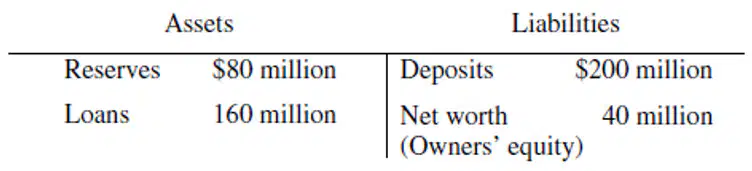
The T-account shown below is for Herzig Bank. The required reserve ratio is .2.
What is the maximum amount that Herzig bank can increase its loans?
a. $20 million
b. $160 million
c. $80 million
d. $40 million
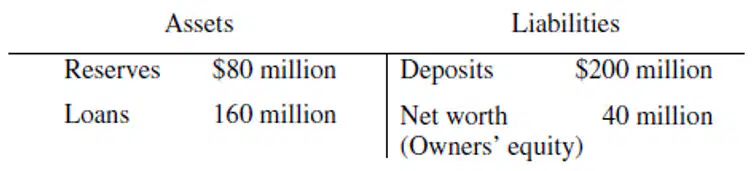
The T-account below is from Herzig Bank. The required reserve ratio is .2.
If the required reserve ratio is changed by the Fed to .1, which of the following is most likely to occur?
a. Herzig Bank will make no change.
b. Herzig Bank will need to seek more depositors to cover the new required reserve ratio obligation.
c. Herzig Bank will need to 'call in' some of its loans.
d. Herzig Bank will increase its loans.
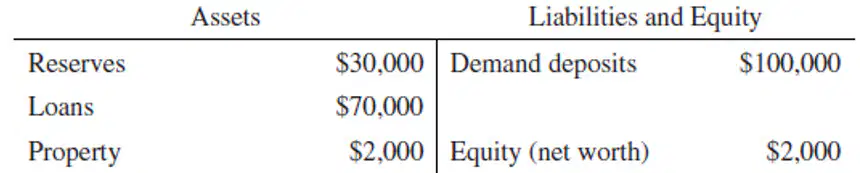
The T-account below is for the Bank of Saxon Country.
Assume that the required reserve is 20%. What is the value of the bank's excess reserves?
a. $10,000
b. $20,000
c. $70,000
d. $30,000
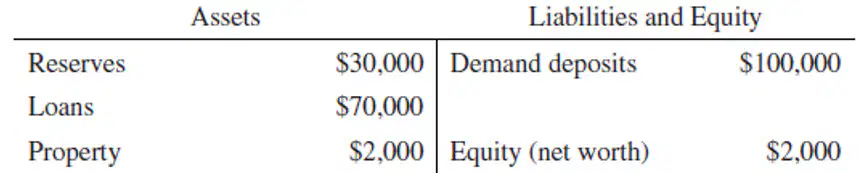
The T-account below is for the Bank of Saxon Country.
If the bank is holding no excess reserves, what is the required reserve set by the Fed?
a. 15%
b. 10%
c. 20%
d. 30%
Which of the following can be used by the Fed to increase the money supply?
a. print more money
b. increase the discount rate
c. decrease the required reserve rate
d. increase the federal funds rate
When a central bank buys securities in the open market, which of the following set of events is most likely to follow?
a. An increase in the money supply, an increase in interest rates, and a decrease in aggregate demand
b. An increase in interest rates, an increase in the government budget deficit, and a movement toward trade surplus
c. A decrease in the money supply, a decrease in interest rates, and a decrease in aggregate demand
d. A decrease in the money supply, an increase in interest rates, and a decrease in aggregate demand
e. An increase in the money supply, a decrease in interest rates, and an increase in aggregate demand
Assume that the government implements a deficit-reduction policy that results in changes to aggregate income and output. Then the Federal Reserve engages in monetary policy actions that further magnifies the changes in income and output caused by fiscal policy action. Which of the following sets of changes in taxes, government spending, the required reserve ratio, and the discount rate is most consistent with these policies?
Taxes Government Spending Required Reserve Spending Ratio
a. Decrease Decrease Decrease Increase
b. Decrease Increase No change Increase
c. Increase Decrease Decrease No change
d.
Increase Decrease Increase No change
e. Increase Increase Decrease Increase
A commercial bank is facing the conditions given below.
ASSETS LIABILITIES
Total Reserves: $15,000 Demand Deposits: $100,000
Securities: $70,000
Loan: $15,000
If the reserve requirement is 10 percent and the bank does not sell any of its securities, the maximum amount of additional lending this bank can undertake is
a.
$5,000
b. $3,000
c. $15,000
d. 0
e. $1,800
Assume that the reserve requirement is 20 percent, but banks voluntarily keep some excess reserves. A $2 million increase in new reserves will result in
a. a decrease in the money supply of $5 million
b. a decrease in the money supply of $1 million
c. an increase in the money supply of $5 million
d. an increase in the money supply of less than $5 million
e.
an increase in the money supply of more than $5 million
To stimulate investment in new plant and equipment without increasing the level of real output, the best policy mix is to
a.
decrease government spending and increase money supply
b. decrease income taxes and increase government spending
c.
increase the money supply and decrease personal income taxes
d. decrease the money supply and increase government spending
e. decrease the money supply and increase income taxes
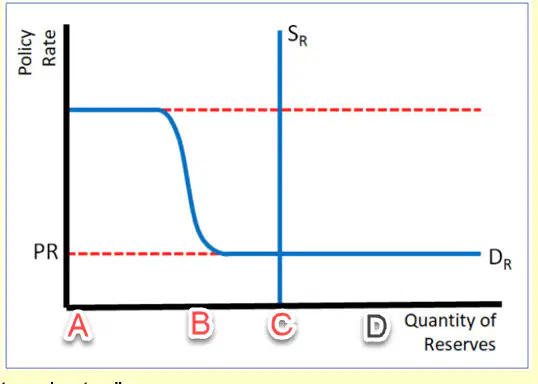
Use the diagram below to answer the question:
Which letter(s) correspond to a financial system having ample reserves? (select all letters that are correct-- there may be more than one)
a. A
b. B
c. C
d. D
What is the main mechanism used by the Fed to move the federal funds rate to the target when there are scarce reserves in the financial system?
a. administered rates
b. discount rate
c. required reserve ratio
d. open-market operations
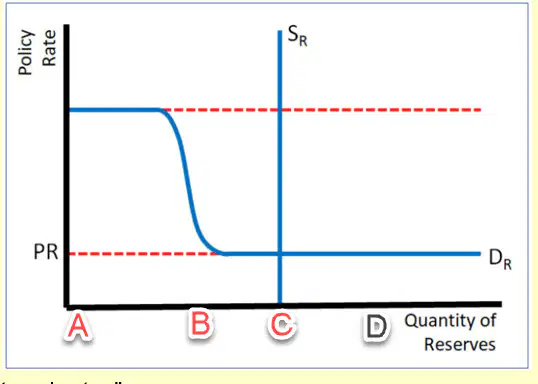
Use the diagram below:
Which letter(s) correspond to a system with scarce reserves? (May be multiple answers-- select all that are correct)
a. A
b. B
c. C
d. D
The economy of Herzigland is experiencing a recessionary gap. What monetary policy should its central bank pursue to return the economy to long-run equilibrium?
a. increase government taxes
b. open-market sale of securities
c. increase government spending
d. open-market purchase of securities
What is the main mechanism used by the Fed to move the federal funds rate to the target when there are ample reserves in the financial system?
a. capital inflow
b. investment spending
c. administered rates
d. open-market operations
The economy of Herzigland is in long-run equilibrium.
The central bank decides to pursue contractionary monetary policy. What will happen to the aggregate price level as a result?
a. the price level has a direct relationship to the unemployment rate
b. the price level will remain unchanged
c. the price level will increase
d. the price level will decrease
The economy of Herzigland is in long-run equilibrium. Credit cards have recently been introduced to Herzigland and people now hold less money because they use credit cards to buy goods and services.
What will happen to the nominal interest rate as a result of the change in consumer behavior?
a. quantity demanded will increase
b. increase
c. decrease
d. no change
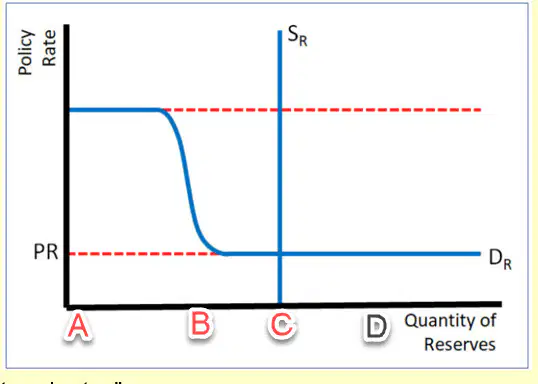
Use the diagram below to answer the question:
Assume that the reserves market equilibrium is at point C on the diagram. If the Fed wants to increase the target federal funds rate, which mechanism will be most effective?
a. increasing the administered rates
b. open-market purchase of securities
c. decreasing the administered rates
d. open-market sale of securities
The economy of Herzigland is in long-run equilibrium. The central bank pursues a contractionary monetary policy.
With a constant money supply, what will happen to the velocity of money?
a. increase
b. unable to calculate
c. change indeterminate
d. decrease
The economy of Herzigland is in long-run equilibrium. The central bank decides to increase the money supply.
Because of the change that this will cause in the interest rate, what will happen to bond prices?
a. unable to determine with information provided
b. no change
c. increase
d. decrease
If the Fed conducts in an open-market purchase of securities, nominal interest rates and bond prices will most likely change in which of the following ways?
Nominal Interest Rates Bond Prices
a. Increase Not change
b. Increase Increase
c. Decrease Decrease
d. Decrease Increase
e. Increase Decrease
Which of the following would cause a shift up of the SRPC?
a.
decrease in discount rate
b.
decrease in technology used in the workplace
c.
increase in government spending
d. increase in worker productivity
e. decrease in oil prices
If an economy is operating with significant unemployment, an increase in which of the following will most likely cause employment to increase and the interest rate to decrease?
a. Purchases of government bonds by the central bank
b. Transfer payments
c. Reserve requirements
d. Government expenditures
e. Investment in basic infrastructure
Stagflation is most closely associated with a/an
a. shift up in the SRPC
b. shift down in the SRPC
c. shift right in the SRAS
d. shift right in the AD
e. shift left in the AD
If the SRPC shifts down, then which phase of the business cycle is the economy most likely to be in?
Selected:
a. expansionary
b. recessionary
c. trough
d. depression
e. zenith
Which of the following is NOT a function of commodity-backed money?
a. A store of value
b. A medium exchange
c. A unit of account
d. A standard of deferred payment
e. A source of intrinsic value
An decrease in inflationary expectations will most likely affect nominal interest rates and bond prices in which of the following ways in the short run?
Nominal Interest Rates Bond Prices
a. Decrease Increase
b. Decrease Decrease
c. Increase Decrease
d. No change Increase
e. Increase No change
The Federal Reserve increases the federal funds rate by
a. increasing the discount rate
b. decreasing the discount rate
c. selling government bonds on the open market
d. decreasing the reserve requirement
e. buying government bonds on the open market
With a constant money supply, if the demand for money increases, the equilibrium interest rate and quantity of money will change in which of the following ways?
Interest Rate Quantity of Money
a. Decrease Increase
b. Increase Not change
c. Increase Decrease
d. Decrease Not change
e. Decrease Decrease
Which of the following would cause movement to the left on the SRPC?
a. open market sale of securities by the Fed
b. increase in nominal wages
c. open market purchase of securities by the Fed
d. decrease in commodity prices
e. increase in commodity prices
An increase in oil prices will most likely cause the short-run Phillips Curve to
a. indeterminate from information provided
b. shift up
c. shift down
d. not change
An increase in worker productivity will most likely cause the short-run Phillips Curve to
a. indeterminate with information provided
b. not change
c. shift down
d. shift up
Assume actual unemployment is equal to the natural rate of unemployment. If the actual unemployment were to decrease below the natural rate, then the economy would experience
a. shift in AD
b. a recessionary gap
c. an increase in inflation
d. shift in LRAS
A positive Aggregate Demand shock causes
a. leftward movement on the short-run Phillips Curve
b. shift down of the short-run Phillips Curve
c. shift up of the short-run Phillips Curve
d. rightward movement on the short-run Phillips Curve
The long-run Phillips Curve interesects the X-axis on the diagram at the
a. natural rate of unemployment
b. equilibrium of the aggregate price level
c. point where inflation is increasing
d. cyclical rate of unemployment
he Federal Reserve increases the federal funds rate by
a. decreasing the discount rate
b. decreasing the reserve requirement
c. selling government bonds on the open market
d. buying government bonds on the open market
e. increasing the discount rate
If the SRPC shifts down, then which phase of the business cycle is the economy most likely to be in?
a. expansionary
b. recessionary
c. trough
d. depression
e. zenith
Which of the following is a function of fiat money?
a.
A mode of transportation
b.
A commodity input for SRAS calculation
c.
A measure of quality of life
d. A store of value
e. A source of intrinsic value
Which of the following would NOT cause a shift of the SRPC?
a. expansionary fiscal policy
b. decrease in oil prices
c. increase in worker productivity
d. decrease in nominal wages
e. increase in commodity prices
Assume that the economy is in equilibrium. If aggregate demand decreases, nominal interest rates and bond prices will most likely change in which of the following ways?
Nominal Interest Rates Bond Prices
a. Increase Decrease
b. Decrease Increase
c. Increase Increase
d. Increase Not change
e. Decrease Decrease
Stagflation is most closely associated with a/an
a. shift up in the SRPC
b. shift down in the SRPC
c. shift right in the SRAS
d. shift right in the AD
e. shift left in the AD
A decrease in inflationary expectations will most likely affect real interest rates and bond prices in which of the following ways in the short run?
Real Interest Rates Bond Prices
a. No change Increase
b. Increase No change
Selected:
c. Decrease Increase
d. Increase Decrease
e. Decrease Decrease
If an economy is operating with significant unemployment, an increase in which of the following will most likely cause employment to increase and the interest rate to decrease?
a. Reserve requirements
b. Government expenditures
c. Transfer payments
d. Investment in basic infrastructure
. Purchases of government bonds by the central bank
With a constant money supply, if the demand for money increases, the equilibrium interest rate and quantity of money will change in which of the following ways?
Interest Rate Quantity of Money
a. Decrease Decrease
b. Increase Decrease
c. Increase Not change
d. Decrease Not change
e. Decrease Increase
Which of the following would cause movement to the right on the SRPC?
a. increase in commodity prices
b. decrease in commodity prices
c. open market sale of securities by the Fed
d. open market purchase of securities by the Fed
e. increase in nominal wages
Under rational expectations, an announced expansion in the money supply will change nominal and real gross domestic products (GDP) in which of the following ways?
Nominal GDP Real GDP
a. Increase Increase
b. No change No change
c. No change Decrease
d.
Increase No change
e. Increase Decrease
According to Keynesian analysis, if government expenditures and taxes are increased by the same amount, which of the following will occur?
a. Aggregate demand will be unaffected.
b. Aggregate demand will decrease.
c. Aggregate supply will decrease.
d. Aggregate supply will increase.
e. Aggregate demand will increase.
Which of the following is true of the long-run Phillips curve?
a. It is positively sloped when the inflation rate exceeds the unemployment rate.
b. It is created by an adverse supply shock.
c. It shifts to the right if aggregate demand increases.
d. It is vertical at the natural rate of unemployment.
e. It shows there is a trade-off between unemployment and inflation.
Which of the following could cause a movement right along a country's short-run Phillips curve?
a. A recession in the economies of the nation's major trading partners
b. An improvement in technology
c. A significant reduction in energy prices
d.
A decrease in nominal wages
e. A movement of the economy from the recovery phase to the expansionary phase of the business cycle
According to the theory of rational expectations, a fully anticipated expansionary monetary policy will
a. increase unemployment
b. have no impact on real output
c. promote the production of consumer goods
d. result in deflation
e. increase potential output

