
 Worksheets
Unit 4 TEST REVIEW- Bonding S23
Total questions: 84
Worksheet time: 3hrs 48mins
Which of the following is the correct name for the compound PbO?
lead oxide
lead monoxide
lead (I) oxide
lead (II) oxide
Which of the following is the correct chemical formula of calcium nitrate?
CaNO3
Ca(NO3)2
CaN
Ca3N2
What is the correct IUPAC name for the compound P2O5?
*IUPAC stands for International Union of Pure and Applied Chemistry and it is the naming system that we use in class.
phosphorus pentoxide
diphosphorus pentoxide
phosphorus oxide
potassium oxide
Metals are good conductors of electricity because when the metal atoms bond the valence electrons are
highly mobile
transferred
shared equally
shared unequally
Which of the following compounds contains both ionic and covalent bonds?
NaCl
PCl3
NaClO4
CaBr2
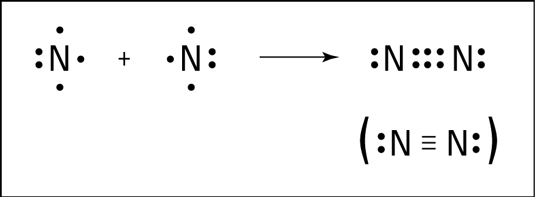
How many pairs of electrons are shared between the nitrogen atoms in a molecule of nitrogen?
2
3
4
6
Which of the following forms a nonpolar covalent bond?
Br2
HBr
NaBr
PBr3
Which of the following is the most polar?
HF
HCl
HBr
HI
Which of the following is a polar molecule?
O2
CO2
NH3
CH4
Predict the bond that is formed between Phosophorus and Chlorine?
Ionic
Covalent
Metallic
H-bond
Which of the pair of elements form an ionic bond?
Magnesium and Oxygen
Magnesium and Sodium
Iron and Zinc
Nitrogen and Hydrogen

How many valence electrons are shown in the diagram?
16
7
6
2
TRUE OR FALSE: Ionic compounds have high boiling points because they consist of a strong ionic bond.
TRUE
FALSE

Which of the following is true for ionic bonding & ionic compounds? Check all that apply!!
They must be made of ions with like charges.
The negative ion must be written first.
Compounds must have an overall charge of zero.
They are made of metals and nonmetals.
The positive ion must be written first.
Which of the following elements does NOT form an ion with a charge of 2+?
Beryllium
Strontium
Magnesium
Fluorine
When Alkali metals (Group 1) form ions, they ____.
lose 1 proton
gain 1 proton
lose 1 electron
gain 1 electron
How does fluorine (F) obey the octet rule when reacting to form compounds?
It doesn’t change its number of electrons - it has a full octet!
Fluorine does not obey the octet rule.
It gains an electron.
It gives up an electron.
Which of the following shows correctly an ion pair and the ionic compound the two ions form?
Sn4+ and N3- form Sn4N3
Cu2+ and O2- form Cu2O2
Cr3+ and I- form CrI
Cr2+ and I- form CrI2
What is the chemical formula of sodium nitride?
NaN
Na2N
Na3N
NaNO3
Select the correct formula for boron trichloride.
B2Cl
B3Cl
BCl3
BCl2



The geometry of a molecule with 4 bonded pairs of electrons and 0 lone pairs of electrons, AB4
Tetrahedral
Trigonal Planar
Bent
Trigonal Pyramidal
Linear
What is the molecular geometry of CO2?
Bent
Trigonal planar
Trigonal pyramidal
Linear


Describe the shape of the molecule.
linear
bent
trigonal pyramidal
tetrahedral
Ionic bonds are the _____ between positive and negative ions.
covalent bonds
metallic bonds
polar bonds
electrostatic attraction
Ionic compounds have ____ melting points and _____ boiling points because _____ ionic bonds must be broken in order to break the lattice.
low, low, weak
low, high, weak
low, high, strong
high, high, strong
Ionic compounds always conduct electricity - whether they are in the solid, liquid or gas form.
True- they can conduct electricity in any form!
False- they can only conduct electricity when dissolved in water or in melted (liquid) form
False- they can only conduct electricity in solid form
Ionic compounds conduct electricity only when molten or in a solution because...
electrons are free to move
water is free to move
molecules are free to move
ions are free to move
When naming ionic compounds with transition metals you need to include Roman numerals to show the _____ of the metal..
atomic number
mass number
charge
ionization energy
SnO2
FeSO4
Is the following compound ionic or covalent?
LiBr
Ionic
Covalent
Is the following compound ionic or covalent?
Exists as a solid, liquid or gas
Ionic
Covalent
Is the following compound ionic or covalent?
A material that has a low boiling point
Ionic
Covalent
Is the following compound ionic or covalent?
A material that forms a crystal lattice
Ionic
Covalent
Is the following compound ionic or covalent?
A material that is hard and brittle
Ionic
Covalent
Is the following compound ionic or covalent?
A material that SHARES electrons
Ionic
Covalent

Which of the following is NOT TRUE about covalent compounds?
They have low melting and boiling points.
They are formed from 2 nonmetals.
They can conduct electricity when dissolved in water (aqueous).
Which element is most likely to form 4 bonds?
Carbon
Fluorine
Sulfur
Nitrogen

The following properties are all characteristics of ionic compounds EXCEPT
solid at room temperature
soft
crystal lattice structure
conduct electricity when dissolved in water
Which types of elements become cations?
non-metals
metals
metalloids
Ionic bonds could be best described as:
A bond formed when 2 atoms share electrons
A firm handshake
An electrostatic attraction between oppositely charged ions
An electrostatic attraction between anions
Have very strong intermolecular forces
ionic compounds
covalent compounds
Why do atoms form bonds?
to increase their potential energy AND decrease stability by filling up their valence shell
to lower their potential energy AND increase stability by filling up their valence shell
to increase their atomic number
Metals have positive ions in a ‘sea of electrons’. Which metal atom provides the most electrons for the sea?
Aluminium
Sodium
Calcium
Magnesium
Copper is a metallic element.
Which statements about copper are correct? Choose all that apply!
Copper is malleable because layers of ions are in fixed positions and cannot move.
The structure of copper consists of negative ions in a lattice.
Copper conducts electricity because electrons can move through the metal.
Electrons hold copper ions together in a lattice by electrostatic attraction.

Why does the melting point of metals increase across period 3, from Sodium (Na) to Aluminium (AI)?
Size of atoms gets smaller
Attraction force between nuclei and free electron increases
Increased space between the valence electrons in the "sea"
Increased number of valence electrons contributed to the "sea"
Metallic bonds form because metals
"want" to give up valence electrons
always share valence electrons
have many valence electrons
always gain valence electrons
What is the ability of a substance to be pulled into a wire?
Malleability
Ductility
Conductivity
Solubility

