
Font size
 Worksheets
Kinectics and Rates
Total questions: 19
Worksheet time: 2hrs 25mins
What is the definition of a rate?
how fast something goes.
change of a thing over change in time
a unit of measurement
a type of currency
On a graph how is the rate represented visually?
different points on a graph
the y axis
the x axis
the slope
What is the definition of a rate law?
how the rate of a reaction depends on the concentration of reactants
the law that defines how any rate is created in the world
how the rate of reaction depends on time and concentration.
how the rate is determined by steps of a reaction
How is the rate law determined? (Select all that apply)
rate=k[A]n[B]m
Determined through experimentation
Determined by stoichiometry
Determined by changes in concentrations
Consider rate=k[A]2[B] which of the following is a true statement regarding this rate law?
B is in 2nd order
A is in 1st order
the reaction is in 3rd order overall
the concentration is going to be a negative number
What defines an integrated rate law?
How rate is dependent on concentration
How rate is dependent on concentration in time
How rate changes when integrated into a half life equation.
How rate integrates into society.
What is a half life?
The exact half way point a reaction will live
A famous video game
The time required to for half of a sample to react
the time require for half the reaction to be complete
For a reaction it needs all of the following EXCEPT which of these answers?
Catalyst
Sufficient Energy
Collision with the correct partner
Proper orientation
True or False, a rate law can be determined by elementary steps.
True
False
A catalyst......
Speeds up an reaction
First appears on the left and then is shows up on the right again
Is used in Catalytic Converters
Is fully used up after being used in a reaction
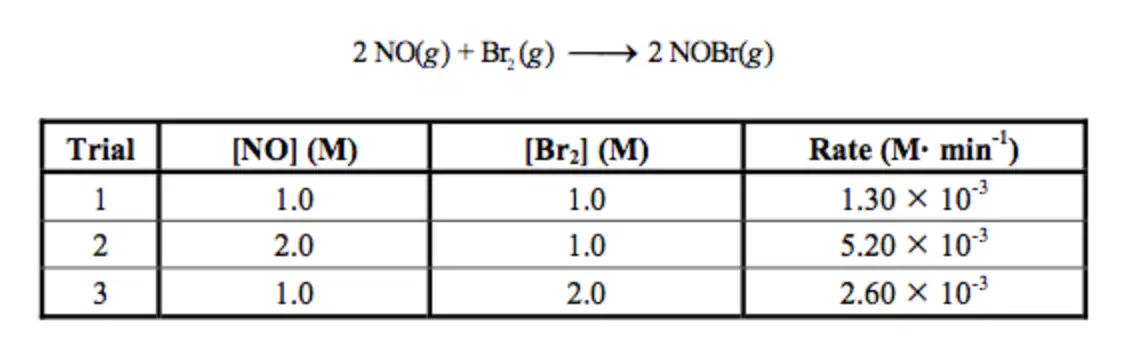
You run a fourth experiment but this time you had a starting concentration of 4.0 M [NO] and 3.0 M [Br2] what is our rate for the trial # 4?

What is the overall reaction for this reaction?

What would be the predicted rate law for this reaction?
The half-life of Zn-71 is 2.4 minutes. If one had 100.0 g at the beginning, how many grams would be left after 7.2 minutes has elapsed?
The reaction for A ------> B is second order in [A] the rate constant is .039 Ms-1. If the initial concentration of A was .30 M at 3 minutes calculate the new concentration.

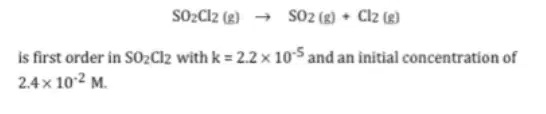
What will the concentration be after 1 hour? (Note the K is in units of M s-1)
2X(g)↔3Y(g)+4Z(g)
A sample consisting of 0.500 mol of x is placed into a system with a volume of 0.750 liters. At equilibrium, the amount of sample x is known to be 0.350 mol. What is our Kc?


