
 Worksheets
Chapter 11 Practice AP Test
Total questions: 10
Worksheet time: 30mins
A chi-square test is used to test whether a 0 to 9 spinner is “fair” (that is, the outcomes are all equally likely). The spinner is spun 100 times, and the results are recorded. The degrees of freedom for the test will be
8
9
10
99
None of these
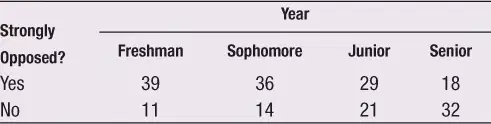
Recent revenue shortfalls in a midwestern state led to a reduction in the state budget for higher education. To offset the reduction, the largest state university proposed a 25% tuition increase. It was determined that such an increase was needed simply to compensate for the lost support from the state. Separate random samples of 50 freshmen, 50 sophomores, 50 juniors, and 50 seniors from the university were asked whether they were strongly opposed to the increase, given that it was the minimum increase necessary to maintain the university’s budget at current levels. The results are displayed below:
Which hypotheses would be appropriate for performing a chi-square test?
The null hypothesis is that the closer students get to graduation, the less likely they are to be opposed to tuition increases. The alternative is that how close students are to graduation makes no difference in their opinion.
The null hypothesis is that the mean number of students who are strongly opposed is the same for each of the 4 years. The alternative is that the mean is different for at least 2 of the 4 years.
The null hypothesis is that the distribution of student opinion about the proposed tuition increase is the same for each of the 4 years at this university. The alternative is that the distribution is different for at least 2 of the 4 years.
The null hypothesis is that year in school and student opinion about the tuition increase in the sample are independent. The alternative is that these variables are dependent.
The null hypothesis is that there is an association between year in school and opinion about the tuition increase at this university. The alternative hypothesis is that these variables are not associated.
Recent revenue shortfalls in a midwestern state led to a reduction in the state budget for higher education. To offset the reduction, the largest state university proposed a 25% tuition increase. It was determined that such an increase was needed simply to compensate for the lost support from the state. Separate random samples of 50 freshmen, 50 sophomores, 50 juniors, and 50 seniors from the university were asked whether they were strongly opposed to the increase, given that it was the minimum increase necessary to maintain the university’s budget at current levels. The results are displayed below:
The conditions for carrying out the chi-square test above are
I. Independent random samples from the populations of interest.
II. All expected counts are at least 5.
III. The population sizes are at least 10 times the sample sizes.
Which of the conditions is (are) satisfied in this case?
I only
II only
I and II only
II and III only
I, II, and III
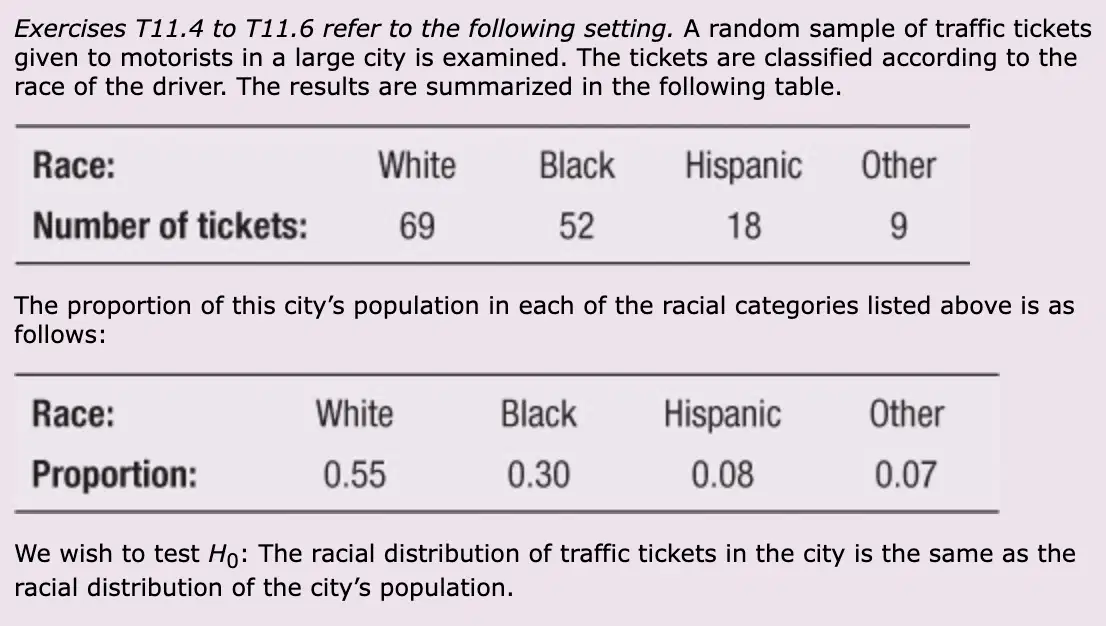
Assuming H0 is true, the expected number of Hispanic drivers who would receive a ticket is
8
10.36
11
11.84
12
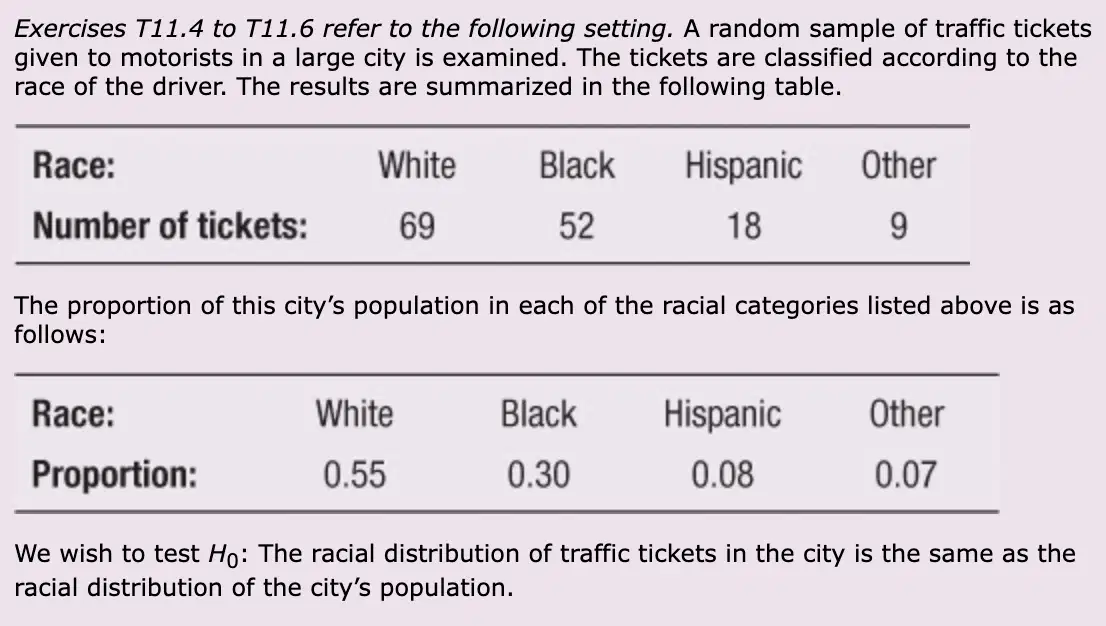
We compute the value of the χ2 statistic to be 6.58. Assuming that the conditions for inference are met, the P-value of our test is
greater than 0.20
between 0.10 and 0.20
between 0.05 and 0.10
between 0.01 and 0.05
less than 0.01
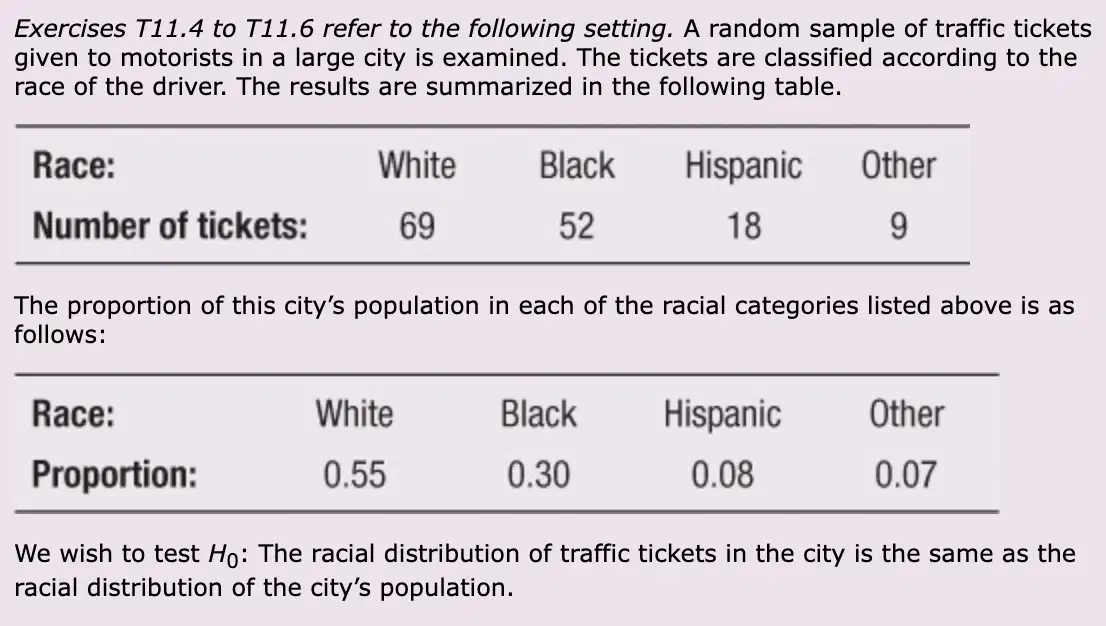
The category that contributes the largest component to the χ2 statistic is
White
Black
Hispanic
Other
The answer cannot be determined because this is only a sample.

The appropriate degrees of freedom for the χ2 statistic is
1
2
3
4
5
The expected count of cases with lymphoma in homes with an HCC is
21579×31
21510×21
1079×31
215136×31
None of these
Which of the following may we conclude, based on the test results?
There is convincing evidence of an association between wiring configuration and the chance that a child will develop some form of cancer.
HCC either causes cancer directly or is a major contributing factor to the development of cancer in children.
Leukemia is the most common type of cancer among children.
There is not convincing evidence of an association between wiring configuration and the type of cancer that caused the deaths of children in the study.
There is convincing evidence that HCC does not cause cancer in children.
A Type I error would occur if we found convincing evidence that
HCC wiring caused cancer when it actually didn’t.
HCC wiring didn’t cause cancer when it actually did.
there is no association between the type of wiring and the form of cancer when there actually is an association.
there is an association between the type of wiring and the form of cancer when there actually is no association.
the type of wiring and the form of cancer have a positive correlation when they actually don’t.

