
 Worksheets
Atomic Theory Review
Total questions: 90
Worksheet time: 1hrs 2mins
Match the Following
Element
A substance that cannot be broken down into simpler substances by chemical means.
Atom
The smallest unit of an element that keeps the element’s chemical properties.
Nucleus
The dense center of an atom containing protons and neutrons.
Proton
Positively charged particles found in the nucleus of an atom.
Neutron
Particles with a neutral charge found in the nucleus of an atom.
Electron
A negatively charged subatomic particle located around the nucleus of an atom.
Electron Shell
Areas around the nucleus filled with electrons.
Valence Electron
The electrons filling the outermost shell; react with other atoms.
Compound
A substance formed from two or more atoms chemically united in fixed proportions.
Molecule
A group of atoms held together by chemical forces.
Periodic Table
All known elements arranged in order by atomic number.
Family/Group
Vertical columns of elements that have the same amount of valence electrons.
Period
Horizontal rows of elements that have the same number of electron shells.
Atomic Mass/Mass Number
The average number of protons and neutrons in one atom of an element.
15) Metal
Elements that are malleable, ductile, and good conductors; typically shiny.
Metalloid
An element that has properties that fall between metals and nonmetals.
Nonmetal
Elements that are brittle, poor conductors, and have low melting and boiling points.
Noble Gas
Elements in group 18 that have very low reactivity.
Using a periodic table (you can use the one in the textbook) order the following elements by mass number, least to greatest.
Hydrogen
Boron
Gallium
Thallium
Radon
Using a periodic table (you can use the one in the textbook) order the following elements by # of Electron Shells, least to greatest.
Sodium
Calcium
Strontium
Barium
Dubnium
Using a periodic table (you can use the one in the textbook) order the following elements by # of valence electrons, least to greatest.
Potassium
Barium
Carbon
Oxygen
Neon

How many electron shells does the pictured atom have?
1
2
3
4

How many valence electrons does the pictured atom have?
20
3
2
4
Which TWO particles can be changed within an element without changing what the element is?
Neutrons
Electrons
Protons
How is an ionic bond formed?
Sharing of electrons
Delocalised electrons
Transfer of electrons
Ionic bonds are formed between...
Non - metals
A metal and a non-metal
Metals
An example of an ionic compound is Sodium Chloride, which is made from Na+ and Cl- ions. Why do these ions form an ionic bond?
They have like charges
They are from the same group
They are from the same period
They have opposite charges
Lead Chloride is an ionic compound, made up from Pb2+ ions and Cl- ions. Which is the correct formula for this compound?
PbCl3
PbCl
PbCl4
PbCl2

Select all the true statements:
Each outer shell electron in Cl is represented by a cross.
In Na, the total charge is -2.
Na+ and Cl- are held together by electrostatic attraction.
Na+ has a full outer shell of electrons.
Sodium Oxide is Na2O. Meaning there are 2 Na present for every O in the ionic compound. As the Oxygen ion has a charge of -2, what charge does each Sodium ion have?
-1
-2
+2
+1
What is the correct formula for aluminium oxide? Aluminium is in group 3 and oxygen is in group 6.
Al₂O₃
AlO
AlO₄
Al₂O
Al₃O₂
Which of the following could NOT form an ionic compound? Check all that apply.
Li+ and Cl-
F- and O2-
Ba2+ and Ag+
Mg2+ and S2-
Calcium Fluoride has a chemical formula of CaF2. What does the chemical formula tell you?
There are 2 Calcium ions for every 1 Fluoride ion in the crystal
There is 1 Calcium ion for every 2 Fluoride ions in the crystal
All atoms are most stable with (or would "prefer") how many electrons in their valence shell?
1
2
8
18

The electronic configuration of an ion is 2.8.8.
What could this ion be?
A
B
C
D
Valence electrons are the
outer most electrons in an atom
total electrons in an atom

This is a correct dot diagram for nitrogen (N)
true
false
Which of these is incorrect?


This could be the dot diagram of
Mg
Cl
C
O

Based on this Lewis Dot diagram, what will a Beryllium atom do to become more stable?
gain two electrons
lose (transfer) two electrons
gain six electrons
lose (transfer) six electrons

Why does the Silver ion have a +1 charge? It
gains one electron
gains seven electrons
transfers (loses) one electron
transfers (loses) seven electrons

Why does the Oxygen ion have a -2 charge? It
gains two electrons
transfers (loses) two electrons
gains six electrons
transfers (loses) six electrons

Based on this Lewis Dot diagram, which is the correct ion that would form and why?


Based on the Lewis Dot diagram, which is the correct ion that would form?


Which diagram correctly illustrates the electron transfer between Sodium and Selenium?


Which diagram correctly illustrates the electron transfer between Aluminum and Iodine?


Each row on the periodic table represents:
an energy level
a sublevel
an electron
an orbital
Which area on the periodic table represents the electrons in the "d" sublevel?
representative elements
columns 3-8
rare earth elements
transition elements


1s22s22p63s23p64s23d10
1s22s22p63s2
Choose the correct shortcut configuration for iodine.
[Ar]4s24d104p5
[Kr]5s24d105p5
[Xe]5s25d105p5
none of the above
Energy levels are denoted by:
letters
numbers
a combination of letters and numbers
subscripts

Choose the correct electron configuration for Beryllium (Be).
1s1
1s2 2s2
1s2 2s2 2p1

Choose the correct electron configuration for Chlorine (Cl).
1s2 2s2 2p1
1s2 2s2 2p6 3s2
1s2 2s2 2p6 3s2 3p5

Choose the correct electron configuration for Nickel (Ni).
1s2 2s2 2p6 3s2 3p6 4s2 3d8
1s2 2s2 2p6 3s2 3p6 4s2 3d2
1s2 2s2 2p6 3s2 3p6 4s10

Choose the correct electron configuration for Krypton (Kr).
1s2 2s2 2p6 3s2 3p6 4s8 3d8
1s2 2s2 2p6 3s2 3p6 4s2 3d8 4p3
1s2 2s2 2p6 3s2 3p6 4s2 3d8 4p6

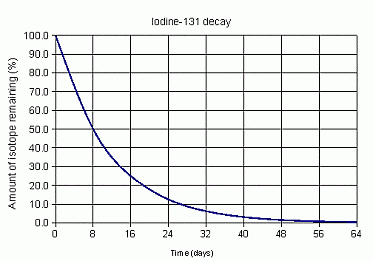
The % of the parent isotope remaining after 1 Half Life.
50%
25%
12.5%
6.25%
The % of the parent isotope remaining after 2 Half Lives.
50%
25%
12.5%
6.25%
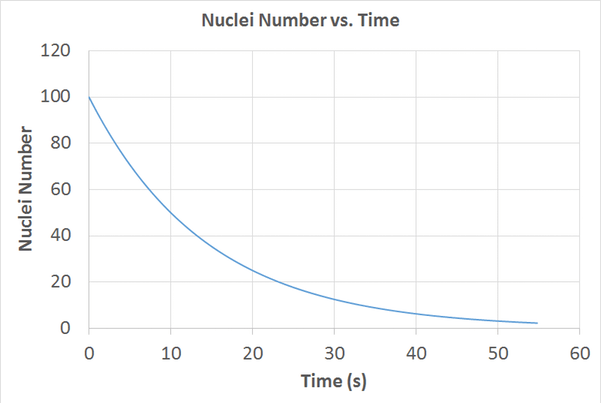
What is the Half life of this isotope?
5 seconds
10 seconds
15 seconds
20 seconds


The three types of nuclear radiation are _______ radiation, _________radiation, and _____________ radiation.
alpha, beta, and gamma
theta, beta, and kappa
alpha, beta, positron
emitted helium nucleus
positron
radioactivity
alpha particle
gamma radiation
beta particle
energetic electron from decomposed neutron
positron
radioactivity
alpha particle
gamma radiation
beta particle
high-energy photons emitted by a radioisotope
positron
radioactivity
alpha particle
gamma radiation
beta particle

Which type of radiation has the charge and mass of an electron?
Alpha radiation
Beta radiation
gamma radiation

What type of radiation can be stopped by clothing or a piece of paper?
Alpha radiation
Beta radiation
gamma radiation


Elements in the same group have : (2 correct answers)
Similar chemical properties
Similar names
Same number of outer (valence) electrons)
The same number of protons

The blue elements (left side) are called
The yellow elements (right side) are called

Match the following elements to the group they belong to.
sodium
alkali metal
calcium
alkaline earth metal
chlorine
halogen
argon
noble gas

Which element has the highest electronegativity?

