
NEW
Font size
 Worksheets
Cold War / Truman & Eisenhower
Total questions: 20
Worksheet time: 10mins
A similarity between the Red Scare of the 1920’s and McCarthyism in the 1950’s was that during each period
thousands of American citizens were expelled from the United States.
the Communist Party gained many members in the United States.
many government employees were convicted of giving secrets to the Soviet Union.
the civil liberties of American citizens were threatened.
In 1957, the United States government responded to the event described in the headline below by
“Sputnik Launch Propels Soviets Ahead in Space Race”
reducing military spending.
building a joint space station with the Soviet Union.
constructing President Ronald Reagan’s “Star Wars” defense system.
providing funds to improve the educational system in the United States.
In the years just after World War II, the United States attempted to prevent the spread of communism in Europe mainly by
taking over the governments of several Western European nations.
increasing opportunities for political refugees to settle in the United States.
holding a series of summit meetings with leaders of the Soviet Union.
establishing policies of economic and military aid for European nations.
What was the main purpose of the GI Bill passed by Congress shortly before the end of World War II?
to offer loans to the defense industry
to provide economic aid to returning veterans
to contain the spread of international communism
to expand career opportunities in the military
The Marshall Plan was important because it
Checked (limited) Soviet power in Cuba.
secured allies for the United States.
was never ratified (approved) by the United States Congress.
helped communist countries rebuild after World War II.
Which of the following is a valid conclusion based on United States involvement in the Korean War?
the policy of containment was applied in Asia as well as in Europe.
United Nations economic sanctions are more effective than military action.
The American people will support United States participation in any war, whether declared or undeclared.
United States cooperation with a wartime ally ends when the war ends.
In order to break the Soviet blockade against West Berlin in 1948, the United States and Great Britain
blockaded Cuba in retaliation to Soviet actions.
began an airlift designed to keep West Berlin supplied with goods.
broke off all diplomatic relations with the Soviet Union.
instituted an economic boycott of all imported Soviet goods.
Which group was created during the Cold War to stop the spread of communism around the world?
The Warsaw Pact
The United Nations
The North Atlantic Treaty Organization (NATO)
The House Un-American Activities Committee (HUAC)
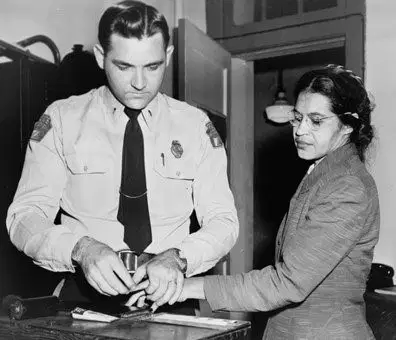
The picture of Rosa Parks above shows her arrest in 1955 Montgomery. Parks helped start a movement that
protested voting discrimination in Alabama.
used economic pressure to try to affect political and social change.
resulted in the integration of lunch counters.
attempted to integrate Robert E. Lee high school in that city.
What do these terms have in common?
· United Nations
· Marshall Plan
· NATO
They were all designed to stop communist forces.
They all failed to achieve their Cold War objectives.
The Soviet Union was prevented from joining and/or influencing them.
The United States was a major force in their creation and/or operation.
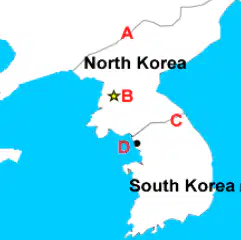
Which labeled area on the map above is known as the "Demilitarized Zone" (DMZ)?
A
B
C
D
Both the GI Bill and the Veteran’s Readjustment Assistance Act of 1952 emphasized the idea that the federal budget should
decrease the amount of money spent on most social services.
provide healthcare services to returning NATO personnel.
allocate funds for the care of veterans after military service.
establish equal educational funding for veterans and civilians.
What was President Eisenhower’s purpose for signing a bill to create a national interstate highway system in 1956?
to allow people to move to the western U.S. more easily
discouraged suburban families from entering big cities more quickly
to force southern states receiving federal funds to end segregation
to provide the means to transport military aid more quickly in the event of a national military crisis
All of these were direct effects of the G.I. Bill after World War II EXCEPT
an acceptance of black veterans returning home.
expansion of suburban home construction.
more small businesses started by veterans.
increased enrollment in colleges and universities.
A common purpose of the Truman Doctrine, the Marshall Plan, and the Eisenhower Doctrine was to
carry out the United States policy of preventing the spread of communism.
insure the survival of the newly independent nations of Africa and Asia.
limit the proliferation of nuclear weapons.
provide medical aid to Latin American nations.
Which statement BEST describes the relationship between Plessy v. Ferguson and Brown v. Board of Education?
Both cases addressed the need for due process of law.
Both cases dealt with the rights of minors in schools.
The Brown decision overturned the Plessy decision..
The Brown case was a precedent for the Plessy case.

The dramatic rise in Defense spending in the first half of the 1950s could be BEST explained by the United States' involvement in
World War I.
World War II.
the Korean War.
the Vietnam War.
The creation of the National Aeronautics and Space Administration (NASA) in 1958 was a direct result of
the Cuban Missile Crisis.
the successful launch and orbit of Sputnik I by the USSR in 1957.
the need for high-altitude aircraft capable of spying on the Soviet Union and Cuba.
competition with communist China over the development of long-range nuclear missiles.
How did Harry Truman's presidency impact the civil rights of African-Americans during the late 1940's and early 1950's?
During Truman's presidency, African-Americans experienced an increased level of discrimination and racism.
Civil rights for African-Americans decreased during Truman's administration due to his segregationist policies.
African-Americans experienced an improved level of civil rights, including the desegregation of the military and the federal government.
Harry Truman's presidency had little effect of the civil rights of African-Americans because of his administration's focus on foreign affairs.
Which of these BEST describes the Supreme Court case of Brown v. Topeka Board of Education?
it reaffirmed the decision of Plessy vs Ferguson
ruled that universities must be open to people of all races
Kansas schools were to be desegregated as an experiment for racial integration
declared that "separate but equal" facilities based on race are inherently unconstitutional

