
 Worksheets
Studio Art 1- T2Q1 Proficiency 2023
Total questions: 55
Worksheet time: 5hrs 35mins

Where was Jean-Michel Basquiat born?
Port-au-Prince, Haiti
Brooklyn, New York
Los Angeles, California
Philadelphia, Pennsylvania

Basquiat got his start as a street artist under a pseudonym (a fictitious name). What was his pseudonym?
JMB-3000
SAMO
JEAN
None of the above

Which of the following were source material for Jean-Michel Basquiat?
Paintings by other artists.
Comic books.
Gray’s Anatomy
All of the above

Which of the following did Basquiat use to make his canvases?
Old t-shirts
Discarded scraps of wood
Corrugated metal
None of the above

Jean-Michel Basquiat once said, “I am not a (a) artist, I am an artist.”
When studying Basquiat, we learned about two styles of art...
Modern & Abstract
Classical & Modern
Abstract & Pop
Neo-Expressionism & Street Art
Jean Michel Basquiat focused on this subject for many of his pieces...
Fish
Nature
Heads
Architecture
What media did Basquiat use in his artwork?
Oil Pastels
Oil Paint
Watercolor
Gesso
Where is Jean-Michel placing his art?
everywhere he goes
in an album
in his home
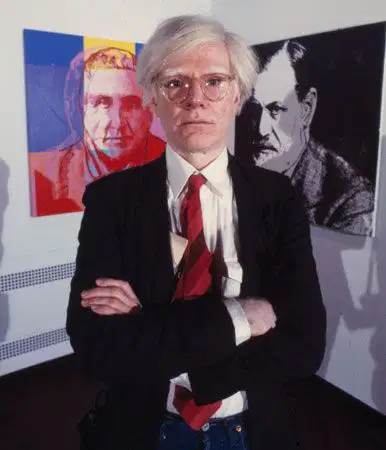
Who is this?
Warhol
Haring
Basquiat

Who is this?
Warhol
Haring
Basquiat
Jean-Michel Basquiat grew up speaking three languages. Which three languages did he speak?
Spanish
German
Italian
Spanish
English
French
French
Arabic
Spanish
English
Italian
French
Basquiat’s signature artistic motif, both acknowledged and challenged the history of Western art, was a ..........
Dinosaur
Flag
Red circle
Crown
What was the racial impact of Basquiat using crowns in his artwork?
Basquiat caused America to elect its first black President.
Basquiat lowered the morale of Black individuals.
Basquiat gave Black figures importance during a time period when racism was rampant.
Basquiat’s art caused a steep increase in the number of Black athletes.
Jean-Michel Basquiat said that his earliest, most vivid memory was getting hit by a car. What is the meaning of the word vivid?
Producing powerful feelings or strong, clear images in the mind.
Able to withstand great force or pressure.
Standing still.
Learning a new language.


What is this tool called?
Baren
Brayer
Bench Hook
Gouge

What is this printmaking tool called?
baren
lino
brayer
lino cut

a sharp division of things or ideas into two contradictory parts. An example of this is grouping mammals by those that live on land and those that live in water.
Misgivings
Ironic
Contradiction
Dichotomy
"Beauty versus brains" is a false ______. You can be both.
Dichotomy
Quintessential
Juxtaposition
Antithesis
Digress

This is the element of art that is the area between, around, above, below or
within things.
Space
Line
Form
Value

This element of art refers to the lightness and darkness of an object.
Shade
Color
Line
Value

This is the element of art that is sometimes called shape in three dimensions.
Form
Line
Shape
Texture

This is concerned with the size relationships of one part to another.
Emphasis
Variety
Proportion
Balance

This term refers to the quality of wholeness or oneness that is achieved through the effective use of the elements and principles of art.
Unity
Balance
Proportion
Rhythm

Uses lots of different shapes, colors, forms, textures, etc. might be used to make the work more interesting.
Emphasis
Balance
Variety
Rhythm

This indicates movement by the repetition of elements.
Rhythm
Variety
Unity
Proportion
The Japanese theory of light and dark is called....
Positive/Negative
Notan
Neutral
Abstract
Empty space is ________ in an artwork.
Positive space
Filled space
Negative space
Creative space
Notan are interesting because they are:
Only postiive shapes
Only negative shapes
Only organic shapes
Equal parts positive and negative shapes.
An example of a Notan design is:
Peace sign
The Nike Swoosh
The Yin Yang symbol
A dodecahedron
“Notan” represents the balance between ________________________.
day and night
light and dark
geometric and natural shapes
good and bad
According to the article, which two elements are the focus of Notan art?
color and shape
space and texture
shape and space
line and color
According to the article, which two principles are addressed in Notan art?
balance and contrast
harmony and repetition
balance and proportion
emphasis and movement

What is this an example of?
asymmetry
a lopsided heart
symmetry
intricate design

What are Notan designs trying to show?
fun designs
a balance between light and dark
nothing
symmetry

The space that is used or taken up in an artwork is called...
black space.
used space.
positive space.
negative space.
Select correct spelling.
Silouette
Silhoette
Silhouette
Silhuoette
Select all the correct characteristics of Silhouettes.
Silhouettes are colourful images of an object.
Silhouettes are outline of objects
Foreground of silhouettes are very bright.
The outline of the main subject appears very cleraly
Silhouettes can be observed when a bright light falls on the object from the back.

Which artist created this self portrait?
Frida Kahlo
Mary Cassatt
Georgia O'Keeffe
Faith Ringgold
Self portrait means
imagine being an artist TV
scoring an image or picture
a picture of our self, model or artist
observing a picture or painting at museum
The word "self", are same with
Socialite
Individual
Population
Community
This word is not similar to "portrait"
Sound
Image
Visual
Picture
A portrait is .....
an image of anyone
an image of a puppy
an image of some fruit
A self portrait is like a portrait but ......
it was made by someone
it was made by the person in the image
it was made by myself
it was made by Mrs. G

In this photo, artist Frida Kahlo is creating a ....
Portrait
Landscape
Self portrait
Photo

In this work by Norman Rockwell, he shows himself looking in a mirror and creating a image of himself. This is an example of a ....
Portrait
Landscape
Photo
Self Portrait

What element is clearly set off by one or more of the other six elements of art?
Color
Shape
Texture

A path of a dot (or point) through space...
Shape
Value
Line

This element refers to distance or depth in artwork.
Space
Value
Form

This element is derived(comes from) reflected light.
Value
Shape
Color

This element is NOT flat.
Shape
Form
Texture

