
NEW
Font size
 Worksheets
Sound
Total questions: 16
Worksheet time: 21mins

Shari is using a tuning fork to learn about sound properties. She is tapping the tuning fork, placing it in the bowl of water (see image), and observing the waves created by the vibrations. Which is an observation Shari most likely made?
The harder the tuning fork is hit, the larger the waves in the water.
When the waves begin to slow down, the tuning fork vibrates faster.
The longer the tuning fork is in the water, the higher the waves get.
When the tuning fork is taken out of the water, it is completely dry.
As Maria and Carl stood in the kitchen talking, a car drove by the house. The music was blaring so loudly that Maria commented, "That loud music makes it seems like my heart is beating with the music! "Well, something is beating with the music," shouted Carl. "Look at the windows!" The windows in the kitchen were vibrating to the beat of the music from the car. What is the MOST accurate explanation of the vibration of the windows?
Sound does not cause the vibration of matter.
Sound waves echo through air.
Sound waves will never push particles back and forth.
Sound waves transmit energy as compression waves.

As the band passed by, the beating drums and trumpets made Billy feel like his body was beating with the music. He could hear the music and he could feel it!How would a scientist explain this to Billy?
Sound waves are transmitted faster through gases than through solids.
Sound waves cannot travel through the air
The marching causes the ground to move which Billy feels
Sound waves transmit energy through all forms of matter.
Keisha plays the drums in her class band. Every time she strikes the drums the audience hears the deep beat. The sound that the audience hears is created
in the drumsticks as they vibrate every time she strikes the drums.
when the surfaces of the drums vibrate after being struck by the sticks.
by the vibration of the floor on which the drums are placed.
due to the vibrations passed through the floor of the hall.

The piece of lab equipment seen here produces vibrations that in turn produce sound. The device is called a
prong.
tuning fork.
tweeter.
tong.
If you have ever plucked a guitar string, you know that it keeps making sound for a while after you pluck it. This is because the string keeps vibrating, and these vibrations keep producing sound.
The vibration of the strings causes vibrations in the air, which reach your ears.
The vibration of the strings causes sound particles to fly into your ears.
The vibration of the strings causes your ears to vibrate, and this is known as hearing.
The vibration of the strings is detected directly by your ears.
The vibration of the strings is detected directly by your ears.
Andy puts some pieces of paper on a drum and then hits the drum with a drumstick. What observation supports the idea that sound is produced by vibration?
The pieces of paper move around when the drum is hit.
The paper blows off of the drum surface.
The pieces of paper remain in the same place.
The paper stops the drum from moving
Which of these statements is correct?
All sounds are produced due to vibrations.
All sounds are produced due to the heat inside the material.
Sound is produced only by metals.
Sound can be produced without any object.

Sound is produced by the vibrations of the rubber band.
Sound is produced due to the change in the mass of the materials.
Sound is produced because rubber band is stretched.
Sound is produced due to the length of the rubber band.
Sound is produced by the vibrations of the rubber band.
You have learned that sound is made by vibrations. The reason we can hear sound is that these vibrations travel into our ears where they are ______________ our ear drums.
reflected by
stuck to
swallowed by
transferred to
When you hold your nose and go underwater, you can still hear sounds that are made above the water, in the air, if they are loud enough. This is because the _________________ in the air get transferred to the water.
volumes
pitches
vibrations
lights

The image seen here is produced through ultrasound. This method allows doctors to see the development of unborn babies without using harmful x-rays. Which of these forms of energy is used to produce the image seen here?
sound waves
heat energy
light rays
radiation
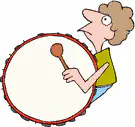
George is playing a bass drum. He notices that the harder he hits the drum, the louder the sound it makes. Based on this information, which of the following is MOST LIKELY true?
The harder George hits the drum, the higher the pitch of the sound it creates.
The harder George hits the drum, the lower the pitch of the sound it creates.
The harder George hits the drum, the weaker the vibration it creates.
The harder George hits the drum, the stronger the vibration it creates.
Kaylee and her friends are getting ready for dance practice. Kaylee places a large portable stereo on a table and turns on the music. One of her friends puts some coins on the edge of the same table. When Kaylee turns up the volume of the stereo, the coins shake and slide off the edge of the table.What is the BEST explanation for why the coins moved?
Turning up the volume increased the pitch of the music, which caused the coins to move.
Turning up the volume increased the amount of electricity flowing through the coins, which caused them to move.
Turning up the volume increased the force of gravity, which caused the coins to fall off the table.
Turning up the volume increased the strength of vibrations coming from the stereo, which shook the table and coins.
Which word BEST completes the following sentence? Higher-pitched sounds are sounds that have __________ vibrations.
slower
stronger
weaker
faster

n science class, Susan and Tommy are making guitars out of shoeboxes. They cut a hole in the box and attach 4 different sized strings over the hole. How does the shoebox guitar work?
When the box is tapped, the box will vibrate the strings and sound like a drum
When the strings are tied together, they will look more like a real guitar
When the strings are plucked, they will snap back to the box and not make a sound
When the strings are plucked, they will vibrate and make a sound

