
 Worksheets
Enzyme
Total questions: 15
Worksheet time: 15mins
Name
Class
Date
1.
Enzymes are considered to be
a)
Lipids
b)
Carbohydrate
c)
Protein
d)
Nucleic Acid
2.
What is the purpose of an enzyme?
a)
give permission for the reaction
b)
raise activation energy
c)
speed up reactions
d)
control how many reactions occur
3.
Where do substrates bind on an enzyme?
a)
voltage-gated channels
b)
surface receptor
c)
calcium channels
d)
active site
4.
What happens when enzymes are heated to a high temperature?
a)
The enzymes die.
b)
The shapes of the enzyme are altered or denatured
c)
The enzymes' amino acid sequence changes.
d)
The enzymes remain the same
5.
What are the enzymes called when they are at high temperature or extreme pH?
a)
denatured
b)
Killed
c)
inactive
d)
normal
6.
Which factors can change the shape of an enzyme and thus denatures a enzyme?
a)
Excessive heat and changes in pH
b)
Nothing can
c)
Exposure to light and sound
d)
Exposure to bacteria and Amoebas
7.

Which of the following conclusions can be drawn from this graph?
a)
The optimum pH of the enzyme is 6.6.
b)
The optimum pH of the enzyme is 5.8
c)
The enzyme’s activity increases as pH increases 5.0 to 9.0
d)
The enzyme’s activity is greater around pH of 8.0 .
8.
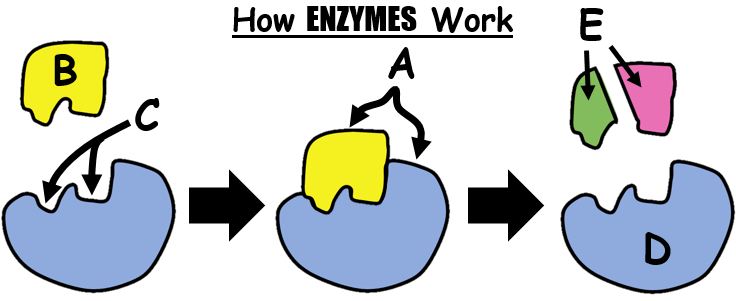
In the diagram, what is letter A?
a)
product
b)
substrate
c)
enzyme-substrate complex
d)
active site
9.
Enzymes are capable of increasing the rate of a chemical reaction within a living cell. Enzymes accomplish this through which of the following means?
a)
reducing the number of products
b)
reducing the activation energy
c)
increasing the temperature of the cell
d)
increasing the concentration of reactants
10.
The "lock and key hypothesis" attempts to explain the mechanism of?
a)
Vacuole formation
b)
Pinocytosis
c)
Sharing of electrons
d)
Enzyme specificity
11.

How do competitive inhibitors affect enzymes?
a)
It binds to the active site, blocking the substrate
b)
It changes the shape of the enzyme
c)
It increases the activation energy
d)
It decreases the activation energy
12.
Which chemical is classified as an enzyme?
a)
Galactose
b)
Lipid
c)
Protease
d)
Manganese dioxide
13.
When a piece of liver is dropped into hydrogen peroxide, the peroxide bubbles vigorously as the hydrogen peroxide (H2O2) decomposes into water (H2O) and oxygen (O2). This rapid change in reaction rate suggests
a)
that liver contains lots of germs
b)
the liver contains an enzyme that breaks down hydrogen peroxide
c)
that liver is a substrate for hydrogen peroxide
d)
that hydrogen peroxide is a powerful enzyme
14.
Give one similarities between competitive inhibitor and non-competitive inhibitor action
a)
Both caused enzyme's conformation changed
b)
The maximum rate of reaction is not reached
c)
Reaction becomes slower
d)
The rate of reaction can be increased by increasing the substrate concentration
15.
Competitive inhibition can be overcome by _______________
a)
increase the concentration of substrate
b)
reduce the concentration of enzyme
c)
increase the concentration of enzyme
d)
reduce the concentration of substrate
100 %

