
Font size
 Worksheets
Thermal Energy
Total questions: 43
Worksheet time: 39mins

Temperature
The total kinetic and potential energy of all the particles in an object.
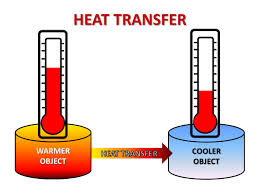
Energy that is transferred from a warmer object to a cooler object.
A measure of the average kinetic energy of the particles in a substance.
The heating of a substance that causes its particles to move more quickly.

Heat
The total kinetic and potential energy of all the particles in an object.
Energy that is transferred from a warmer object to a cooler object.
A measure of the average kinetic energy of the particles in a substance.
The heating of a substance that causes its particles to move more quickly.

Conduction
The transfer of energy by electromagnetic waves.
A circular motion of air that causes wind and changes in weather
A type of heat transfer that occurs through the movement of fluids.
The transfer of energy from one particle of matter to another within an object or between two objects that are in direct contact.

Convection
The transfer of energy by electromagnetic waves.
A circular motion of air that causes wind and changes in weather
A type of heat transfer that occurs through the movement of fluids.
The transfer of energy from one particle of matter to another within an object or between two objects that are in direct contact.

Radiation
A circular motion of air that causes wind and changes in weather
The transfer of energy by electromagnetic waves.
A type of heat transfer that occurs through the movement of fluids.
The transfer of energy from one particle of matter to another within an object or between two objects that are in direct contact.

Specific Heat
Materials that do not conduct heat well.
A material that conducts heat well,
The amount of energy required to raise the temperature of 1 kilogram of a material by 1 kelvin.
The expansion of matter when it is heated.

Insulators
Materials that do not conduct heat well.
A material that conducts heat well,
The amount of energy required to raise the temperature of 1 kilogram of a material by 1 kelvin.
The expansion of matter when it is heated.


What type of heat transfer takes place in liquids and gasses?
Conduction
Convection
Radiation
Thermal Equilibrium
Hot things have ____________ thermal energy than cold things
more
less
same
potato
Temperature is a way we ____________ energy
eat
measure
gain
lose



What is the BEST reason cooking pots are made out of the materials aluminum, copper, and sometimes glass?
They are able to stop the flow of heat.
They are good conductors of heat.
They keep the same amount of heat.
They are good insulators of heat.
If a cup of hot chocolate is put in the microwave, would that add or remove thermal energy to the hot chocolate.
Thermal Energy is Added
Thermal Energy was Removed
If thermal energy is increasing, what is happening to the kinetic energy.
Kinetic energy would be decreasing
Kinetic energy would stay the same
Kinetic energy would be increasing

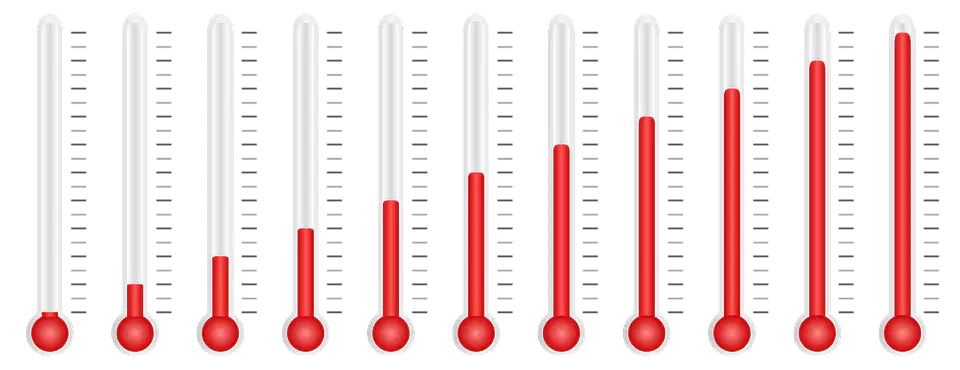
Cold things often have a _________ kinetic energy because_______
lower; particles are moving around less
lower; particles are moving around more
higher; particles are moving around the same
higher; particles do not move

What would be the effect on the particles if more heat is supplied to the system? (a)
Water boils at 373 __ and freezes at 273 __.
oF
oC
K
Water boils at 212 __ and freezes at 32 __.
oF
oC
K
Water boils at 100 __ and freezes at 0 __.
oF
oC
K
The coldest temperature ever recorded on Earth was -89.2 oC in Antarctica. What is this temperature in oF?
-129.6
-67.3
183.8
-362.2

