
NEW
Font size
 Worksheets
Practice Quiz 4.1 - Ecosystems
Total questions: 11
Worksheet time: 33mins
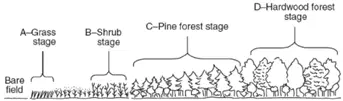
Stage D in the diagram below is located on land that was once a bare field. The sequence of stages leading from bare field to stage D best illustrates the process known as...?
replication
feedback
succession
recycling
Which biotic factors affect the size of a population in a specific ecosystem?
The number of soil minerals in the ecosystem.
The average temperature of the ecosystem.
The number and kinds of predators in the ecosystem.
The amount of oxygen in an ecosystem.
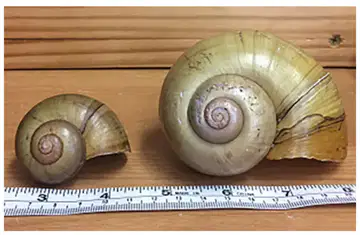
The snail to the right is Pomacea paludosa and the snail to the left is Pomacea macula. Pomacea macula is a large apple snail native to Singapore. This species was introduced to the Florida Everglades, most likely due to someone dumping their freshwater aquarium into a canal in South Florida. This species of snail grows larger and produces more offspring than its native relative. What will probably occur after the introduction of this organism into Florida?
It will likely die due to lack of food.
It will likely be naturalized having natural predators here to keep its population in check.
It will likely outcompete the native snail and the native snail’s population will decline.
It will likely share a niche with the native species of apple snail and both snails’ population will stay the same.
Since the Burmese python was introduced into the Florida everglades in the 1970s, its population has grown significantly. After 2010, the numbers of encounters with pythons have dropped slightly but have maintained a relatively steady population. Which of the following most likely occurred in the snake populations?
Climate change has prevented the population of the python from increasing.
After 2010, the snakes stopped reproducing to conserve resources.
Harsh winter and summer temperatures impacted the growth rate of the pythons./
The population of the pythons in Florida reached its carrying capacity.
A fire burns an oak forest down to soil. Over the next 150 years, if the climate remains the same, this area will likely...?
Remain bare ground
Return to an oak forest
Become a desert
Become a wetland
Which of the following is an area where freshwater and saltwater meet that provides habitat for a diversity of organisms?
Steam/River
Pond/Lake
Estuary
Coral Reef
Disease resulting in the deaths of 1/3 of a dense population of bats in a cave would likely be which of the following?
Density-Dependent Factor
Exponential Growth
Density-Independent Factor
Carrying Capacity
Which of the following is an example of a type of symbiotic relationship called commensalism?
A mosquito biting a human & sucking its blood. The mosquito receives food, & the human is harmed.
A clownfish living in a sea anemone. The clownfish receives food and a place to live, and the anemone is neither helped nor harmed.
An oxpecker (a type of bird) and a zebra. The oxpecker lands on the zebra and eats the insects buzzing around the zebra. The oxpecker receives food, and the zebra no longer has insects bothering it.
A bee and a flower. The bee transfers pollen from one flower to another, pollinating the second plant. The bee gets a meal, and the plants get to reproduce.
Gypsy moths were accidentally introduced into North America. The most likely reason these insects have become serious pests in North America is they:
were bred by research scientists.
feed on plants.
have no natural enemies and reproduce successfully.
are protected by environmental laws
Which statement best describes exponential growth?
Each individual plant grows much larger than usual.
The population immediately decreases.
The species cannot reproduce as well in a new habitat.
Within a few years the population increases dramatically.
At a nuclear bomb testing area, the government has been testing nuclear bombs for years. They decide to shut down the testing area and scientists are called in to get an initial assessment of the ecosystem. The scientists found that there is soil, but no organic life left in the 6-mile diameter area of the center. If you were a scientist observing the growth of this habitat, what type of succession would you expect to observe?
Primary
Secondary
Tertiary
There can be no succession.

