
 Worksheets
TN READY REVIEW ESS 1.1 and 2.1 Erosion and Deposition
Total questions: 15
Worksheet time: 10mins
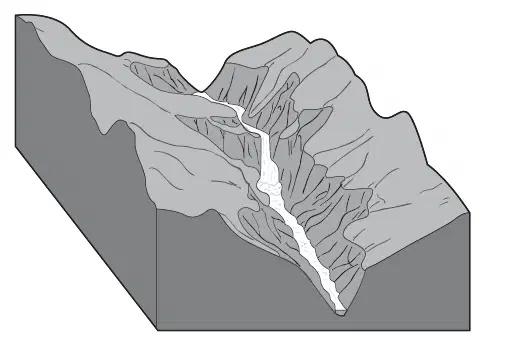
The diagram shows a V-shaped valley. The valley did not exist thousands
of years ago.
This valley is most likely the result of
sediment being deposited by slow-moving water
riverbanks being eroded by fast-moving water.
earthquakes causing the ground to split open.
glaciers moving sediment to a new location.
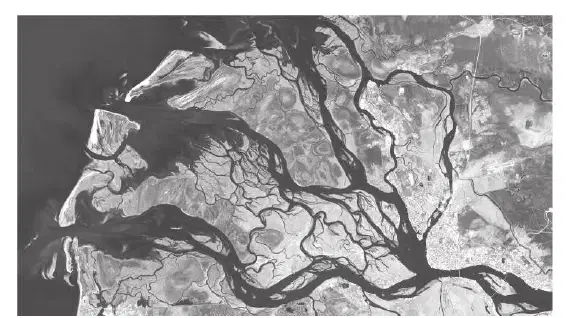
A photograph of a river delta is shown.
Which statement correctly describes the delta in the photograph?
Deposition is causing the delta to become narrower over time.
Deposition is causing the delta to become bigger over time.
Erosion is causing the delta to become smaller over time.
Erosion is causing the delta to become wider over time.
How are the formation of canyons and the formation of deltas similar?
Both are formed by moving
glaciers.
Both are formed due to the
deposition of sediments.
Both are formed by wind
erosion.
Both are formed due to fast
moving water.
Which agent of erosion leads to the formation of sand dunes?
Wind
Water
Animals
Ice
The Grand Canyon is more than 400 km long and in some places almost 2 km deep. Which model best represents the main process that formed the Grand Canyon?


Which of the following describes the long term effects of erosion on landscapes?
Erosion has no long term effects on landscapes
Erosion only changes landscapes in the short term.
Erosion is not noticeable over long periods of time.
Erosion creates new landforms over long periods of time.
How do weathering and erosion contribute to the creation of new landforms?
Weathering breaks down rocks and minerals, and
erosion moves the broken pieces to new locations.
Weathering only affects surface features, while
erosion creates new landforms.
Weathering and erosion do not contribute to the
creation of new landforms.
Weathering and erosion combine to form new types of
rock, which create new landforms.
Canyons and mesas are two landforms found in the western part of the United States. Which statement best describes how canyons and mesas are similar?
Both were formed by slow-moving glaciers.
Both were formed by erosion by wind and water.
Both were part of a mountain that was weathered by ice.
Both were part of a desert that was reshaped by a flood.
Deltas are large landforms found along coastlines. What process forms deltas?
Cementation of sediments by rivers
Deposition of sediments by rivers
Erosion of sediments by ocean waves
Deposition of sediments by ocean waves
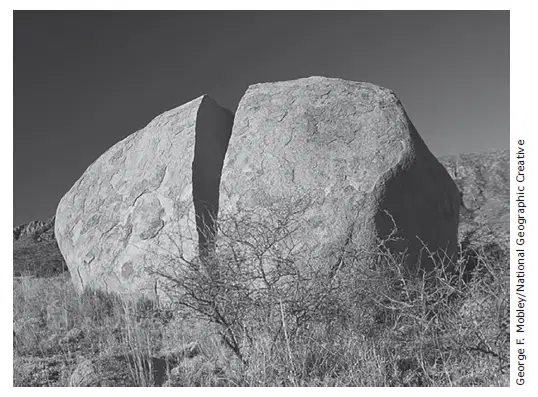
A picture of a rock is shown.
Which process most likely caused the crack in the rock?
Water freezing and thawing in the rock
Wind blowing particles against the rock
Water moving and dropping the rock
Glaciers scraping over the surface of the rock
Every year in the spring, Tennessee Department of Transportation (TDOT) trucks repair potholes on our roadways. What explanation best supports what is occurring over the winter?
More traffic occurs on the highways during the winter.
Water in cracks freezes and breaks apart the concrete.
Precipitation increases in the winter washing away roadways.
Spring brings warmer weather temperatures which causes roadways to crack.
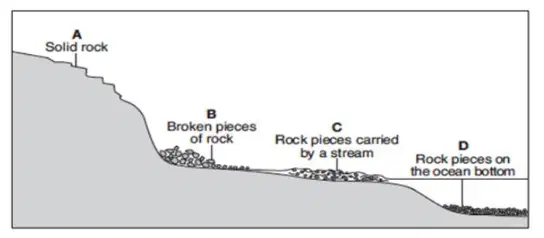
What natural process might cause a rock at location A to travel to location D over time?
gravity and water
people and gravity
wind and earthquakes
ice and people
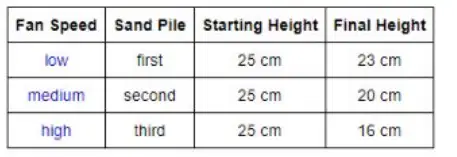
Marty plans to run the fan for exactly one minute in front of each sand pile. He will set the fan on lows speed for the first pile, medium speed for the second pile, and high speed for the third pile. Then he will record the new height of each sand pile.
The results of Marty's investigation are shown in the table. Which fan speed caused the most sand erosion?
low speed
medium speed
high speed
cannot be determined from the information given
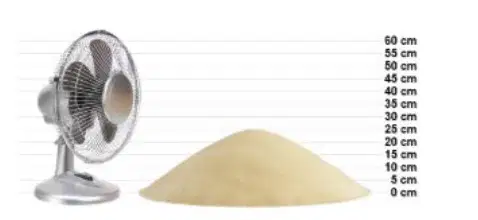
Marty plans to run the fan for exactly one minute in front of each sand pile. He will set the fan on lows speed for the first pile, medium speed for the second pile, and high speed for the third pile. Then he will record the new height of each sand pile.
Marty's investigation is meant to investigate which of the following:
The different types of sand used in the investigation.
How sediment is transported by wind.
How fast the air from the fan is moving.
How much time the fan ran in front of each sand pile.
On a forest field trip, a student is assigned a list of observations to make.
One observation the student looks for is evidence of mechanical weathering.
Which activity would allow the student to check mechanical weathering
off the list?
an acorn falling out of a tree
an ant placing a soil particle on an anthill
a puddle getting smaller as the sun shines on it
a stone becoming smooth in a flowing riverbed

