
 Worksheets
Challenges
Total questions: 10
Worksheet time: 28mins

Egyptians are famous for their gigantic pyramids. However, back when they were built complex mechanisms did not exist. So, how do you think they were able to transport big stone blocks to build those monuments? Try to be creative using simple machines.

Durante la Edad Media las ciudades se amurallaban para fortificarlas, por lo que los atacantes diseñaron artilugios para causar destrucción desde el exterior y poder derribar los muros. ¿Qué máquinas de asedio crees que se empleaban? Trata de pensar en posibles usos de máquinas simples.

This mechanism is called "universal joint", and it is often used as part of the transmission system in vehicles. Which characteristic makes it that useful? Think about the types of movement it allows.

Este mecanismo es un "tornillo sin fin", y se utiliza principalmente por su capacidad de reducción de velocidad. Trata de averiguar la relación de transmisión del mecanismo para un piñón con ocho dientes.

Engines work due to a chemical reaction that generates a small controlled explosion which moves a piston. In this process, we need two main mechanisms: one to handle the flow of chemical reactives and another to transform linear into rotary movement. Which two mechanisms are those? Look at the motor in the image for some help.
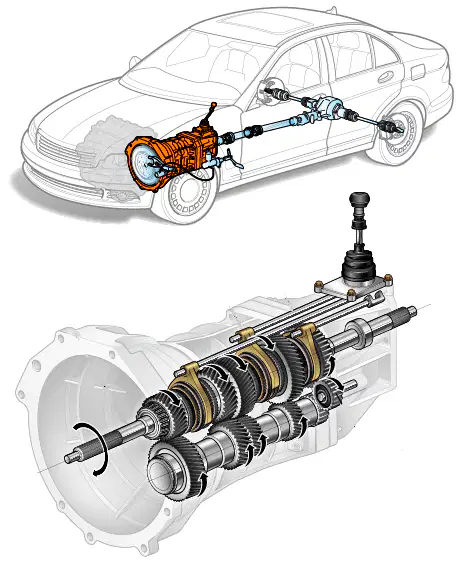
Una parte del sistema de transmisión de un coche es la "caja de cambios", que interviene entre el motor y las ruedas. Este mecanismo consiste en un conjunto de engranajes en el que podemos seleccionar cuáles engranan mediante una palanca (marchas). ¿Para qué sirve este mecanismo? Intenta averiguarlo pensando en lo que hará el coche cuando cambiemos de marcha.

Identify the mechanism in this weight scale. Where does the dark box need to be placed to balance the scale? What could we change to make it be unbalanced towards the left?

Calcula los módulos de cada engranaje del tren con los datos de la tabla. ¿Engranan correctamente? ¿Se trata de un sistema reductor o multiplicador?
Mechanisms are always around us. Try to find a mechanism within the classroom and explain its functioning and purpose. Think about the kind of movements it involves. What type of mechanism is it?
Durante el día estamos en contacto con muchos artilugios basados en mecanismos. Piensa en un sistema que incluya un mecanismo de transmisión de movimiento y otro que incluya uno de transformación de movimiento. Explica la funcionalidad del mecanismo en el artilugio.

