
 Worksheets
ROLLING STOCK PROPULSION AND BRAKING
Total questions: 10
Worksheet time: 7mins
[ELECTRIC PROPULSION] This traction motor uses carbon brush to ensure continuous connectivity of the power supply to the commutator, then the armature. The rotation of the rotor allows the commutator to change contact with the carbon brush. This changes the direction of the current flow in the armatures thus changing its polarity.
DC Traction Motor
AC Traction Motor

[DC TRACTION MOTOR] Motors are one of the greatest human invention in the history of electrical revolution. It mainly uses the principle of magnets and electromagnets. In DC Traction Motors, permanent magnets are found on the _____.
ROTOR
STATOR
CARBON BRUSH
COMMUTATOR
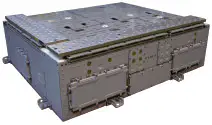
[MOTOR CONTROLLER] Most of the rolling stocks nowadays are equipped with Three-Phase AC Motors. The use of AC Motors in railways with DC power distribution system was made possible due to this equipment.
Chopper
Variable Voltage Variable Frequency
Rectifier
Static Inverter
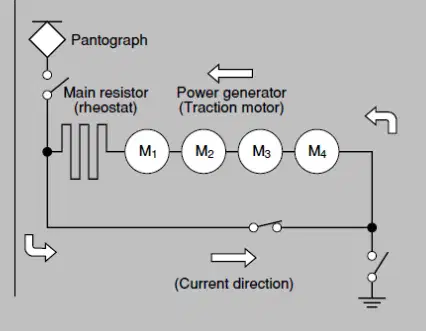
[PRINCIPLES OF ELECTRO-DYNAMIC BRAKING] When an electric train applies electro-dynamic brake at high speed, the traction motor acts as a generator. If the overhead line is not receptive at the time of electro-dynamic braking, the current generated is fed into an on-board resistor to turn it into heat. This type of electric brake is called (a) .
[PRINCIPLES OF ELECTRO-DYNAMIC BRAKING] This type of electric brake occurs when the train applies electro-dynamic brake at high speed and the main circuitry disconnects from the power source (OCS) and connects with the main resistor.
(a)
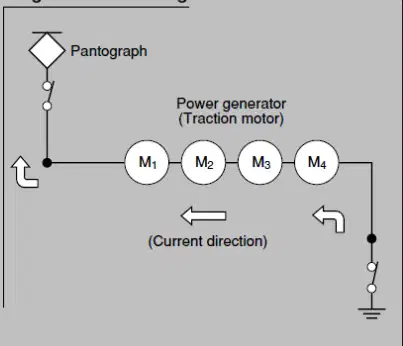
[PRINCIPLES OF ELECTRO-DYNAMIC BRAKING] In electro-dynamic braking, the traction motors of the rolling stock act as generators thus creating a force opposite the direction of the wheel rotation. If receptive, the current generated is fed back to the catenary for other trains to use. This type of electro-dynamic brake is called (a) .

[PNEUMATIC BRAKE SYSTEM] It holds enough air to allow the brakes to be used several times, even if the compressor stops working. It is a storage tank used to hold compressed air. Limits are set such that if the air pressure falls below the threshold, the emergency brakes will automatically apply.
(a)

[PNEUMATIC (AIR) BRAKE] Electro-Pneumatic brake is another type of mechanical/friction brake that utilizes air pressure to actuate moving components of its system. Friction is created when the brake cylinder pushes the _____ to make contact with the wheel thread.
Rail Brake Shoe
Brake Shoe
[CLASSIFICATION OF BRAKE] This brake requires the application of maximum brake effort upon the actuation of the train operator, train conductor, passenger, or other safety-related systems.
(a)
[OTHER BRAKES] Rolling is when a railroad vehicle stopped at a garage or the like starts moving without permission. This brake is a wedge-shaped device that is inserted between the wheels and rails to prevent rolling.
(a)

