
 Worksheets
DOL: STAAR Review Day 7 (9A/B, 10A,B,C, 12A)
Total questions: 6
Worksheet time: 6mins
How do other body systems interact with the endocrine system to regulate body
processes?
Select TWO correct answers.
The nervous system helps control the release of hormones throughout the body.
The immune system helps prevent infection from hormones within the body.
The digestive system helps convert hormones into proteins that are absorbed
within the body.
The circulatory system helps transport hormones throughout the body.
The integumentary system helps provide oxygen to initiate hormone production
throughout the body.
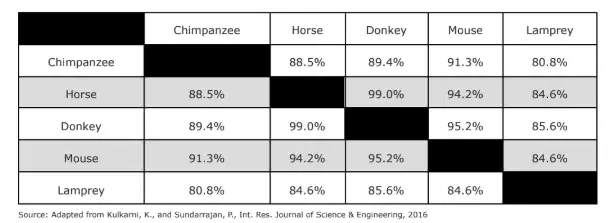
Cytochrome c is a protein that is found in the mitochondria of all aerobic eukaryotic
cells. The gene sequence for cytochrome c has been mapped and analyzed for
thousands of species. The table shows the percentage of the cytochrome c amino-
acid sequence that different species have in common.
Which list is ordered from the species most closely related to the mouse to the
species least closely related to the mouse?
Horse, chimpanzee, donkey, lamprey
Lamprey, donkey, chimpanzee, horse
Chimpanzee, donkey, lamprey, horse
Donkey, horse, chimpanzee, lamprey

Cytochrome c is a protein that helps release energy from food and is produced by
nearly all organisms. The table shows a short sequence of the amino acids in
cytochrome c for several species. Identify the organism that is MOST CLOSELY related to tuna AND explain your
reasoning using evidence from the table.
Think about the information carefully. Then enter your response in the box
provided.
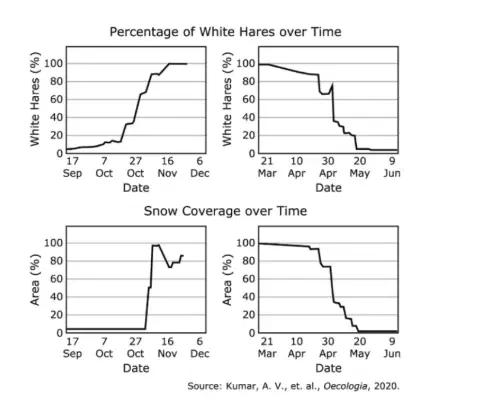
The snowshoe hare often molts, or sheds its fur, during different seasons, going
from a reddish brown to a white fur color.
The graphs show both the change in coat color in one population of snowshoe hares
and the average snow coverage during two periods of the year.
Which statement BEST explains the data shown in the graphs?
Hares with seasonal changes in fur color have a survival advantage and are more
likely to successfully reproduce.
Hares change their fur color as a result of mating choice during the spring
months.
Natural selection allows for mutations to occur during seasonal changes when
food is abundant.
Hare fur color changes when sexual maturity occurs in the fall months.
Which statement describes why brightly colored feathers are selected for in
populations of male peacocks?
The feathers help resist diseases.
The feathers help avoid competition.
The feathers help with movement.
The feathers help attract mates.
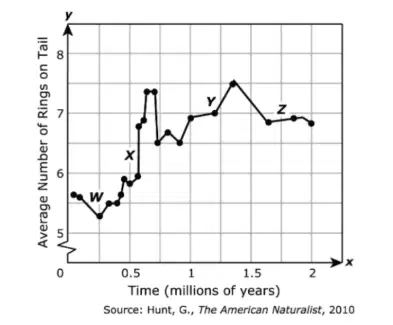
Scientists studied the evolution of ancient organisms known as trilobites.
Scientists collected fossils of one species of trilobite that were determined to have
lived during a 2‐million‐year span. The scientists observed that, over time, the
number of rings in the trilobites' tails changed. The graph shows the results of this
investigation. Which labeled section of the graph represents a time when the environment where
trilobites lived was changing rapidly?
Section W
Section Y
Section X
Section Z

