wayground logo

Free Printable Worksheets

Font size

S
M
L
XL
Worksheets

18.1 P Rates of Reaction

Total questions: 190

Worksheet time: 2hrs 19mins
Name
Class
Date
1.
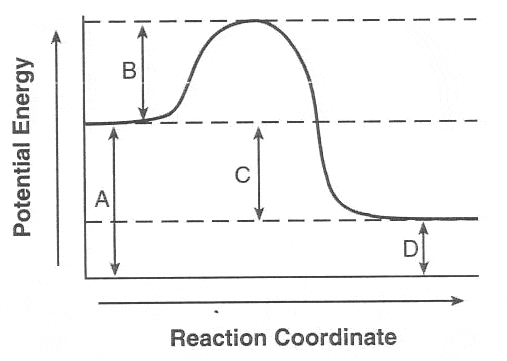
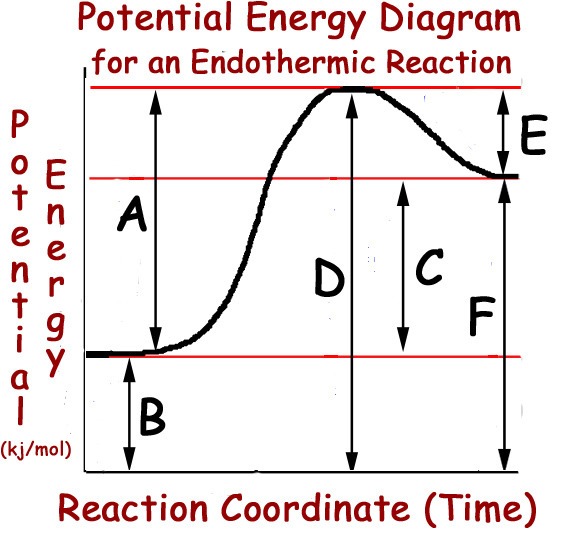
What letter represents the activation energy?
a)
A
b)
B
c)
C
d)
D
2.
Grinding a seltzer tablet into powder increases the rate of reaction due to increased
a)
concentration
b)
surface area
c)
temperature
d)
reactants
3.
Which factors increase the rate of a reaction.
a)
increasing temperature
b)
increasing concentration
c)
increasing surface area
d)
all of these
4.
Smaller particle size allows for a _________ surface area to be exposed for the reaction.
a)
larger
b)
smaller
5.
Increasing the concentration of the reactants will slow down the reaction.
a)
false 
b)
true
6.
Why does a higher temperature increase the rate of a reaction?
a)
it increases both the frequency and energy of particle collisions
b)
it only increases the frequency of particle collisions
c)
it only increases the energy of particle collisions
d)
it reduces the activation energy of the reaction
7.
Why does a higher concentration increase the rate of reaction?
a)
it increases the amount of reactants
b)
it lowers the activation energy
c)
it increases the energy of particle collisions
d)
it increases the frequency of particle collisions because there are more collision sites
8.
Which of these will NOT speed up the rate of reaction between a strip of magnesium and hydrochloric acid?
a)
tightly coil up the strip of magnesium
b)
cut up the strip of magnesium
c)
increase the concentration of the hydrocholoric acid
d)
increase the temperature of the hydrocholoric acid
9.
Products will form faster if____________
a)
the particle size of the reactants are larger.
b)
temperature is decreased.
c)
concentration of the reactants are increased.
d)
the reaction is not stirred.
10.
Explosions can happen when there is a large amount of powdered substance because of a large
a)
temperature
b)
surface area
c)
concentration
d)
pressure
11.

Why does a higher concentration increase the rate of reaction?

a)

it increases the amount of reactants

b)

it lowers the activation energy

c)

it increases the energy of particle collisions

d)

it increases the frequency of particle collisions

12.

Increasing the temperature gives particles more __________.

a)

Time

b)

Energy

c)

Space

d)

Frequency

13.

As the frequency of ______________ increases, the rate of reaction increases.

a)

Time

b)

Reactions

c)

Collisions

d)

Reactants

14.

Adding a catalyst ___________ the activation energy.

a)

Raises

b)

Lowers

c)

Doesn't affect

d)

Inreases

15.

The minimum amount of energy needed for colliding particles to react is called

a)

Chemical Energy

b)

Kinetic Energy

c)

Activation Energy

d)

Potential Energy

16.

Powdered sugar has a greater ______ _____ than a solid cube of

sugar.

a)

Surface Area

b)

Catalyst

c)

Temperature

17.
What two factors govern whether a collision between reacting particles will be effective?
a)

orientation and direction

b)

energy and orientation

c)

temperature and kinetic energy 

18.
Under the collision theory, the particles must collide with  ____ and ____ for a reaction to occur.
a)
sufficient rate and sufficient energy
b)
sufficient surface area and correct orientation
c)
sufficient catalyst and sufficient energy
d)
sufficent energy and correct orientation
19.
Which of the following is NOT a factor affecting reaction rate?
a)
temperature
b)
catalysts
c)
particle size
d)
polarity
20.

Which group of particles shows that increasing surface area increases collisions among particles?

a)

Left side

b)

Right side

c)

Cannot be determined by either picture

21.

In the reaction between magnesium ribbon and hydrochloric acid,which aspect of the reaction can be used to measure its rate?Select one answer.

a)

The production of a colourless gas

b)

The darkening of the magnesium ribbon

c)

The production of a white precipitate

d)

The reduction in the volume of liquid

22.

In an experiment to measure the rate of reaction of calciumcarbonate and hydrochloric acid, the reactants were put in a conical flaskon a digital balance and the mass lost every minute was noted.The results were plotted on the graph. How long did it take to produce 1.8 g of carbon dioxide?

a)

2.5 minutes

b)

1.5 minutes

c)

4 minutes

d)

3 minutes

23.

There are four products of the reaction between sodium thiosulfate and hydrochloric acid.Match each of them to their state on completion of the reaction.

a)

Sulfur

1.

Solid

b)

Sodium chloride

2.

In solution

c)

Sulfur dioxide

3.

Gas

d)

Water

4.

Liquid

24.
Question Image

In a reaction between magnesium ribbon and hydrochloric acid, agas was collected in a gas syringe and the volume noted over time.The results were plotted on the graph:Match the following

a)

20.2 cm³

1.

30 seconds

b)

22 cm³

2.

40 seconds

c)

15.2 cm³

3.

10 seconds

d)

18.5 cm³

4.

20 seconds

25.

Which of the following are ways of measuring the rate of a reaction?

a)

Time taken for a reaction to go to completion

b)

Time taken for a reaction to go to completion

c)

Volume of gas produced over time

d)

Volume of gas produced over time

26.

In the reaction between sodium thiosulfate and hydrochloric acid,which two of the following turn the solution cloudy?

a)

Sodium chloride

b)

Water

c)

Sulfur

d)

Sulfur dioxide

27.

What is the limiting reactant?

a)

The reactant that interacts with a catalyst to increase the rate of reaction

b)

The reactant that is still present when the reaction stops

c)

The reactant whose bonds are most difficult to break

d)

The reactant that is used up when the reaction stops

28.

Iron oxide and aluminium react to produce aluminium oxide andiron:

Fe₂O₃ + 2Al → Al₂O₃ + 2Fe

The relative atomic masses of the constituents are

Fe:56,

O:16,

Al:27

If 10.8 g of aluminium is heated with an excess of iron oxide, how manygrams of aluminium oxide will be produced?

29.

A student puts 1.2 g of magnesium ribbon into a flask of 100 cm³ of1.00 mol dm-3 hydrochloric acid.1.12 dm³ of hydrogen gas is produced and, at the end of the reaction, the flask contains only magnesium chloride dissolved in water; there is no magnesium or hydrochloric acid left. Using this data, match the following quantities of reactant to the volumeof hydrogen produced.Match the following

a)

1.8 g Mg;

200 cm³ HCl

1.

1.68 dm³

b)

2.4 g Mg;

200 cm³ HCl

2.

2.24 dm³

c)

0.6 g Mg;

50 cm³ HCl

3.

0.56 dm³

d)

1.2 g Mg;

25 cm³ HCl

4.

0.28 dm³

30.

The relative atomic masses of carbon, oxygen and hydrogen areC:12, O:16, H:1.Match the molecule to its relative molecular mass.

a)

C₃H₆

1.

42

b)

C₄H10

2.

58

c)

C₂H₅OH

3.

46

d)

CH₃COOH

4.

60

31.

If a reaction finishes quickly it…  

a)

is endothermic

b)

has a slow rate of reaction

c)

is exothermic

d)

has a fast rate of reaction

32.

A reaction produces a gas as a product. Here are some results of a reaction. Calculate the rate of reaction in the first 10 seconds,

33.

At what time does the reaction finish? 

(a)  

34.

Catalytic converters were made compulsory on all cars in the UK manufactured from 1992 onward.

What is the purpose of a catalytic converter?

Explain why it needs the exhaust gases to be hot for it to work effectively.

4 lines
35.

Cheap vegetable oils can be converted into more useful hydrogenated fats for use in food. The vegetable oils are heated then mixed with hydrogen gas and a catalyst. Here is some data for 3 possible catalysts.

State which catalyst would be preferred for use in the food industry, giving reasons.

4 lines
36.

Which of these would have no effect on the rate of a chemical reaction.

a)

The person doing the experiment

b)

Temperature of reactants

c)

Surface area of reactants

d)

Adding a catalyst

37.

A temperature increase causes the particles ......

a)

to slow down

b)

move faster

c)

collide higher

d)

in the right order

38.

How does a catalyst work in speeding up a reaction?

a)

By lowering the activation energy or reaction

b)

by giving them more energy

c)

by making them more available

39.

Why does a higher concentration increase the rate of reaction?

a)

it increases the amount of reactants

b)

it lowers the activation energy

c)

it increases the energy of particle collisions

d)

it increases the frequency of particle collisions
40.
What is the rate of reaction?
a)
How fast a reaction is 
b)
How big a reaction is
c)
How loud a reaction is
d)
How much gas a reaction produces
41.
Grinding a seltzer tablet into powder increases the rate of reaction due to increased
a)
concentration
b)
surface area
c)
temperature
d)
reactants
42.
Which factors increase the rate of a reaction.
a)
increasing temperature
b)
increasing concentration
c)
increasing surface area
d)
all of these
43.

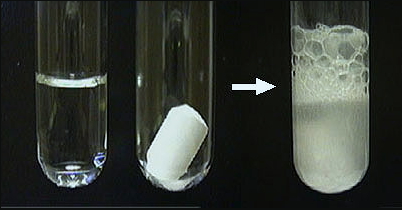
How could we make this reaction happen more quickly?

a)

Decrease the concentration of the acid

b)

crush the chalk to increase the surface area

c)

Put the test tube in an ice bath

44.

The major theory of reaction rate is called

a)

Collision theory

b)

Crash theory

c)

Newton's laws

d)

Thermodynamics

45.

Which of the following will lower the rate

of reaction?

a)

adding an enzyme to the reaction

b)

decreasing the temperature from 40°C to

10°C

c)

breaking a chunk of calcium up into

smaller pieces

d)

increasing the amount of solute

dissolved in a solution

46.

Why does a higher temperature increase the rate of a reaction?

a)

it increases both the frequency and energy of particle collisions

b)

it only increases the frequency of particle collisions

c)

it only increases the energy of particle collisions

d)

it reduces the activation energy of the reaction

47.

Grinding a effervescent tablet into powder increases the rate of reaction due to increased

a)

concentration

b)

surface area

c)

temperature

d)

reactants

48.

Adding a catalyst ___________ the activation energy.

a)

Raises

b)

Lowers

c)

Doesn't affect

d)

Inreases

49.

The minimum amount of energy needed for colliding particles to react is called

a)

Chemical Energy

b)

Kinetic Energy

c)

Activation Energy

d)

Potential Energy

50.

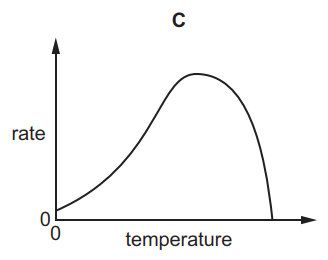
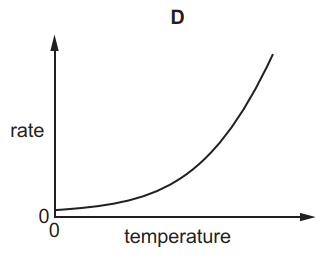
Which graph shows the effect of increasing temperature on the rate of reaction of calcium carbonate with dilute hydrochloric acid?
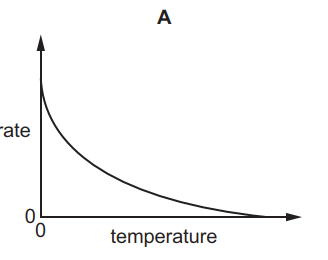
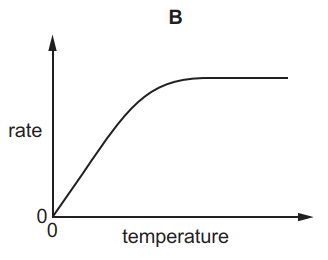
a)
b)
c)
d)
51.
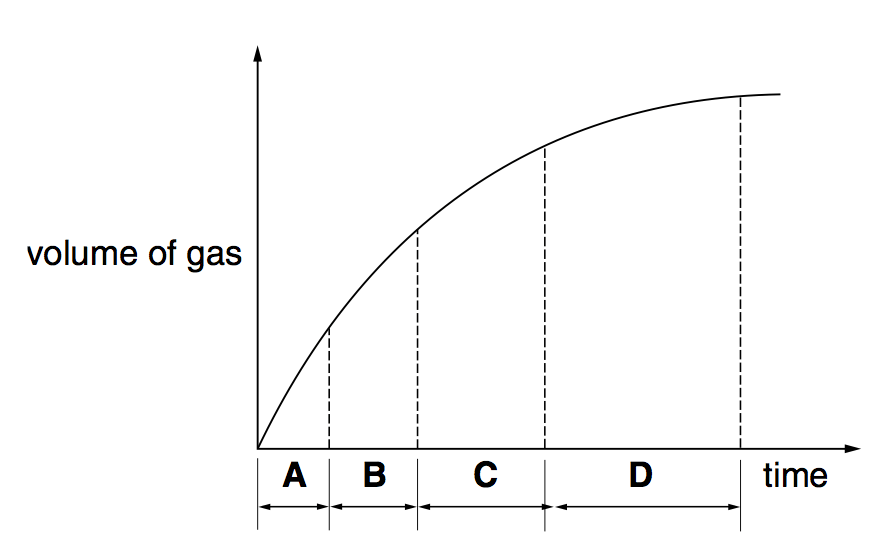
The graph shows how the total volume of a gas given off from a reaction changes with time. In which time interval is least gas given off? 
a)
A
b)
B
c)
C
d)
D
52.
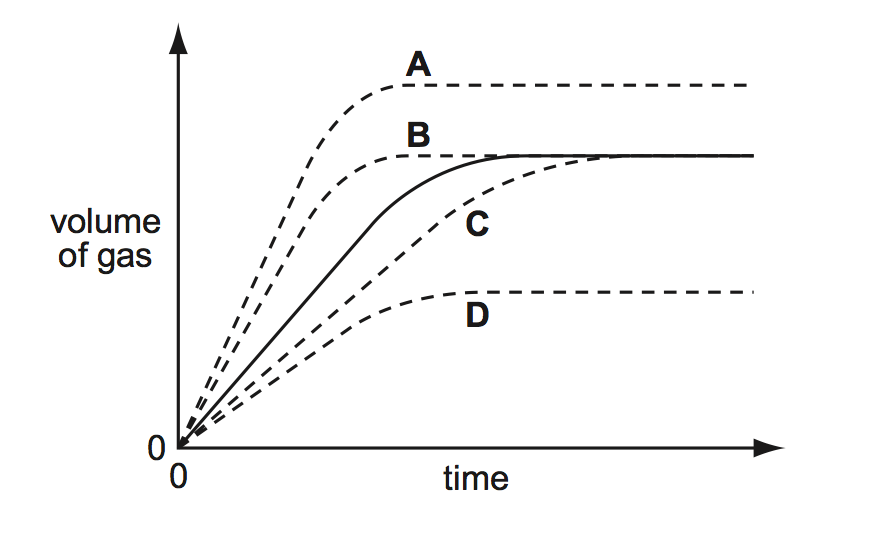
In an experiment, a 2 g lump of zinc and 2 g of powdered zinc are added separately to equal volumes of dilute sulphuric acid. The solid line on the graph shows the volume of gas given off when the 2 g lump is used. Which dotted line is obtained when the zinc is powdered? 
a)
A
b)
B
c)
C
d)
D
53.
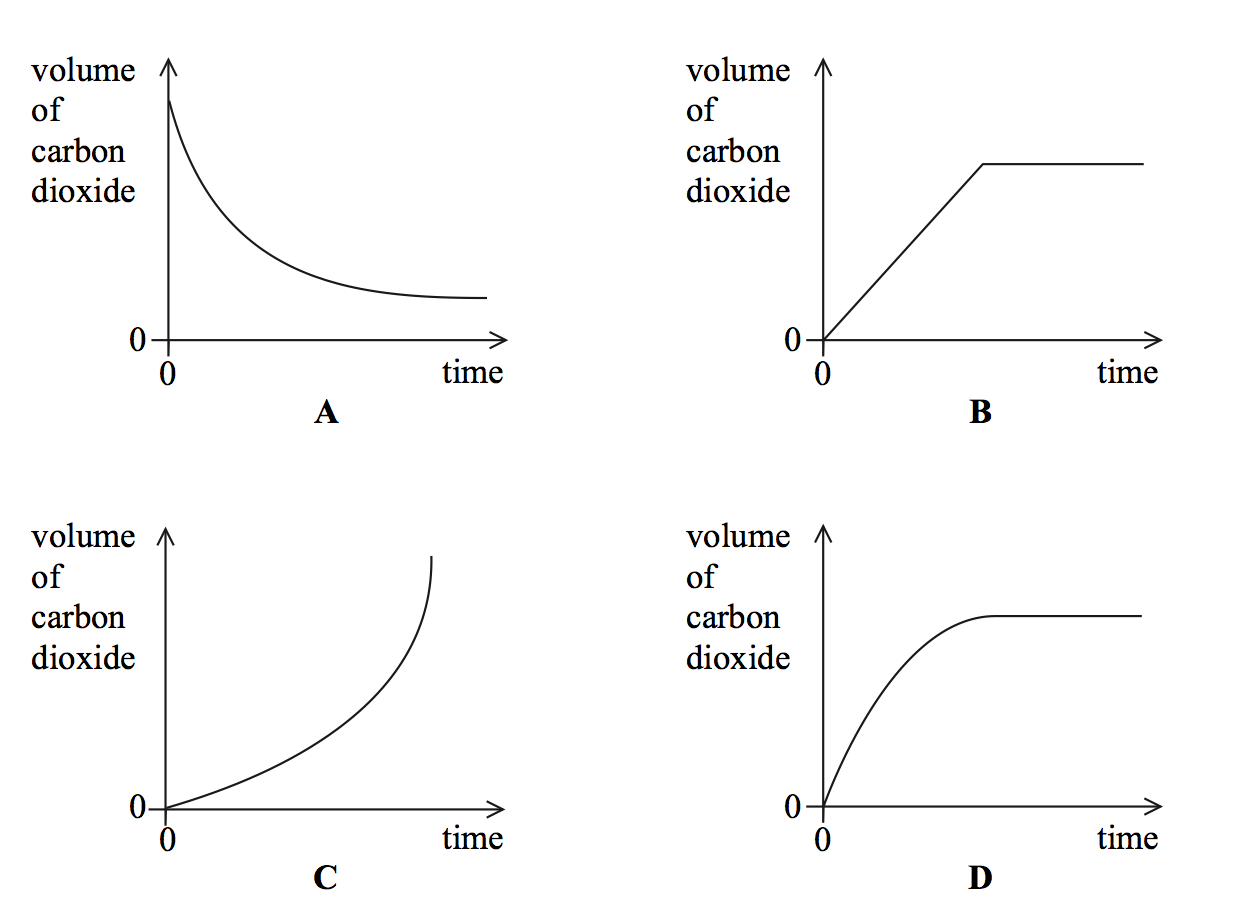
A student investigated the rate of reaction of calcium carbonate with dilute hydrochloric acid. Every minute, the student recorded the total volume of carbon dioxide produced, until some time after the reaction was complete.
Which graph shows the correct results? 
a)
A
b)
B
c)
C
d)
D
54.
Order the letters from highest to lowest rate of reaction.
a)
A > B > C > D
b)
A > BC > D (B and C have the same rate)
c)
A > B > CD (C and D have the same rate)
d)
D > C > B > A
55.
Why does a catalyst increase the rate of reaction?
a)
it produces extra energy for the reactants
b)
it increases the speed of the reactant particles
c)
it increases the frequency of particle collisions
d)
it reduces the activation energy of the reaction 
56.
Why don't all collisions between particles cause a reaction?
a)
the particles also need to collide with a catalyst
b)
not all the particles collide with enough energy
c)
not all the particles collide at a high enough temperature
d)
the particles need to collide with each other twice
57.

How could we make this reaction happen more quickly?

a)

Decrease the concentration of the acid

b)

crush the chalk to increase the surface area

c)

Put the test tube in an ice bath

58.

The major theory of reaction rate is called

a)

Collision theory

b)

Crash theory

c)

Newton's laws

d)

Thermodynamics

59.
The following graph shows two different reaction pathways for the same overall reaction at the same temperature. Which pathway is slower and why?
a)
Red, because the activation energy is larger
b)
Blue, because the activation energy is lower
c)
both reaction progress at the same rate
60.
What does NOT happen when the temperature is increased?
a)
Particles collide more often
b)
Particles collide with more energy
c)
Particles move faster
d)
More particles collide in the correct orientation
61.
What makes an effective collision?
a)
When molecules collide.
b)
When molecules collide with the proper orientation.
c)
When molecules collide with proper orientation and enough kinetic energy.
d)
High Temperature.
62.
What is the rate of reaction?
a)
How fast a reaction is 
b)
How big a reaction is
c)
How loud a reaction is
d)
How much gas a reaction produces
63.
Which letter corresponds to the activation energy of the forward reaction?
a)
A
b)
B
c)
C
d)
D
64.

When we investigate the rate of reaction we are looking at the...

a)

amount of product formed

b)

speed of reaction

c)

concentration of reacting particles

d)

combining reactants with products

65.
Which factors increase the rate of a reaction.
a)
increasing temperature
b)
increasing concentration
c)
increasing surface area
d)
all of these
66.
Increase in temperature of the reactants can do one of the following
a)
Slow collision frequency
b)
Allow less effective collision between the particles
c)
Neutralise the reaction
d)
increase collision between the particles thus increasing the rate.
67.
Why does a catalyst increase the rate of reaction?
a)
it produces extra energy for the reactants
b)
it increases the speed of the reactant particles
c)
it increases the frequency of particle collisions
d)
it reduces the activation energy of the reaction 
68.
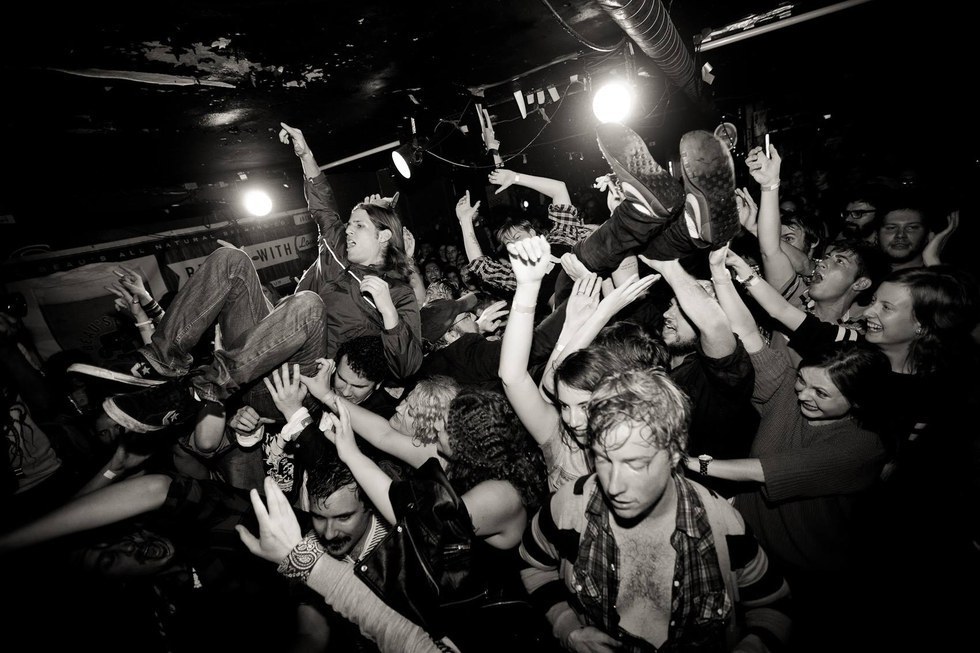
You add more bodies into a "mosh pit" to hope for more collisions.  You have increased-
a)
temperature
b)
concentration
c)
pressure
d)
catalyst
69.
Which of the following increase the reaction rate?
a)
less surface area
b)
lower temperature
c)
an inhibitor
d)
increased concentration
70.
Why don't all collisions between particles cause a reaction?
a)
the particles also need to collide with a catalyst
b)
not all the particles collide with enough energy
c)
not all the particles collide at a high enough temperature
d)
the particles need to collide with each other twice
71.
Why does a higher temperature increase the rate of a reaction?
a)
it increases both the frequency and energy of particle collisions
b)
it only increases the frequency of particle collisions
c)
it only increases the energy of particle collisions
d)
it reduces the activation energy of the reaction
72.
To slow down a chemical reaction you will do one of the following:
a)
Place the reactants in hot water
b)
Place the products in ice bath
c)
Place the reactants in a ice bath
d)
Keep stirring the reactants with a stirring rod
73.

How could we make this reaction happen more quickly?

a)

Decrease the concentration of the acid

b)

crush the chalk to increase the surface area

c)

Put the test tube in an ice bath

74.

Creating fossils is a very _____ chemical reaction

a)

Fast

b)

Slow

c)

It is not a chemical reaction

75.

What does the M after a concentration value stand for?

a)

meters

b)

music

c)

Molarity

d)

moles

76.

Which is the highest concentration?

a)

10m

b)

2M

c)

25 mmol

d)

0.5M

77.

The major theory of reaction rate is called

a)

Collision theory

b)

Crash theory

c)

Newton's laws

d)

Thermodynamics

78.

When surface area is decreased the rate of reaction...

a)

Decreases, because there are LESS possible sites for correct collisions

b)

Increases, because there are LESS possible sites for correct collisions

c)

Decreases, because there are MORE possible sites for correct collisions

d)

Increases, because there are MORE possible sites for correct collisions

79.

When we investigate the rate of reaction we are looking at the...

a)

amount of product formed

b)

speed of reaction

c)

concentration of reacting particles

d)

combining reactants with products

80.
Why don't all collisions between particles cause a reaction?
a)
the particles also need to collide with a catalyst
b)
not all the particles collide with enough energy
c)
not all the particles collide at a high enough temperature
d)
the particles need to collide with each other twice
81.
Why does a higher temperature increase the rate of a reaction?
a)
it increases both the frequency and energy of particle collisions
b)
it only increases the frequency of particle collisions
c)
it only increases the energy of particle collisions
d)
it reduces the activation energy of the reaction
82.
What does NOT happen when the temperature is increased?
a)
Particles collide more often
b)
Particles collide with more energy
c)
Particles move faster
d)
More particles collide in the correct orientation
83.

Which factors increase the rate of a reaction?

a)

increasing temperature

b)

increasing concentration

c)

increasing surface area

d)

all of these

84.

Icing sugar has a greater ______ than a solid cube of

sugar.

a)

Surface Area

b)

Catalyst

c)

Temperature

85.
Why does breaking up a solid reactant increase the rate of reaction?
a)
it creates more solid
b)
it creates more energy
c)
it increases the surface area
d)
it increases the concentration
86.

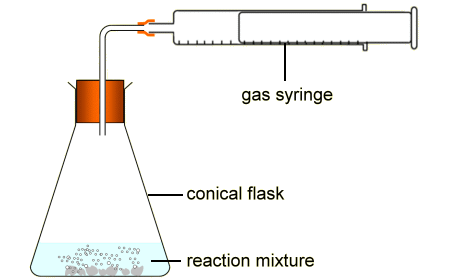
How is this equipment being used to measure the rate of reaction?

a)

The gas syringe measures how much gas is produced in a certain time

b)

The reaction mixture will increase in volume in a certain time

87.

List four factors that affects the rate of a reaction

a)

temperature

b)

concentration

c)

surface area

d)

volume

e)

catalysts

88.

A temperature increase causes the particles ......

a)

to slow down

b)

move faster

c)

collide higher

d)

in the right order

89.

How does a catalyst work in speeding up a reaction?

a)

By lowering the activation energy or reaction

b)

by giving them more energy

c)

by making them more available

90.
The following graph shows two different reaction pathways for the same overall reaction at the same temperature. Which pathway is slower and why?
a)
Red, because the activation energy is larger
b)
Blue, because the activation energy is lower
c)
both reaction progress at the same rate
91.

The ______________is required to break the bonds of the reactants.

a)

Carbonic energy

b)

Activation energy

c)

Plutonic energy

d)

Energi Gaib

92.
What makes an effective collision?
a)
When molecules collide.
b)
When molecules collide with the proper orientation.
c)
When molecules collide with proper orientation and enough kinetic energy.
d)
High Temperature.
93.
To slow down a chemical reaction you will do one of the following:
a)
Place the reactants in hot water
b)
Place the products in ice bath
c)
Place the reactants in a ice bath
d)
Keep stirring the reactants with a stirring rod
94.

How could we make this reaction happen more quickly?

a)

Decrease the concentration of the acid

b)

crush the chalk to increase the surface area

c)

Put the test tube in an ice bath

95.

When surface area is decreased the rate of reaction...

a)

Decreases, because there are LESS possible sites for correct collisions

b)

Increases, because there are LESS possible sites for correct collisions

c)

Decreases, because there are MORE possible sites for correct collisions

d)

Increases, because there are MORE possible sites for correct collisions

96.

List four factors that affects the rate of a reaction

a)

temperature

b)

concentration

c)

surface area

d)

volume

e)

catalysts

97.

A temperature increase causes the particles ......

a)

to slow down

b)

move faster

c)

collide higher

d)

in the right order

98.

How does a catalyst work in speeding up a reaction?

a)

By lowering the activation energy or reaction

b)

by giving them more energy

c)

by making them more available

99.
The following graph shows two different reaction pathways for the same overall reaction at the same temperature. Which pathway is slower and why?
a)
Red, because the activation energy is larger
b)
Blue, because the activation energy is lower
c)
both reaction progress at the same rate
100.
What does NOT happen when the temperature is increased?
a)
Particles collide more often
b)
Particles collide with more energy
c)
Particles move faster
d)
More particles collide in the correct orientation
101.
In an exothermic reaction, heat is ...
a)
taken in
b)
given out
102.

Why does a higher concentration increase the rate of reaction?

a)

it increases the amount of reactants

b)

it lowers the activation energy

c)

it increases the energy of particle collisions

d)

it increases the frequency of particle collisions

103.

Why does a higher temperature increase the rate of a reaction?

a)

it increases both the frequency and energy of particle collisions

b)

it only increases the frequency of particle collisions

c)

it only increases the energy of particle collisions

d)

it reduces the activation energy of the reaction

104.

The ______________is required to break the bonds of the reactants.

a)

Carbonic energy

b)

Activation energy

c)

Plutonic energy

d)

Energi Gaib

105.
What makes an effective collision?
a)
When molecules collide.
b)
When molecules collide with the proper orientation.
c)
When molecules collide with proper orientation and enough kinetic energy.
d)
High Temperature.
106.
Why don't all collisions between particles cause a reaction?
a)
the particles also need to collide with a catalyst
b)
not all the particles collide with enough energy
c)
not all the particles collide at a high enough temperature
d)
the particles need to collide with each other twice
107.
What is the rate of reaction?
a)
How fast a reaction is 
b)
How big a reaction is
c)
How loud a reaction is
d)
How much gas a reaction produces
108.
Located on the left side of the reaction
a)
reactants
b)
products
109.

The minimum amount of energy needed for colliding particles to react is called

a)

Chemical Energy

b)

Kinetic Energy

c)

Activation Energy

d)

Potential Energy

110.
Grinding a seltzer tablet into powder increases the rate of reaction due to increased
a)
concentration
b)
surface area
c)
temperature
d)
reactants
111.

A temperature increase causes the particles ......

a)

to slow down

b)

move faster

c)

collide higher

d)

in the right order

112.

A temperature increase causes the particles ......

a)

to slow down

b)

move faster

c)

collide higher

d)

in the right order

113.

How does a catalyst work in speeding up a reaction?

a)

By lowering the activation energy or reaction

b)

by giving them more energy

c)

by making them more available

114.
The following graph shows two different reaction pathways for the same overall reaction at the same temperature. Which pathway is slower and why?
a)
Red, because the activation energy is larger
b)
Blue, because the activation energy is lower
c)
both reaction progress at the same rate
115.

Why does a higher concentration increase the rate of reaction?

a)

it increases the amount of reactants

b)

it lowers the activation energy

c)

it increases the energy of particle collisions

d)

it increases the frequency of particle collisions

116.
What is the rate of reaction?
a)
How fast a reaction is 
b)
How big a reaction is
c)
How loud a reaction is
d)
How much gas a reaction produces
117.
Grinding a seltzer tablet into powder increases the rate of reaction due to increased
a)
concentration
b)
surface area
c)
temperature
d)
reactants
118.

As the frequency of ______________ increases, the rate of reaction increases.

a)

Time

b)

Reactions

c)

Collisions

d)

Reactants

119.
This slows down or even stops a chemical reaction.
a)
de-activator
b)
catalyst
c)
enzyme
d)
inhibitor
120.
Which factors increase the rate of a reaction.
a)
increasing temperature
b)
increasing concentration
c)
increasing surface area
d)
all of these
121.

What is collision theory?

a)

Increasing the number of collision that occur between molecules will increase the rate of the chemical reaction.

b)

Molecules need enough energy to collide and react.

c)

Atoms constantly collide and react.

d)

The minimum energy needed for atoms to react

122.

A temperature increase causes the particles to ......

a)

to slow down

b)

move faster

c)

collide higher

d)

in the right order

123.

Why does a higher concentration increase the rate of reaction?

a)

it increases the amount of reactants

b)

it lowers the activation energy

c)

it increases the energy of particle collisions

d)

it increases the frequency of particle collisions

124.

Why does a higher temperature increase the rate of a reaction?

a)

it increases both the frequency and energy of particle collisions

b)

it only increases the frequency of particle collisions

c)

it only increases the energy of particle collisions

d)

it reduces the activation energy of the reaction

125.
What is the rate of reaction?
a)
How fast a reaction is 
b)
How big a reaction is
c)
How loud a reaction is
d)
How much gas a reaction produces
126.

The rate of a reaction is how _____________ a reaction occurs.

a)

Quickly

b)

Easily

c)

Unusually

d)

Differently

127.

Increasing the temperature gives particles more __________.

a)

Time

b)

Energy

c)

Space

d)

Frequency

128.

Increasing the temperature, increases the _____ of reaction

a)

Catalyst

b)

Time

c)

Rate

d)

Weight

129.
Rate of chemical reaction means
a)
amount of product formed
b)
speed of reaction
c)
concentration of reacting particles
d)
combining reactants with products
130.

You add more people into an enclosed space in hope for more collisions. You have increased:

a)

temperature

b)

concentration

c)

pressure

d)

catalyst

131.

Why does a higher temperature increase the rate of a reaction?

a)

it increases both the frequency and energy of particle collisions

b)

it only increases the frequency of particle collisions

c)

it reduces the energy of particle collisions

d)

it reduces the activation energy of the reaction

132.
The following graph shows two different reaction pathways for the same overall reaction at the same temperature. Which pathway is slower and why?
a)
Red, because the activation energy is larger
b)
Blue, because the activation energy is lower
c)
both reaction progress at the same rate
133.

How does a catalyst work in speeding up a reaction?

a)

By lowering the activation energy or reaction

b)

by giving them more energy

c)

by making them more available

134.

Why does a higher concentration increase the rate of reaction?

a)

it increases the amount of reactants

b)

it lowers the activation energy

c)

it increases the energy of particle collisions

d)

it increases the frequency of particle collisions

135.

The ______________is required to break the bonds of the reactants.

a)

Carbonic energy

b)

Activation energy

c)

Plutonic energy

d)

Energi Gaib

136.
What makes an effective collision?
a)
When molecules collide.
b)
When molecules collide with the proper orientation.
c)
When molecules collide with proper orientation and enough kinetic energy.
d)
High Temperature.
137.
Why don't all collisions between particles cause a reaction?
a)
the particles also need to collide with a catalyst
b)
not all the particles collide with enough energy
c)
not all the particles collide at a high enough temperature
d)
the particles need to collide with each other twice
138.
Located on the left side of the reaction
a)
reactants
b)
products
139.
A substance that increases speed of chemical reaction without being being changed is called:
a)
Catalyst
b)
Acid
c)
Base
d)
pressure
140.
The amount of a substance in a given volume.
a)
concentration
b)
temperature
c)
surface area
d)
catalyst
141.
This symbol indicates that a reaction is ____________
a)
reversible
b)
irreversible
142.
Which is the reactant - and why?
a)
A, as concentration decreases
b)
B, as concentration decreases
c)
A, as concentration increases
d)
B, as concentration increases
143.
At what time the reaction reached equilibrium?
a)
t1
b)
t2
c)
t3
d)
t4
144.
For the reaction...
SO2 + O2 <=>  SO3
If the equilibrium position shifts to the right, the concentration of O2 will ___________.
a)
increase
b)
decrease
c)
remain the same
d)
double
145.
For the reaction...
SO2 + O2  <=>  SO3
If the concentration of SOis increased, the equilibrium position of the reaction will shift ___________.
a)
to the left
b)
to the right
c)
to the left and right 
d)
neither left nor right
146.
An equilibrium constant with a large value, e.g. Kc = 1000, indicates…
a)
A very fast reaction
b)
Mostly products at equilibrium
c)
Mostly reactants at equilibrium
d)
Nothing useful at all
147.
Le Chatelier's Principle states that.... 
If a (dynamic) equilibrium is disturbed by changing the conditions, the position of equilibrium................
a)
moves to increase the change
b)
moves to counteract the change
c)
does not change
148.
What are [A] and [B]?
a)
concentration of reactants
b)
concentration of products
c)
energy of reactants
d)
energy of products
149.
What are the two factors to look for when determining if the reaction is at equilibrium?
a)
Forward reaction rate is faster than the reverse and concentrations are equal
b)
Forward and reverse reaction rates are equal and concentration is conctant
c)
Forward and revers reaction rates are equal and concentration is equal
d)
Forward reaction rate is faster than the reverse and concentration is equal
150.
Define chemical equilibrium.
a)
A reaction is reversible.
b)
The concentration of the reactants is equal to the concentration of the products.
c)
The rate of a forward reaction is equal to the rate of the reverse reaction.
d)
The reaction stops and no further change in concentration occurs.
151.
What is the activation energy?
a)
the quantity of heat absorbed in a reaction
b)
the minimum energy needed to begin a reaction
c)
the energy given off after reactants collide.
d)
both the energy and frequeny of collisions in increased
the energy difference between reactants and products
152.

For the reaction...

SO2 + O2 ⇌ SO3

If the concentration of SO2 is increased, the equilibrium of the reaction will shift ___________.

a)

left

b)

right

c)

left and right

d)

neither left or right

153.

For the reaction...

SO2 + O2 <−> SO3

If the equilibrium shifts to the right, the concentration of O2 will ___________.

a)

increase

b)

decrease

c)

double

d)

stay the same

154.

Le Chatelier's Principle states that if a chemical system at equilibrium is stressed,

a)

the system will adjust to increase the stress

b)

the system will adjust to reduce the stress

c)

the system will not adjust

155.

Why does a higher concentration increase the rate of reaction?

a)

it increases the amount of reactants

b)

it lowers the activation energy

c)

it increases the energy of particle collisions

d)

it increases the frequency of particle collisions

156.

Why does a higher temperature increase the rate of a reaction?

a)

it increases both the frequency and energy of particle collisions

b)

it only increases the frequency of particle collisions

c)

it only increases the energy of particle collisions

d)

it reduces the activation energy of the reaction

157.

Breaking up a lump of potassium into smaller pieces increases the rate of reaction due to increased

a)

concentration

b)

surface area

c)

temperature

d)

reactants

158.

Which colour on the graph would represent the solution with the higher temperature?

a)

Red

b)

Blue

c)

None

d)

Both

159.
Activation energy is required to start a chemical reaction. What is activation energy?
a)
The energy needed for a reaction to occur
b)
The minimum amount of energy needed for a reaction to potentially occur
c)
The energy added by a catalyst
d)
The energy possessed by the products
160.
What letter represents the activation energy?
a)
A
b)
B
c)
C
d)
D
161.
Why does breaking up a solid reactant increase the rate of reaction?
a)
it creates more solid
b)
it creates more energy
c)
it increases the surface area
d)
it increases the concentration
162.
A ______________ is a substance that increases the rate of a reaction without being used up during the reaction. 
a)
catalyst
b)
product
c)
reactant
d)
solute
163.
What type of reaction is this?
a)
Endothermic
b)
Exothermic
164.
Which of these will NOT speed up the rate of reaction between a strip of magnesium and hydrochloric acid?
a)
tightly coil up the strip of magnesium
b)
cut up the strip of magnesium
c)
increase the concentration of the hydrocholoric acid
d)
increase the temperature of the hydrocholoric acid
165.
In an endothermic reaction the products have 
a)
more energy than the reactants
b)
less energy than the reactants
c)
the same energy as the reactants
d)
no energy
166.

Which of the following would increase the rate of CO2 made using marble chips and HCl?

a)

Lowering the temperature

b)

Crushing the marble chips

c)

Using less acid

d)

Using bigger marble chips

167.
Rate of chemical reaction means
a)
amount of product formed
b)
speed of reaction
c)
concentration of reacting particles
d)
combining reactants with products
168.
A substance that increases speed of chemical reaction without being being changed is called:
a)
Catalyst
b)
Acid
c)
Base
d)
pressure
169.
Activation energy is required to start a chemical reaction. What is activation energy?
a)
The maximum amount of energy used
b)
The minimum amount of energy required to cross the reaction barrier
c)
The energy of the reactants
d)
The energy possessed by the products
170.
Increasing the pressure of a reacting vessel only affects:
a)
Gaseous reactants
b)
Solid reactants
c)
Liquid reactants
d)
None of the above
171.
To slow down a chemical reaction you will do one of the following:
a)
Place the reactants in hot water
b)
Place the products in ice bath
c)
Place the reactants in a ice bath
d)
Keep stirring the reactants with a stirring rod
172.
Reactions that give out heat to the surrounding are classified as one of the following:
a)
Spontaneous
b)
Sluggish
c)
Exothermic
d)
Endothermic
173.
Increase in temperature of the reactants can do one of the following
a)
Slow collision frequency
b)
Allow less effective collisions between the particles
c)
Neutralize the reaction
d)
increase collision between the particles thus increasing the rate.
174.
Grinding a seltzer tablet into powder increases the rate of reaction due to increased
a)
concentration
b)
surface area
c)
temperature
d)
reactants
175.
In an endothermic reaction the products have 
a)
more energy than the reactants
b)
less energy than the reactants
c)
the same energy as the reactants
d)
no energy
176.
In an exothermic reaction the products have
a)
more energy than the reactants
b)
the same energy as the reactants
c)
less energy than the reactants
d)
no energy
177.
B represents
a)
energy absorbed
b)
energy released
c)
activation energy
178.
C represents
a)
energy absorbed
b)
energy released
c)
activation energy
179.
Define chemical equilibrium.
a)
A reaction is reversible.
b)
The concentration of the reactants is equal to the concentration of the products.
c)
The rate of a forward reaction is equal to the rate of the reverse reaction.
d)
The reaction stops and no further change in concentration occurs.
180.
What makes an effective collision?
a)
When molecules collide.
b)
When molecules collide with the proper orientation.
c)
When molecules collide with proper orientation and enough kinetic energy.
d)
High Temperature.
181.
This symbol indicates that a reaction is ____________
a)
reversible
b)
irreversible
182.
Which is the reactant?
a)
A, its concentration decreases
b)
B, its concentration decreases
c)
A, its concentration increases
d)
B, its concentration increases
183.
When the rate of the forward reaction is equal to the rate of backward reaction, the system is said to be in
a)
Chemical Equilibrium
b)
Chemical Balance
c)
Chemical Constant
d)
Chemical Reaction
184.
When the system X + 2 Y <--> Z has reached equilibrium, which of the following is TRUE?
a)
Forward reaction and Backward reaction stopped.
b)
Forward reaction has speeded up and backward reaction has slowed down.
c)
Forward and backward reactions occur at the same time.
d)
Forward reaction has slowed down and backward reaction has speeded up.
185.
At what time the reaction reached equilibrium?
a)
t1
b)
t2
c)
t3
d)
t4
186.
Which of the following conditions are going to create more H2?
N2 + 3 H2 ↔ 2 NH3 + 92 kJ
a)
Decreasing Temperature and pressure
b)
Increasing Temperature and Pressure
c)
Increasing Temperature and NH3
d)
Decreasing Temperature and N2
187.
Which of the following conditions are going to create more N2 & H2?
N2 + 3 H2 ↔ 2 NH3 + 92 kJ
a)
Decreasing Temperature and pressure
b)
Increasing Temperature and Decreasing Pressure
c)
Increasing Temperature and NH3
d)
Decreasing Temperature and N2
188.
Which of the following conditions are going to create more NH3?
N2 + 3 H2 ↔ 2 NH3 + 92 kJ
a)
Decreasing Temperature and pressure
b)
Increasing Temperature and Decreasing Pressure
c)
Increasing Temperature and NH3
d)
Decreasing Temperature and N2
189.
What causes the reaction to go FORWARD
A  + B ↔ C + D + energy
a)
Increasing D
b)
Increasing C
c)
Increasing A
d)
Increasing Temperature
190.
What causes the reaction to go REVERSE
A  + B ↔ C + D + energy
a)
Decreasing D
b)
Decreasing C
c)
Decreasing B
d)
Decreasing Temperature