wayground logo

Free Printable Worksheets

Font size

S
M
L
XL
Worksheets

Science Quarter 3 Review

Total questions: 100

Worksheet time: 2hrs 47mins

Name
Class
Date
1.

Which law is this picture illustrating?

a)

Law 1

b)

Law 2

c)

Law 3

2.

A rocket pushes burning gases DOWN which causes the rocket to launch UP. Which law is this?

a)

Law 1

b)

Law 2

c)

Law 3

3.

A sports car speeds up much faster than a dump truck when a traffic light turns from red to green. Which law is this?

a)

Law 1

b)

Law 2

c)

Law 3

4.

When a mule stops suddenly, the packages on its back continue to move forward onto the ground. Which law is this?

a)

Law 1

b)

Law 2

c)

Law 3

5.

An object in motion stays in motion and an object at rest stays at rest UNLESS

a)

acted on by a balanced force.

b)

acted on by an unbalanced force.

6.

Force is related to mass and acceleration. Which law is this?

a)

Law 1

b)

Law 2

c)

Law 3

7.

It is much more difficult to move a dresser full of clothes than an empty dresser.

a)

Law 1

b)

Law 2

c)

Law 3

8.

A book sitting on the table does not move.

a)

Law 1

b)

Law 2

c)

Law 3

9.

Weight is the measure of gravitational force on an object.

a)

True

b)

False

10.

Forces have strength and direction.

a)

True

b)

False

11.

You can reduce friction by

a)

increasing the mass

b)

adding lubricant

c)

adding more surface area

12.

Which factor is NOT involved in determining gravitational force?

a)

mass

b)

speed

c)

distance

13.
According to Newton’s first law of motion, a moving object that is not acted on by an unbalanced force will
a)
remain in motion.
b)
eventually come to a stop.
c)
change its momentum.
d)
accelerate.
14.
Forces always act in equal and opposite pairs.
a)
Newton's 1st Law
b)
Newton's 3rd Law
c)
Newton's second law
15.
What is Newton's First Law
a)
F=ma
b)
Every action has an equal and opposite reaction
c)
An object at rest stays at rest, an object in motion stays in motion. 
d)
Friction 
16.
F = MxA
a)
1st
b)
2nd
c)
3rd
17.
Acceleration is due to a force put on an objects mass. 
a)
1st
b)
2nd
c)
3rd
18.
a)
1st
b)
2nd
c)
3rd
19.
a)
1st
b)
2nd
c)
3rd
20.
a)
1st
b)
2nd
c)
3rd
21.
a)
1st
b)
2nd
c)
3rd
22.
What law is best described by inertia?
a)
1st
b)
2nd
c)
3rd
23.
Which has more Inertia? (and more force to move) 
a)
Truck
b)
Ant
c)
Cat
d)
Desk
24.
What changes when you go to the moon?
a)
Your weight
b)
Your volume
c)
Your mass
d)
Your density
25.
Objects tendency to resist change
a)
Friction
b)
Inertia
c)
Force
d)
Gravity
26.
Why is water added to a slide to help you move down it quickly?
a)
To make it stop
b)
To make it less slippery
c)
To reduce friction
d)
To increase friction
27.
When an unbalanced force acts on an object in the same direction of motion, then the object's speed ________________.
a)
increases
b)
decreases
c)
stays the same 
d)
does nothing
28.
Think about the experiment we performed with the coin on an index card. When we flicked the index card, the coin dropped into the cup. Why did it drop straight down?
a)
Due to its inertia and action
b)
Due to its volume and mass
c)
Due to its density
d)
Due to its weight and inertia
29.
A wall exerts a 3 newton force on the person leaning on it.  The force exerted by the person leaning on the wall is _____________ . 
a)
30 newtons
b)
3 newtons
c)
0.3 newtons
d)
0 newtons
30.

The man drops both balls (a medicine ball and a basketball) from the same height at the same time.  What does he notice?

a)

They both fall at the same rate.

b)

The medicine ball falls faster than the basketball.

c)

The basketball falls faster than the medicine ball.

d)

They remain in the air 

31.
If an object is moving forward, which way is the force of friction on the object.
a)
up
b)
backward
c)
down
d)
forward
32.
___________________ can be speeding up, slowing down, or changing direction.
a)
Acceleration
b)
Speed
33.
As a rollercoaster falls from the top of its highest point, what increases
a)
Potential energy
b)
Kinetic energy
34.
Where does the roller coaster have the most potential energy? 
a)
at the beginning of the ride
b)
at the top of the highest hill
c)
at the end of the ride
d)
on the top of the loop
35.
What law does the picture represent?
a)
Newton's First Law
b)
Newton's Second Law
c)
Newton's Third Law
36.
What law does the picture represent?
a)
Newton's 1st Law
b)
Newton's 2nd Law
c)
Newton's 3rd Law
37.
What law does the picture represent?
a)
Newton's First Law
b)
Newton's Second Law
c)
Newton's Third Law
38.
A more massive object has _________ inertia. 
a)
less
b)
more
c)
no
d)
some
39.
A less massive object has ____________ inertia. 
a)
less 
b)
more
c)
no 
d)
some
40.

What is the unit to MEASURE force?

a)

Kilogram

b)

Meter

c)

Pounds

d)

Newton

41.

A ____________ is a push or a pull on an object.

a)

friction

b)

force

c)

magnet

d)

gravity

42.
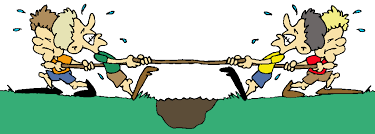
If these teams are pulling with the same amount of force what will happen?
a)
The boy in blue will win.
b)
They will not move at all.
c)
The boy in red will win.
d)
Both will fall down.
43.
The sum of all forces acting on an object.
a)
Contact Force
b)
Balanced Force
c)
Unbalanced Force
d)
Net Force
44.
What will cause an object to move?
a)
Applied forces
b)
Balanced forces
c)
Unbalanced forces
45.
A push or pull that causes a change in motion
a)
Friction
b)
Gravity
c)
Force
d)
Mass
46.
When forces are _________ the object DOES NOT move.
a)
unbalanced
b)
balanced
c)
heavy
d)
light
47.
When forces are ___________ the object will move.
a)
unbalanced
b)
balanced
c)
light
d)
gravity
48.

What may happen if she stops short?

a)

everything stops

b)

boxes tumble forward

c)

boxes tumble backwards

49.

What force(s) is/are acting on the girl & wagon?

a)

gravity

b)

friction

c)

air resistance

d)

all of the above

50.

When the cloths pin is removed, which direction with the balloon go?

a)

right

b)

left

c)

up

51.

Which of Newton's laws will explain the resulting action?

a)

1st law; inertia

b)

2nd law; force = mass X acceleration

c)

3rd law; action reaction

52.

What is the relationship between gravity and mass of the planets?

a)

more mass = more gravity

b)

less mass = more gravity

c)

mass and gravity are always the same

53.

Name 2 planets with less gravity than earth.

a)

Jupiter and Pluto

b)

Mars and Uranus

c)

Mercury and Mars

54.
An automobile you are riding in suddenly stops, but you continue to go forward.
a)
Newton's
1st
Law of Motion
b)
Newton's
2nd
Law of Motion
c)
Newton's
3rd
Law of Motion
55.
When the force on a car is doubled, the acceleration is doubled.
a)
Newton's
1st
Law of Motion
b)
Newton's
2nd
Law of Motion
c)
Newton's
3rd
Law of Motion
56.
A stationary bumper car is set in motion by the outside force of another bumper car colliding with it.
a)
Newton's
1st
Law of Motion
b)
Newton's
2nd
Law of Motion
c)
Newton's
3rd
Law of Motion
57.
A rocket in outer space continues to move.
a)
Newton's
1st
Law of Motion
b)
Newton's
2nd
Law of Motion
c)
Newton's
3rd
Law of Motion
58.
A magician pulls a table cloth from under a table of dishes.
a)
Newton's
1st
Law of Motion
b)
Newton's
2nd
Law of Motion
c)
Newton's
3rd
Law of Motion
59.
A skater pushes another skater forward, but the one pushing moves backwards.
a)
Newton's
1st
Law of Motion
b)
Newton's
2nd
Law of Motion
c)
Newton's
3rd
Law of Motion
60.
The harder you hit a baseball, the faster it accelerates.
a)
Newton's
1st
Law of Motion
b)
Newton's
2nd
Law of Motion
c)
Newton's
3rd
Law of Motion
61.
You push against a wall and the wall is pushing back on you.
a)
Newton's
1st
Law of Motion
b)
Newton's
2nd
Law of Motion
c)
Newton's
3rd
Law of Motion
62.
As the fuel in a rocket ignites, the force of gas expansion and explosion pushes out the back of the rocket and pushes the rocket forward.
a)
Newton's
1st
Law of Motion
b)
Newton's
2nd
Law of Motion
c)
Newton's
3rd
Law of Motion
63.
You step from a boat to a dock.  The boat moves backwards as you move forwards and you fall in the water.
a)
Newton's
1st
Law of Motion
b)
Newton's
2nd
Law of Motion
c)
Newton's
3rd
Law of Motion
64.
You push against the floor when you walk and the floor pushes back on you.
a)
Newton's
1st
Law of Motion
b)
Newton's
2nd
Law of Motion
c)
Newton's
3rd
Law of Motion
65.
You are carrying a lunch tray when you bump into the edge of a table.  Although the tray did not tip, your milk falls off of the front of the tray.
a)
Newton's
1st
Law of Motion
b)
Newton's
2nd
Law of Motion
c)
Newton's
3rd
Law of Motion
66.
You slide towards the window when a car makes a sudden turn.
a)
Newton's
1st
Law of Motion
b)
Newton's
2nd
Law of Motion
c)
Newton's
3rd
Law of Motion
67.
A swimmer pushes water back with her arms but her body moves forward.
a)
Newton's
1st
Law of Motion
b)
Newton's
2nd
Law of Motion
c)
Newton's
3rd
Law of Motion
68.
A second grader is pulling her sled behind her in the snow.  She is crying because when she stopped to tie on her hat, the sled kept sliding and hit her in the back of her legs.
a)
Newton's
1st
Law of Motion
b)
Newton's
2nd
Law of Motion
c)
Newton's
3rd
Law of Motion
69.
When you paddle a kayak, you push the paddle backwards in the water and the kayak goes forward.
a)
Newton's
1st
Law of Motion
b)
Newton's
2nd
Law of Motion
c)
Newton's
3rd
Law of Motion
70.
Mass is a measure of an object's inertia. Objects with greater mass have a greater inertia; objects with less mass have less inertia.
a)
true 
b)
false 
71.
Calculate the net force of the object in the image shown.
a)
20N
b)
35N
c)
5N
d)
25N
72.
Which direction will the object move?
a)
Up
b)
Down
c)
Right
d)
Left
73.
Which direction will the object move?
a)
Right
b)
Left
c)
Up
d)
Down
74.
What is the net force of this object?
a)
0N
b)
50N
c)
25N
d)
5N
75.
Is this a balanced or unbalanced force?
a)
Balanced
b)
Unbalanced
c)
Neither
d)
Both
76.

A force is ____.

a)

a push or pull that can cause movement

b)

a magnet

c)

when someone does not work

77.

Gravity is ____.

a)

a force that attracts objects towards each other

b)

a force that moves objects away

c)

a push or pull

78.

This is an example of ____.

a)

gravity

b)

wind

c)

magnetism

d)

static electricity

79.

This is an example of _____.

a)

magnetism

b)

gravity

c)

wind

d)

static electricity

80.

Which of the following is NOT an example of an unseen force?

a)
b)
c)
d)
81.

What force is causing the trees to move?

a)

wind

b)

gravity

c)

magnetism

d)

static electricity

82.

The girl's hair and the comb are attracting one another. What is the unseen force?

a)

static electricity

b)

magnetism

c)

wind

d)

gravity

83.

Potential energy depends on the ________ and ________ of the object.

a)

Height (position)

b)

Mass

c)

Speed

d)

Friction

84.

At which point of the roller coaster is potential energy the greatest?

a)

W

b)

X

c)

Y

d)

Z

85.

__________ is stored energy.

a)

Potential

b)

Kinetic

86.
What kind of energy is in a rock at the edge of a cliff?
a)
Potential
b)
Kinetic
87.
What kind of energy is in a moving skateboard?
a)
Potential
b)
Kinetic
88.
Energy can not be created or destroyed, only converted from one form to another.
a)
true
b)
false
89.

A basketball is being held in the hands of a player. This shows...

a)

Potential energy

b)

Kinetic energy

90.
What is energy?
a)
rate of work
b)
Motion of an object
c)
ability to do work
d)
force over time
91.

Kinetic energy depends on the ________ and ________ of the object.

a)

Height (position)

b)

Mass

c)

Speed

d)

Friction

92.

Speed can be found by calculating...

a)
acceleration/velocity
b)
friction/gravity
c)
momentum/time
d)
distance/time
93.

A car takes 3 hours to travel180 miles north at a constant speed. How fast and at what velocity is the car traveling?

a)

30 mph and 30 mph north

b)

50 mph and 50 mph north

c)

60 mph and 6o mph north

d)

90 mph and 90 mph north

94.
Scott drives a Jeep 12 km east, then 4 km north, then finally 3 km west. He traveled a total distance of:
a)
5 km
b)
10 km
c)
13 km
d)
19 km
95.
A ping-pong ball rolls forward 6 meters, and bounces backward 3 meters. It traveled a total distance of:
a)
9 meters
b)
6 meters
c)
3 meters
d)
0 meters
96.

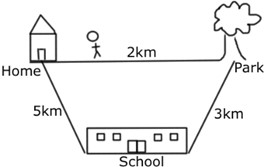
Jerry walked from home to school, then from the school to the park. What is his total displacement?

a)

2 km

b)

5 km

c)

8 km

d)

10 km

97.

Jerry walked from home to school, then from the school to the park. What is his total distance?

a)

2 km

b)

5 km

c)

8 km

d)

10 km

98.

What type of motion could this be described as?

a)

circular

b)

vibrational

c)

straight line

99.

How could we describe this type of motion?

a)

circular

b)

straight- line

c)

vibrational

100.

How could we describe this type of motion?

a)

straight-line

b)

circular

c)

vibrational