
 Worksheets
Cells and Viruses STAAR Review
Total questions: 6
Worksheet time: 3mins

A student groups different types of cells as shown.
Which table headings should the student use for the two groups?
1. Animal cells
2. Plant cells
1. Prokaryotic cells
2. Eukaryotic cells
1. Mobile cells
2. Motile cells
1. Fungal cells
2. Bacterial cells

Materials are provided to students to build modes of a prokaryotic cell, a eukaryotic cell, and a virus. The material and the structures they represent are listed in the table shown. Which materials would be used in all three models?
Yellow paper oval
Gray paper hexagon
Blue yarn
Purple buttons
Viruses can be transmitted through air, water, food, insect bites, and direct skin contact. Once a virus gains entry to the body, it invades a host cell in order to -
deactivate the host cell's defenses
synthesize antibodies for defense
metabolize host proteins and grow
access cellular process for replication
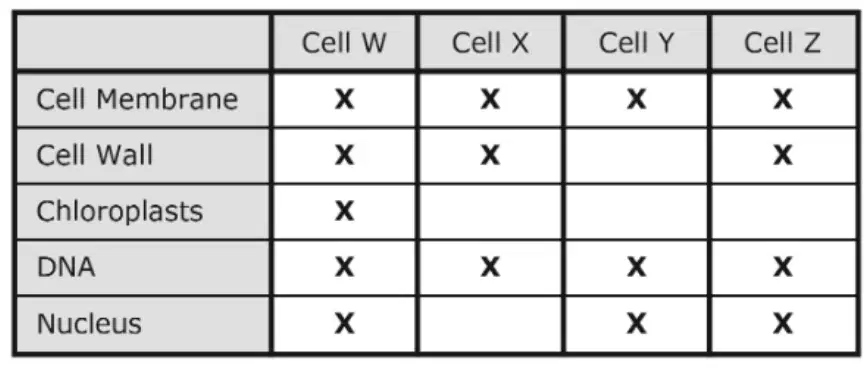
Students use a microscope to look for structures present in four different cells. The students placed an X for each structure that was viewed for each cell on the table shown.
Which cell that was viewed is most likely a prokaryote?
Cell W
Cell X
Cell Y
Cell Z
Severe acute respiratory syndrome (SARS) is an illness caused by a coronavirus. Symptoms including a high fever, headaches, and body aches typically occur two to seven days after infection by the virus. SARS is more serious in elderly patients. This information suggests that the reproductive cycle of the SARS virus is -
lysogenic, because the virus is a coronavisus
lytic, because the virus causes respiratory illness
lysogenic, because the virus primarily affects older people
lytic, because of the quick onset of symptoms after infection

A table comparing the characteristics of four samples is shown.
Which sample most likely contains viruses?
Sample 1
Sample 2
Sample 3
Sample 4

