
 Worksheets
End-Of-The-Year-Civics Preparation
Total questions: 150
Worksheet time: 3hrs 33mins
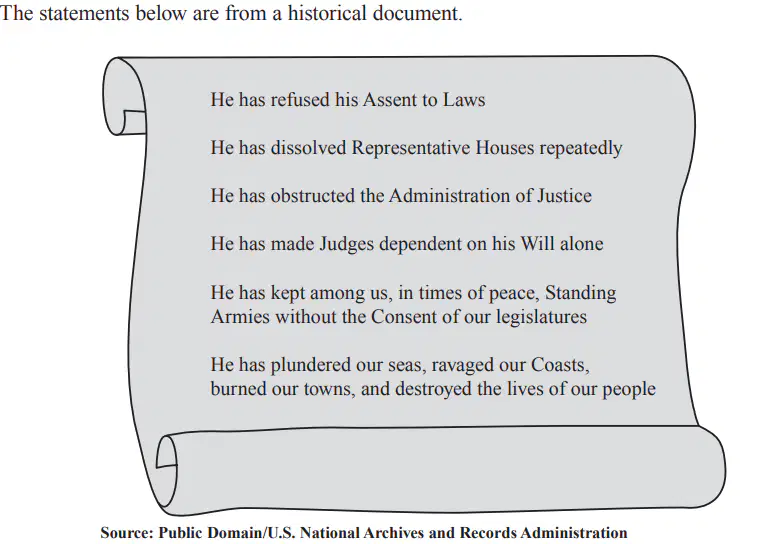
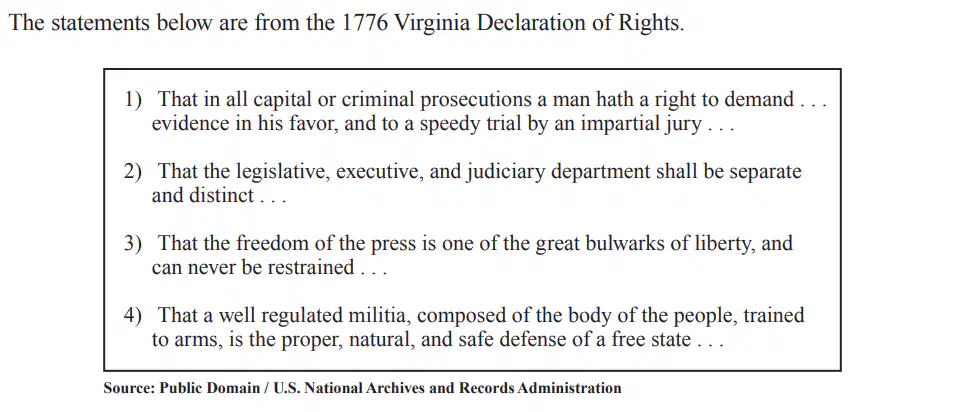
In which document are these statements found?
Magna Carta
Mayflower Compact
Articles of Confederation
Declaration of Independence
You are an American citizen because you were born in American territory. This is known as ________.
Natural-born Citizen
Law of Soil
New-born Citizen
resident
Civics is the study of:
The people and places of the world
The history of the United States
The rights and duties of citizens
Military strategy
What is the difference between a responsibility and a duty?
A responsibility is something you should do; a duty is something you are required to do.
A responsibility is something you are required to do; a duty is something you should do.
Responsibilities are listed in the Bill of Rights, but duties are not.
Only adults have duties.
What is the process by which a foreign-born person obtains American citizenship?
Natural-born
Fealty
Homage
Naturalization
Any person born in the 50 states, District of Columbia, American territories, or a US military base are automatically American citizens at birth. The person is known as an __________________________.
Natural-Born Citizenship
Dual Citizenship
Naturalization
Natural-born
Which action illustrates citizen participation in an international organization?
Samantha teaches others about the history of the United Nations (UN).
Jada volunteers to help raise funds for the United Nations Children’s Fund (UNICEF).
Ethan writes a report on the origins of the North Atlantic Treaty Organization (NATO).
David reads the annual report published by the World Trade Organization (WTO).
Which situation does NOT involve a right protected by the Bill of Rights?
Freedom to publish opinions in the local newspaper
The ability to own a gun, as long as the laws are followed
The guarantee of a well-paying job
Freedom to join the church of choice
Peter Brown has lived in his home since he was a child. Now the department of parks and
recreation wants to tear down his neighborhood to build a park. A government official comes to visit Peter and offers to buy the house from him. Peter refuses. The official says that the
government will now seize the property under the constitutional power of "eminent domain."
According to the U.S. Constitution, under what circumstances would Peter win his fight to keep
his home?
If Peter could prove that he had paid the full price of the house already
If Peter was born as a citizen of the United States, not a naturalized citizen or resident
If the government did not make a reasonable effort to build the park in an uninhabited area
If the government did not offer him fair market price for his home
Ben was prosecuted and convicted in state court for speaking out publicly against the
governor. During his trial, he was denied the counsel of a lawyer. Two years later, the U.S.
Supreme Court overturned his conviction, explaining that the state had not guaranteed Ben’s
constitutional rights. Which amendments apply to this case?
Amendment I (free speech) and Amendment VI (due process)
Amendment I (free press) and Amendment IV (search and seizure)
Amendment IX (unenumerated rights) and Amendment VI (due process)
Amendment IX(unenumerated rights) and Amendment IV (search and seizure)
Anne Tracy works as a journalist for The Daily Mouth. She wrote a story about how Senator Jones cheated on a law school exam. She interviewed witnesses who saw the senator cheating. The story ran on the front page. Senator Jones denied the charges. Then he resigned from office. He plans to sue The Daily Mouth for damages. Under what circumstances could he sue the paper and win his lawsuit?
He could sue the paper for libel and could win the case if he proved that Tracy had a grudge against him
He could sue the paper for slander and could win the case.
He could sue the paper for libel and could win the case if he proved that the accusations were
untrue and his reputation was hurt.
He could sue the paper for slander and could win the case if he proved that Tracy had a grudge against him.
The constitutional guarantee of a free press has resulted in
a government more likely to hide its actions from the people
a government more responsive to the needs of the people
the establishment of English as the official language of the United States
the establishment of government-run news organizations
A more informed society has resulted from which constitutional protection?
Trial by jury
Free speech
Right to bear arms
Due process
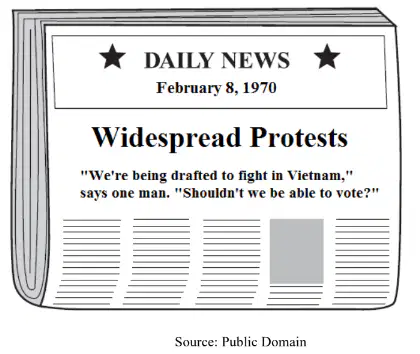
How did opinions like the one shown in this news story affect the political process in the United States?
It led to the Fifteenth Amendment, allowing racial minorities to vote.
It led to the Nineteenth Amendment, allowing women to vote.
It led to the Twenty-Sixth Amendment, allowing 18-year-olds to vote.
It led to the Twenty-Sixth Amendment, allowing 21-year-olds to vote.

How did passage of this legislation affect the political process in the United States?
It enforced the Fifteenth Amendment, protecting the right of racial minorities to vote.
It enforced the Nineteenth Amendment, protecting the right of women to vote.
It extended suffrage to U.S. citizens, allowing 18-year-olds to vote.
It extended suffrage to U.S. citizens, allowing 21-year-olds to vote.
What happened in American schools after the 1954 U.S. Supreme Court decision in Brown v. Board of Education?
States could continue segregation as long as facilities were separate but equal.
Individuals of different races voluntarily stopped all forms of school segregation.
The federal government ordered that states desegregate classes.
Desegregation was ordered for only high schools.
Following the 1966 Supreme Court decision in Miranda v. Arizona, police began informing people placed under arrest that they "have the right to remain silent." What basic freedom is this meant to protect, and how does it affect arrested individuals?
The right to freedom of speech; it provides them with the ability to speak to their attorneys
without fear of incrimination.
The protection against self-incrimination; it informs them that speaking to law enforcement
could incriminate them.
The protection of due process; it prevents convicted offenders from receiving cruel and
unusual punishments.
The right to freedom of assembly; it prevents law enforcement from asking them questions
without the presence of an attorney.
How do modern Democrats and Republicans view taxation?
Democrats tend to favor tax increases to support new social programs more than
Republicans.
Republicans tend to favor tax increases to support new social programs more than
Democrats.
Democrats tend to favor tax decreases, while Republicans tend to favor keeping tax rates the
same.
Republicans tend to favor tax increases, while Democrats tend to favor keeping tax rates the
same.

The political campaign posters are for two candidates running for the U.S. Senate. According to the information on the posters, which individual would more likely vote for Aleksi Alho?
A voter concerned about leadership experience
A voter concerned about women’s rights
A voter concerned about protecting the rights of the accused
A voter concerned about rising unemployment in the state
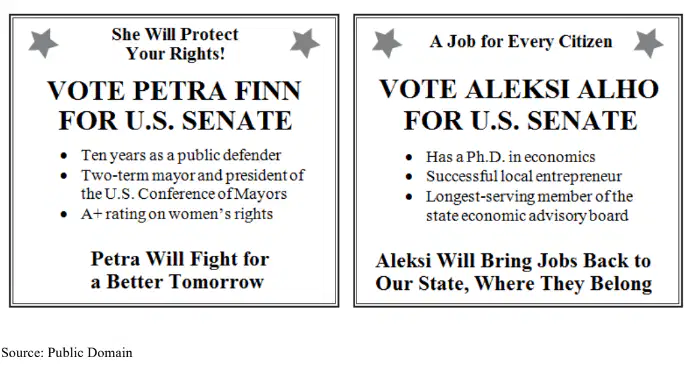
The political campaign posters are for two candidates running for the U.S. Senate. According to the information on the posters, what is one reason Petra could be considered more qualified than Aleksi to be elected to the U.S. Senate?
Her business experience
Her educational experience
Her political experience
Her lobbyist experience

The table below shows lobbying methods and their associated costs and time required.
Lela wants to show her district’s representative in Congress that there is a lot of popular support of an upcoming bill. She has drawn up a chart of lobbying methods. She wants to lobby indirectly, but she does not have much money, and her deadline is a month from now. Which are her best options?
An online petition and letters to citizens
Calling citizens by phone and letters to citizens
Emailing the representative and an online petition
Group rally event and emailing the representative
James Madison wrote that “liberty is to faction what air is to fire.” After reading this, Jack points out that the Founders would have wanted more restrictions on lobbyists, special-interest groups, and media influencing the government. What would be a good counterargument?
Elected officials are better able to measure public opinion if there are no interfering factions.
Lobbyists will balance one another in government influence if they are subject to fewer laws.
Political ads, despite their biases, are best able to inform citizens when there are no
regulations.
The media, despite its biases, are best able to monitor the government when they are free.

This poster was displayed in 1947, at the beginning of the Cold War. How can the information on this poster best be categorized?
Advertisement
Entertainment
Factual
Propaganda
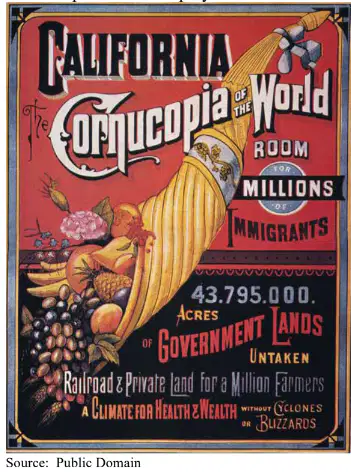
This poster was displayed in 1876. What is primary goal of this propaganda poster?
To encourage people to move to government lands
To discourage people from moving to government lands
To encourage people to move to California
To discourage people from moving to California
Flora is concerned because her little brother became ill at school. The doctor explains he has the flu.
"I've seen an increase in flu cases among children the past few years," says the doctor.
"Many children need flu shots, but their parents can't afford them."
Flora decides to take action. Which should be Flora’s final step in attempting to encourage her community to provide low-cost flu shots?
Identify public policy alternatives by talking to her doctor about options to locate funding for
shots.
Outline her citizen-action plan to the local health department proposing it offer a low-cost
vaccination clinic.
Evaluate public policy alternatives by speaking to federal health officials about similar efforts in other communities.
Conduct background research by visiting reliable web sites to read about side effects of flu
shots.

Evelyn is preparing to speak to her fellow city council members about trash collection in the city. She looks at a chart made by her aide. Which argument could she make in favor of using the current city trash-collection service instead of a private service?
Can replacement will be easier if the city service collects trash.
Recycling will increase if the city service collects trash.
Residents will pay less if the city service collects trash.
There will be more jobs available if the city service collects trash.
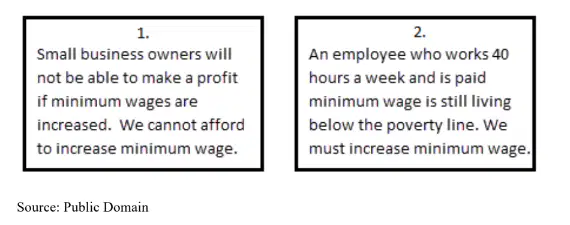
These are views for and against the increase of minimum wage. Which conclusion can be drawn from the views?
Minimum wage changes impact both small business owners and employees.
Minimum wage changes impact small-business owners more than employees.
Minimum wage changes impact employees more than small-business owners.
Minimum wage changes have little impact employees or small-business owners.
Fred is a homeowner interested in conserving the desert surrounding his home. Michaela is a nurse at the local children's hospital with three children of her own. Carlos is the owner of a medical supply company active in the local running club. Gina is a community college student who will soon be transferring to the local university to complete her degree.
Which person would be most likely to vote “yes” to raise local taxes to pay for construction of a new hospital?
Fred, because he wants the vacant lot near him to be used for construction
Michaela, because public funding would be split between two hospitals
Carlos, because he will profit from supplying the new business
Gina, because she will need to find work when she graduates
Which example involves changing foreign policy?
Congress lifting the oil embargo on a formerly communist government
A Supreme Court hearing on worker discrimination based on national origin
Congress voting to construct an aid center in Florida for political refugees
A Supreme Court justice voting to take a case involving his country of birth
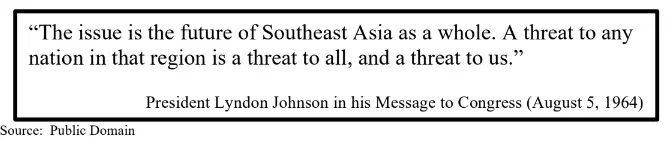
This statement justifies an international action. Which international action is President Johnson justifying with this speech?
Sending troops to stabilize a region
Using sanctions against a country
Sending humanitarian aid to a country
Using nuclear weapons to end a war
What is the term for a type of government in which one person possesses unlimited power?
Socialism
Communism
Democracy
Autocracy
Kayla sat in the meeting hall and listened to the different candidates for her state's open Senate seat. The candidates debated about their positions on issues. When Election Day came along, she voted for the candidate she thought would best serve her community’s interests. What form of government does Kayla have?
Direct democracy
Representative democracy
Oligarchy
Monarchy
Who has the most power in a unitary system?
Central government
Local government
State government
Regional government
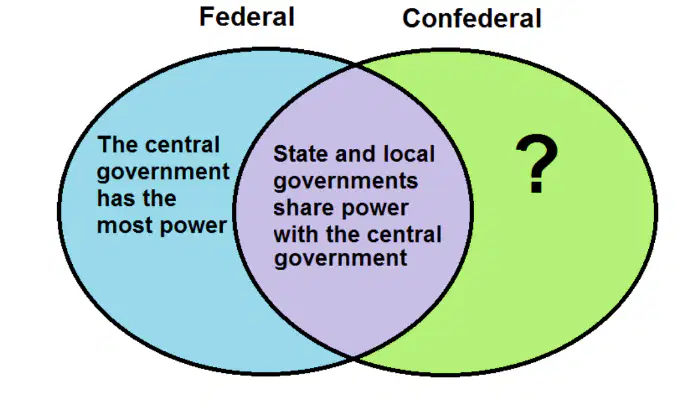
This diagram shows two different forms of government. Which statement completes the diagram?
In a confederal system, city governments have the most power.
In a confederal system, international associations have the most power.
In a confederal system, state governments have the most power.
In a confederal system, the people have the most power.
How are the responsibilities of the legislative and executive branches of government different when it comes to treaties?
U.S. Senate proposes treaties; the president carries out foreign treaties.
U.S. Senate negotiates foreign treaties; the president approves treaties.
U.S. Senate carries out foreign treaties; the president proposes treaties.
U.S. Senate ratifies treaties; the president negotiates foreign treaties.
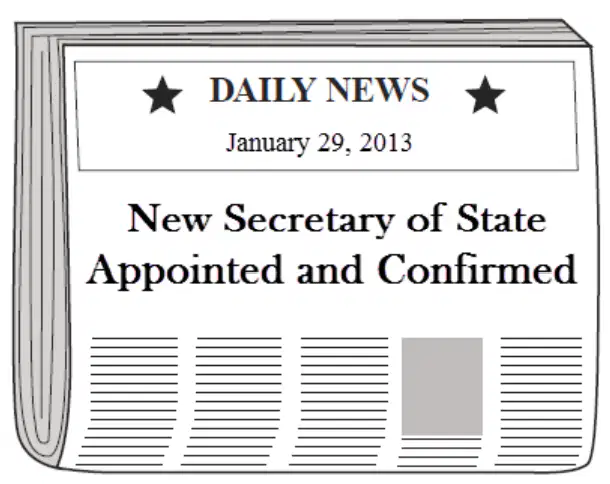
The newspaper headline below describes an event in U.S. history. Which parts of the national government participated in the process described in the newspaper headline?
Senate and president
House of Representatives and Senate
Supreme Court and president
Supreme Court and House of Representatives
Which statement describes a difference between the state and federal governments under the U.S. Constitution?
Only the federal government provides for public welfare.
Only the federal government charters banks.
Only the federal government borrows money.
Only the federal government regulates interstate trade.
Which of the following accurately describes one way an amendment to the U.S. Constitution may be proposed?
Two-thirds of each house of Congress votes to propose.
Two-thirds of citizens nationwide vote to propose.
Three-fourths of state legislatures vote to propose.
Three-fourths of each house of Congress votes to propose.
According to John Locke, which agreement did individuals enter into to form their own society?
constitution
social contract
Mayflower Compact
English Bill of Rights
Montesquieu came up with idea of the __________________.
Magna Carta
trial by a jury
separation of powers (legislative branch, executive branch, and judicial branch)
natural law

How did the opinions expressed in these statements help influence the American political system in the United States?
Citizens believed legislators should be elected.
Citizens believed government should be limited.
Voters believed laws should be publicly debated.
Voters believed equality should be legally assured.

How does the modern political system in the United States uphold the principles expressed in these statements?
by requiring voter registration laws for local elections
by causing elected officials to be responsible to citizen needs
by allowing federal judges to be appointed by elected officials
by making local governments responsible for monitoring elections
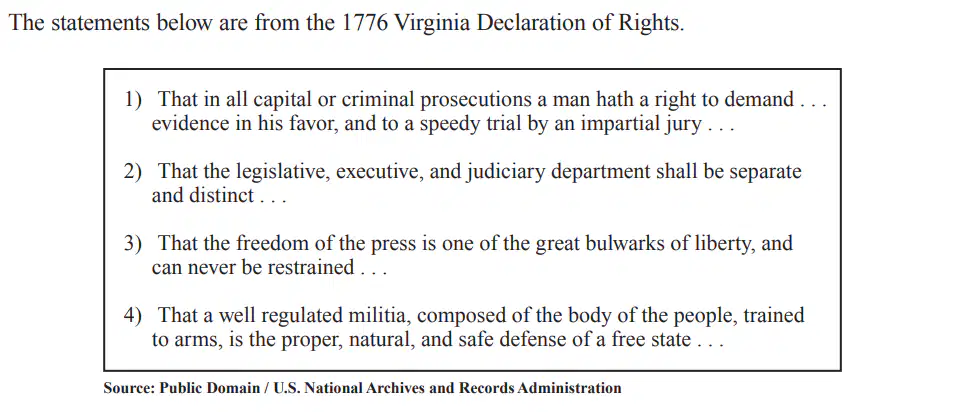
Which statement reflects the Enlightenment ideas of government as expressed by Montesquieu?
1
2
3
4

Which phrase completes the diagram?
Separation of powers
Economic freedom
Self-government
Individual rights
Which action completes the diagram?
Colonial agricultural trade increases.
Colonial religious devotion increases.
Colonial demand for political change increases.
Colonial demand for military assistance increases.
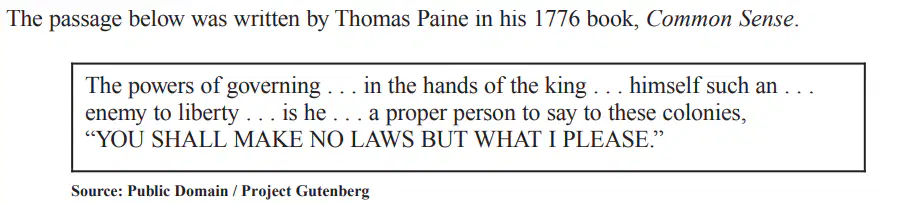
Based on this passage, with which complaint against the king from the Declaration of Independence would Thomas Paine agree?
persecuting immigrant groups
taking away religious rights
taking away political rights
persecuting racial groups
How did the U.S. Constitution solve a problem created by the Articles of Confederation?
It avoided the issue of states’ rights.
It allowed the states to elect representatives.
It prevented the amendment of federal laws.
It enabled the federal government to collect taxes.
In the Preamble to the U.S. Constitution, what is the meaning of the phrase “We the People”?
The people express their will through political parties.
The people express their will by directly creating laws.
Government receives taxes from the people and exists to support them.
Government receives its power from the people and exists to serve them.
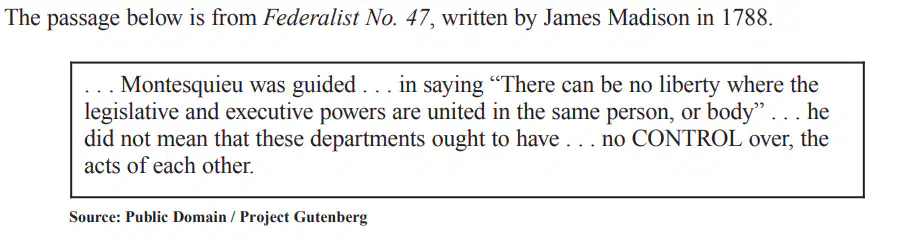
Based on this passage, which constitutional principle does Madison describe?
separation of powers
checks and balances
popular sovereignty
judicial review
Which statement supports the Anti-Federalists in the struggle over ratification of the U.S. Constitution?
The Constitution should limit state government.
The Constitution should protect fundamental rights.
The Constitution should create a strong national government.
The Constitution should prevent the election of amateur politicians.
Which characteristic serves as a long-term protection against tyranny and is a foundation of liberty in the United States?
the commerce clause
the elastic clause
the right to trial
the rule of law
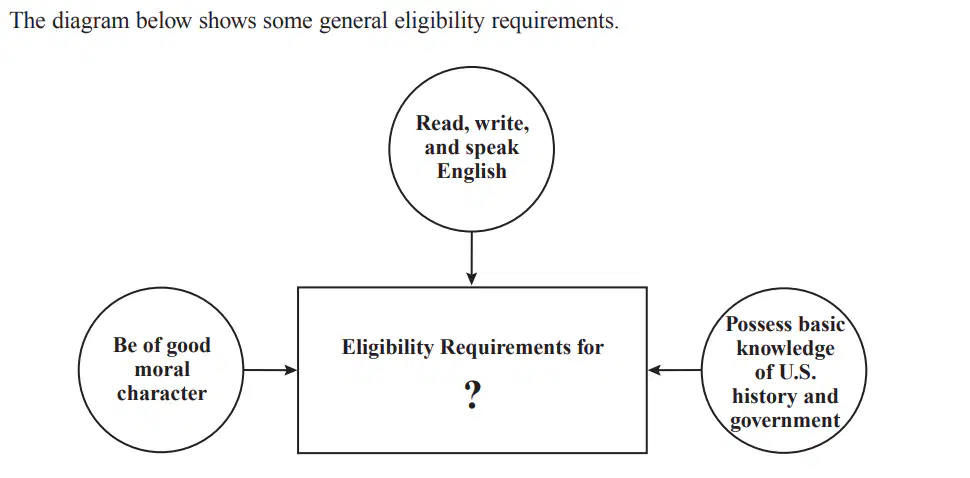
Which statement completes the diagram?
Joining a Military Service
Obtaining a Driver’s License
Becoming a Naturalized Citizen
Receiving a Social Security Card
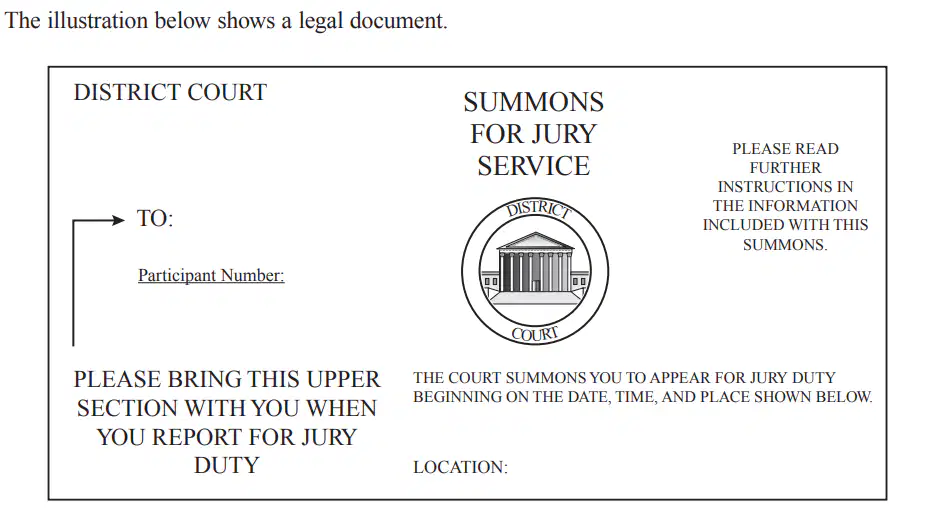
Why are citizens obligated to respond to such documents?
to guarantee court hearings remain public
to guarantee courts provide probable cause
to protect the constitutional right to be tried by one’s peers
to protect the constitutional right to confront one’s accuser

Why should this freedom be guarded?
to provide the news media with a guaranteed profit
to keep the news media from controlling the political process
to provide the government with an accurate information source
to keep the government from becoming the primary information source
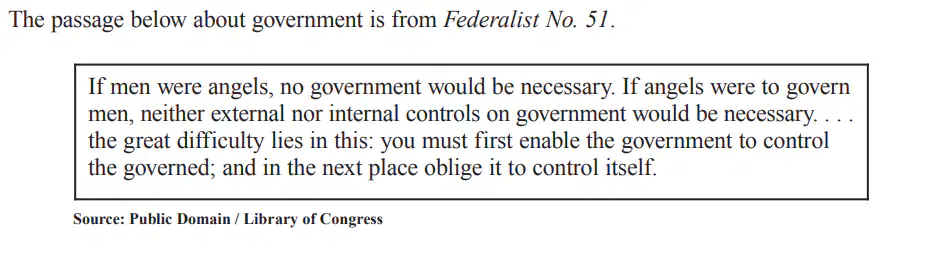
How are the author’s views from this passage applied in the U.S. Constitution?
The U.S. Constitution doesn't limits the rights of the people and the states.
The U.S. Constitution limits the rights of the people.
The U.S. Constitution requires the states to provide for the common defense.
The U.S. Constitution requires the government to promote the general welfare.
In the modern political system, which issue represents a basic disagreement between Republicans and Democrats?
the responsibilities of government
the frequency of national elections
the legality of the U.S. Constitution
the support for the U.S. military soldier
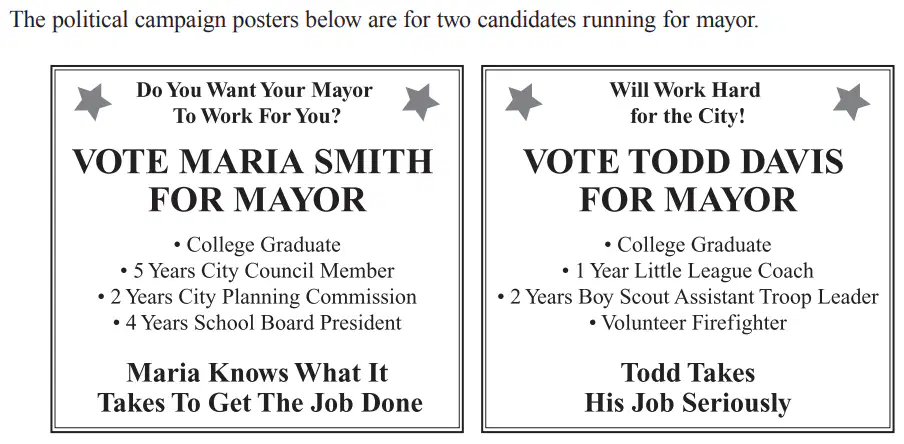
According to the information on the posters, what is the reason Maria could be considered more qualified than Todd to be elected mayor?
her political policies
her college education
her campaign promises
her experience working in government
Based on the government system in the United States, which individual activity is used to directly influence legislative decisions?
watching political debates on television
discussing political issues at work
collecting opinions for a yearbook
gathering signatures for a petition

Which type of communication is shown in this poster?
accurate
biased
propagandized
informational
Luis owns a small store in the downtown business district. He learned that at the next monthly council meeting, the mayor will propose limiting the amount of time that people can park on the streets in the business district. Luis is afraid that if the city council approves the proposal, his business will suffer. Which of the following should be Luis’s final step in attempting to resolve this issue?
prepare a map of the available downtown parking spaces
present an alternative proposal at the next council meeting
call council members with concerns about the proposed policy
survey downtown businesses to determine their thoughts on the issue

Which conclusion can be drawn from these views?
Running an election campaign takes many taxpayers.
Campaigning for elected office requires many opinions.
Campaigning for elected office takes a large amount of time.
Running an election campaign requires a large sum of money.
What do an absolute monarchy and an autocracy have in common?
a single ruler
a written constitution
a national court system
a single legislative house

Which information completes the table?
power shared / power delegated
rule by a democracy / rule by a monarchy
role of government expanded / role of government limited
power divided among the branches / power held by one branch
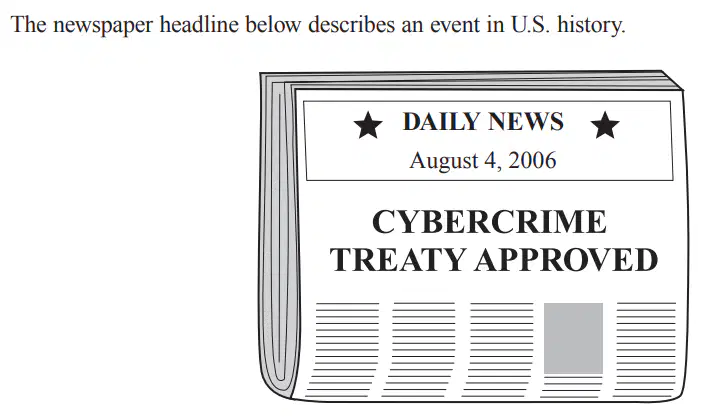
Which parts of the national government participated in the process described in the newspaper headline?
Senate and President
Supreme Court and President
House of Representatives and Senate
Supreme Court and House of Representatives
Which statement describes a similarity between the state and the federal governments under the U.S. Constitution?
Both levels of government allow for the election of judges.
Both levels of government have the power to ratify treaties.
Both levels of government allow for the collection of taxes.
Both levels of government have the power to appoint ambassadors.
Which is the last step in amending the U.S. Constitution?
The voters approve the amendment in a national election.
The president signs the amendment in a public ceremony
Three-fourths of the state legislatures ratify the amendment
Two-thirds of both houses of Congress ratify the amendment.
What has been one long-term result of the constitutional protection of free speech?
fewer court cases involving minors
fewer laws limiting minority rights
a more accurate election
a more informed society
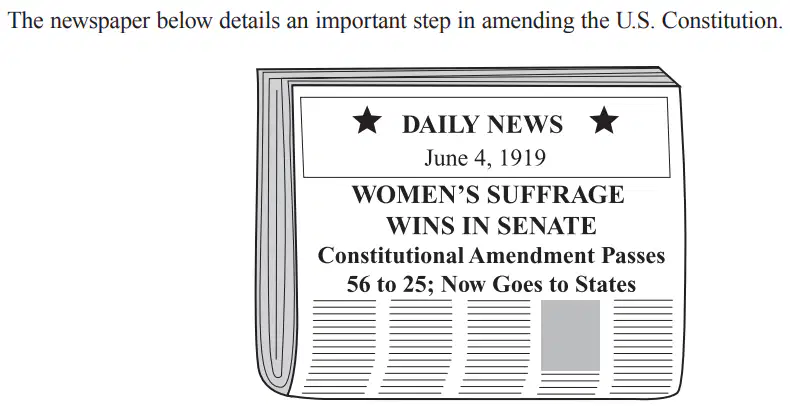
How did the passage of this amendment to the U.S. Constitution impact the political process in the United States?
Women were allowed to contribute to political campaigns.
Women were allowed to hold citizenship rights.
Women were allowed to hold public offices.
Women were allowed to vote in national elections.
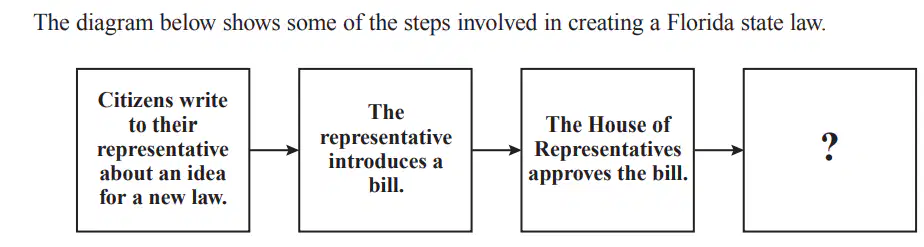
What is the next step in the lawmaking process?
The governor signs the bill into law.
The bill goes to the Senate for action.
The people vote on the bill in an election.
The bill goes to the Supreme Court for a hearing.

Which court completes the diagram?
Court of Veterans Appeals
Court of Appeals
Military Courts
Claims Courts
What lessons did future U.S. leaders learn from the 1974 U.S. Supreme Court case United States v. Nixon?
The president is accountable for obeying the law.
The president is responsible for enforcing the law
The president is not allowed to hold secret talks with foreign governments.
The president is not allowed to have private meetings with cabinet members.
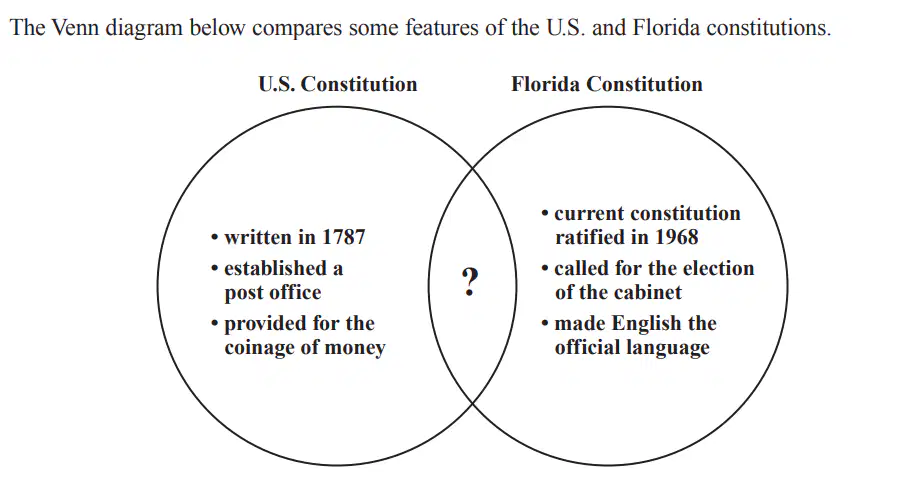
Which feature completes the Venn diagram?
created property taxes
established a zoning board
required a balanced budget
guaranteed individual freedoms

Which service completes the Venn diagram?
regulating taxicabs
creating a police force
regulating savings banks
issuing driver licenses
Which action is an example of a foreign-policy decision?
Congress increased providing support to newly arrived immigrants.
The president requested a law to regulate pollution near international borders.
Congress raised educational standards to make students competitive in a global market.
The president signed an executive order restoring relations with a communist government.
The U.S. government is a member of which organization?
United Nations
European Union
World Wildlife Fund
International Red Cross
A country with very strong economic ties to the United States is allowing human rights violations to take place. Based on U.S. foreign policy, which is an appropriate first response?
Initiate a trade ban.
Initiate public protests.
Initiate diplomatic talks.
Initiate a military operation.
These thinkers brought the light of reason to everything they studied and their movement became known as the ________________. These thinkers applied human reason to understand the world, and they criticized tradition, authority, and superstition. Instead, these thinkers proposed the use of reason to make the world a better place.
Enlightenment
Believers
Civic Thinkers
Natural Law
John Locke rejected the idea that rulers received their power from God. Instead, Locke believed rulers received their power from people whom they govern. Then the group of people makes an agreement, known as the ___________, to form a community.
social contract
enlightenment
natural law
people's agreement
John Locke believe that natural law guaranteed each of us the right to ___________________________.
a social contract
life, liberty, and the use of our own property
natural laws
enlightment

Which court completes the diagram?
Court of Veterans Appeals
Court of Appeals
Military Courts
Claims Courts
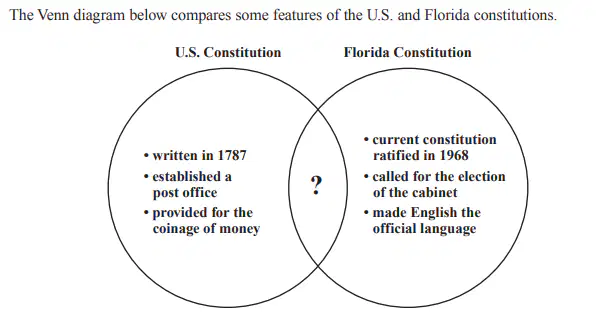
Which feature completes the Venn diagram?
created property taxes
established a zoning board
established a redistricting board
guaranteed individual freedoms
French nobleman, Baron Charles de Montesquieu, believed government powers should be separated. Montesquieu believed laws were best divided into three parts:
legislative branch makes the laws, executive branch executes the laws, judicial branch interprets the laws and rules on their application.
emperors, king and queen will make and enforce the laws, soldiers will carry out the laws, nobles will interpret the laws and decide on specific cases
God, ruler, people will be the order on how all laws are made and enforced
None of these answers are correct.
According to John Locke, which rights were guaranteed by natural law?
trail by jury and no cruel punishment
freedom of speech and of the press
life, liberty, and property
freedom of worship and the right to petition

Which right was guaranteed in this excerpt from Magna Carta?
trail by jury
no taxation without representation
freedom of the press
freedom of religion
How was Locke's social contract theory related to his belief in natural law?
He argued that God had especially chosen kings and queens to rule over their subjects as part of nature.
He argued subjects has the right to rebel against a ruler who acted against natural law.
He argued that whatever the king did was good according to natural law.
He argued that natural law required the colonists to be given their independence.
Which describes an impact of Magna Carta on the American colonists in the 1770s?
They believed they could not be taxed without their consent.
They believed they could not be governed by a far-away island.
They thought they had the right to overthrown a kind who did not protect their rights.
They favored a separation of the powers of government into different branches.
Which document confirmed the rights of English subjects after the overthrow of James II in the Glorious Revolution?
Magna Carta
Mayflower Compact
English Bill of Rights
Montesquieu's Spirit of the Laws
What most attracted the Founding Fathers to Montesquieu's views on the separation of powers?
It could help protect the rights of the nobility from the actions of the king because the people could work with the king on all issues.
It could preserve the privileges of the monarch and nobles from popular attack.
It could help prevent the central government from becoming tyrannical and oppressive because each branch had to depend on the other.
It could protect the rights of the nobility from actions of the king.
Which of the following were most similar?
the Mayflower Compact and Joh Locke's social contract theory
the English Bill of Rights and Thomas Paine's Common Sense
Magna Carta and Montesquieu's separation of powers
the Mayflower Compact and Montesquieu's separation of powers

The statements are from the 1776 Virginia Declaration of Rights. Which statement guarantees a right first granted by Magna Carta?
1
2
3
4
Thomas Paine's Common Sense encouraged the colonists ___________.
establish a strong tradition of self-government
to declare their independence during the American Revolution
to support King George
to write an English Bill of Rights
Because of the _____________, the "English colonists" felt they were entitled to all the right of freeborn Englishmen. This meant they could not be taxed without the approval of Parliament, they were entitled to carry arms to protect themselves, and they could not be subjected to cruel and unnatural punishments.
Magna Carta
English Bill of Rights
Mayflower Compact
natural laws
What is a Parliamentary system?
A system of government where the power is shared between the central (national) government and the states.
A system of government where the power is in the legislative body, and the leader of the country is a part of the legislature.
A system of government where the power is given to independent states.
A system of government where the national government (the “unit”) conducts all functions of government.
What is a Parliamentary system?
Citizens choose the political party they like, and then the party chooses its members who will serve as representatives of the people.
Citizens elect members of the legislative branch, the executive branch, and some members of the judicial branch.
Citizens elect members of the legislative branch and the executive branch.
The national government may choose to delegate powers to smaller government units, such as states.
A confederal system of government:
A system of government where the power is shared between the central (national) government and the states
A system of government where the power is given to independent states. There is little or no central (national) power
A system of government where the national government (the “unit”) conducts all functions of government. The national government may choose to delegate powers to smaller government units, such as states.
A system of government where the power is in the legislative body, and the leader of the country is a part of the legislature. Citizens indirectly elect officials through their participation in political parties.
A system of government where the power is shared between the central (national) government and the states. Citizens elect members of the legislative branch, the executive branch, and some members of the judicial branch. The United States is an example of a country that practice this form of government.
Communism
Socialism
Federal
Unitary
Some ________ governments hold power at the national level while other __________ governments delegate authority to regional/state and local governments.
unitary
federal
communist
parliamentary
Because power is shared between the legislative body and the leader of the country, New Zealand is a __________ system of government.
federal
parliamentary
socialist
unitary
The U.S. government plans its foreign policy. This includes a plan for ___________, which means trying to keep good relationships with other nations (countries).
alliance
treaties
diplomacy
foreign and domestic policy
Because there is no central power, the European Union is a ___________ system of government.
foreign and domestic policy
Confederal
Parliamentary
alliance
As part of the president’s cabinet, the _____________ has an important role in guiding and carrying out the nation’s foreign policy plan. The ___________, serves as head of the State Department, gives advice to the president, visits other nations, and holds meetings with foreign leaders and government officials.
vice president
Secretary of State
ambassadors
foreign and domestic policy
The U.S. government also has to decide which countries to form an alliance with. The __________________ is one example of a strong military alliance between the U.S. and many European countries.
North American Trade Agreement
North Atlantic Treaty Organization (NATO)
international relations
United Nations
What is an agreement or arrangement between two or more countries?
Treaty
Foreign Policy
Diplomacy
Ambassador
The national legislative body of the United States that consists of the Senate, or upper house, and the House of Representatives, or lower house. This legislative body is called:
President
Ambassador
International Relations
Congress
The United States Constitution gives specific powers to _________________ when it comes to dealing with other nations, especially wars and other military conflicts.
the president and vice president
Congress and the president
federal government
Secretary of State
Article I of the Constitution discusses the powers of the ______________ and gives _______________ the power to declare war, the power to approve spending for the military, and the power to raise an army and navy.
legislative branch (Congress)
executive branch (president)
Secretary of State
Federal Government
Article II of the Constitution discusses the powers of the executive branch (president) and gives the president the title of _____________. This means that the president is in charge of the military and has the power to send troops to other countries.
Commander in Chief
Ambassador
Negotiator
Marshall Plan
______________ are private organizations that work independently from any government. They do a variety of things: help people who are suffering, help the poor, protect the environment, provide for basic needs like food and water, or help communities to become better places to live.
Red Cross
Non Governmental Organizations (NGOs)
United Nations Children’s Fund
United Nations
The __________________ is an international humanitarian organization with approximately 97 million volunteers, members and staff. It was founded to protect human life and health, to promote respect for all human beings, and to help people who suffer because of war or natural disasters.
International Red Cross
United Nations
North Atlantic Treaty Organization (NATO)
International Court of Justice
_____________ was a military conflict in 1991 between Iraq and a group of 34 nations; the war was approved by the United Nations and led by the U.S; also known as the Persian Gulf War
Korean War
Vietnam War
Gulf War I
Gulf War II
____________ was a war between North and South Korea; South Korea was aided by the U.S. and other countries; it was fought from 1950-1953.
Vietnam War
Korean War
Gulf War I
Gulf War II
_____________ was a 2003 military conflict in Iraq, also called the Iraq War or "Operation Iraqi Freedom", which began March 20, 2003; started by the U.S., Great Britain, and other nations.
Vietnam War
Korean War
Gulf War I
Gulf War II
______________ was a military conflict (1954-1975) between the Communist forces of North Vietnam (supported by China and the Soviet Union) and the non-Communist forces of South Vietnam (supported by the U.S.)
Vietnam War
Korean War
Gulf War I
Gulf War II
_______________ was a war between the Allied Powers (including Russia, France, British Empire, Italy, the U.S., Japan, Romania, Serbia, Belgium, Greece, Portugal, Montenegro), and the Central Powers (including Germany, Austria-Hungary, Turkey, Bulgaria); that lasted from 1914 to 1918.
Gulf War I
Gulf War II
World War I
World War II
____________ was a war that began in 1937 in Asia, in 1939 in Europe, and in 1941 in the U.S.; it lasted until 1945 and involved most of the world’s countries.
Gulf War I
Gulf War II
World War I
World War II
The president has the title of "Commander in Chief" which means that
the president controls Congress and the states.
the president is in charge of the military and has the power to send troops to other countries.
the president is in charge of the states and local governments.
the president is in charge of foreign policy.
There are many ways of the United States deal with ____________. These methods include: declaring war, diplomacy, military invasions, developing alliances with other nations, joining international organizations such as NATO or the UN, increasing taxes on goods coming in from other countries, putting limits on trade with certain nations), isolation (not getting involved in other nations’ conflicts), and making treaties.
international conflicts
foreign policy
domestic policy
international trade agreements

Which statement reflects the Enlightenment ideas of natural law as expressed by Locke?
A
B
C
D

Which action completes the diagram?
British eliminate all taxes on colonists
Colonists vote to elect new member of Parliament
British ignore colonist grievances
Colonist send troops to Britain in protest

Which complaint should be added to this list?
Requiring colonists to send representation to Parliament
Suspending trial by jury in many cases
Ordering colonists to move from Native American land
Allowing the wealthy to avoid local laws
What did many American colonists use Thomas Paine's Common Sense to justify?
Acts of sabotage against British merchants
Declaring independence from Britain
Joining the army instead of the militia
Supporting the British monarchy

Based on this passage, with which complaint in the Declaration of Independence would John
Locke agree?
He has affected to render the Military independent of and superior to the Civil power.
He has erected a multitude of New Offices, and sent hither swarms of Officers to harass our
people...
He has kept among us, in times of peace, Standing Armies without the Consent of our
legislatures.
He has refused his Assent to Laws, the most wholesome and necessary for the public good.
Which of the following was a weakness of the Articles of Confederation?
The government did not have a separate judicial branch (national court system).
The states could not print their own currency.
The president was able to spend taxes freely.
The government had too much power over trade.
How did the U.S. Constitution address the problem under the Articles of Confederation that Congress had no power to ensure its laws were followed by the states?
It created an executive branch to enforce laws.
It gave each state sovereign authority over its laws.
It required the president to resolve disputes between states.
It required unanimous consent of states to create new laws.
What does the phrase "insure domestic tranquility" in the Preamble of the Constitution mean?
Give land to the homeless
Fight wars on foreign soil
Keep the homeland at peace
Provide citizens with insurance

This diagram shows the purpose of government according to the Preamble of the Constitution. Which phrases complete the diagram?
depends on people; serve the people
depends on law; maintain the law
depends on legislators; serve legislators
depends on liberty; maintain those liberties
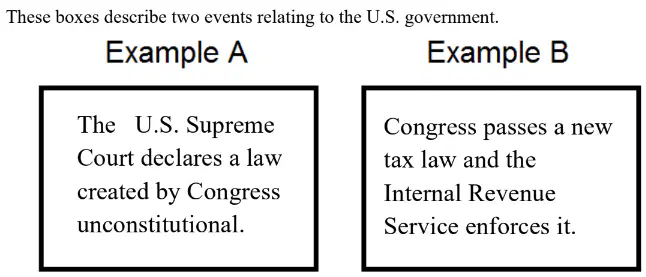
What constitutional principles are demonstrated in examples A and B?
Example A: checks and balances; Example B: separation of powers
Example A: checks and balances; Example B: judicial review
Example A: separation of powers; Example B: individual rights
Example A: separation of powers; Example B: checks and balances
Which service is performed by local government?
Delivering mail
Granting teacher certificates
Minting quarters
D. Providing fire protection
Taylor took notes during his civics class comparing the U.S. Constitution with the state of Florida’s Constitution. However, he forgot to write down which set of features applied to which constitution. How can he tell the difference between them?
He remembers that the Florida Constitution does not have a bill of rights, but the U.S.
Constitution does.
He remembers that the Florida Constitution does not allow for the executive branch to
establish a cabinet, but the U.S. Constitution does.
He remembers that the Florida Constitution has five methods to propose an amendment, but
the U.S. Constitution only has two.
He remembers that the Florida Constitution gives the executive branch power over military
forces, while the U.S. Constitution does not.
Claude runs a chain of tourist businesses in Florida. He imports T-shirts from Haiti to sell in his stores. One day, student protesters damage several of his shops, demanding that he pay his workers in Haiti a fair wage. Claude estimates the damage at $4,000. Claude sues the protestors for the damage they cause. Where is the original jurisdiction of this case?
This is a local small-claims case.
This is a local challenge to international trade.
This is a federal small-claims case.
This is a federal challenge to international trade.

The diagram outlines the appeals path through a state court system. Which court completes the diagram?
U.S. court of appeals
State-level court of claims
Florida Supreme Court
Court of Veterans Appeals
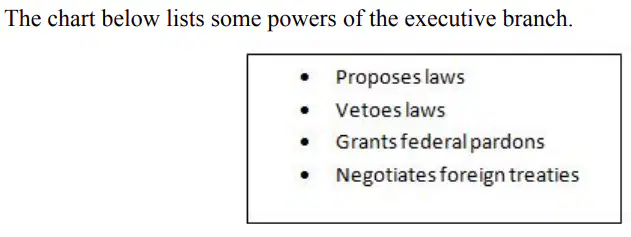
Which of the following is also a power of the executive branch?
Appoints federal judges
Declares acts of Congress unconstitutional
Ratifies treaties
Impeaches and removes judges
Why is a formal amendment process important?
To allow the Constitution to be adjusted as times change
To prevent the Supreme Court from being eliminated
To keep some states from being too powerful
To give the president a role in changing the government
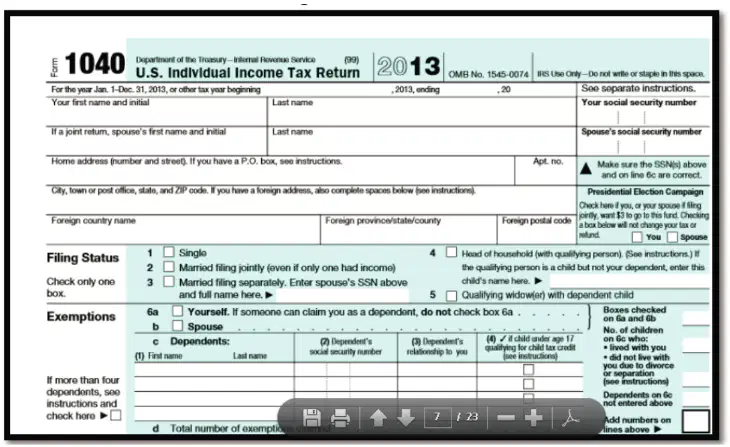
The illustration shows a legal tax document. Which of the following is one reason why citizens are required to file such documents with the government?
To ensure that students can go to private schools
To ensure the operation of international trade
To provide a fair report of business practices
To provide social programs for needy citizens

What will happen if a citizen does NOT perform these actions?
The democracy will fail.
The common good will suffer.
The citizen will be charged with a crime.
The citizen will be fined.

This graph shows the number of naturalized U.S. citizens from 2000 to 2008. Which of the following statements can be inferred from this graph?
Naturalization has become less popular than it was in the past.
Naturalization has steadily increased voter turnout.
Naturalization laws have become increasingly strict over time.
Naturalization leads to a larger pool of voters.
What is the term used in the Fourteenth Amendment to describe persons who are born or naturalized in the United States?
Aliens
Citizens
Immigrants
Residents
What is a government that is run by the people, either directly or indirectly?
Democracy
Oligarchy
Autocracy
Communism
What is the term used in the Fourteenth Amendment to describe persons who are born or naturalized in the United States?
Aliens
Citizens
Immigrants
Residents
How does rule of law affect U.S. government officials and institutions?
It holds government officials and institutions accountable to the law.
It requires government officials and institutions to create new laws.
It prevents government officials and institutions from making their work public.
It ensures government officials and institutions are exempt from laws.
Which viewpoint was common among Anti-Federalists?
There is no need for a separate Bill of Rights.
The Constitution does not give enough power to the states.
The Constitution will not strengthen the government.
A strong national government will protect the people in times of crisis.
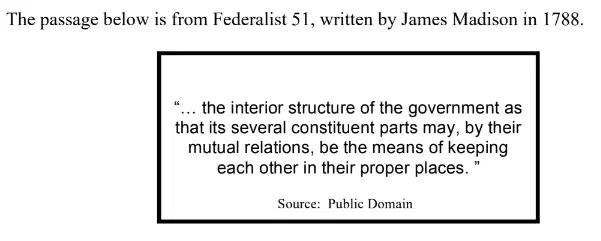
The passage is from Federalist 51, written by James Madison in 1788. Which constitutional principle does Madison describe in the passage?
Popular sovereignty
Judicial review
Checks and balances
Separation of powers
In _____________, the Supreme Court first claimed the right to declare acts of the legislative and executive branches unconstitutional. With that step, the Supreme Court defined itself as the final authority on what the Constitution means.
Judicial Branch
Marbury v. Madison
Brown v. the Board of Education
Plessy v. Ferguson
In the _____________, the Supreme Court (judicial branch) made itself independent of and equal to the other branches (legislative and executive) by declaring itself as the final authority on what the Constitution means.
Marbury v. Madison
Brown v. the Board of Education
Plessy v. Ferguson
McCulloch v. Maryland
A person accused of a crime must have the opportunity for a trail by jury. The Fifth Amendment right of _____________, means that the government may not take our lives, liberty, or property without following legal procedure.
search warrant
bill of attainder
ex post facto law
due process
In 1868, the ________________ granted citizenship to black men.
Tenth Amendment
Fourteenth Amendment
Fifteenth Amendment
Nineteenth Amendment
In 1920, the ___________________ granted equal citizenship (voting rights) to all women.
Tenth Amendment
Fourteenth Amendment
Fifteenth Amendment
Nineteenth Amendment
The conditions of becoming an American citizen are laid out in the _______________ to the Constitution.
Eighth Amendment
Tenth Amendment
Fourteenth Amendment
Eighteenth Amendment
If you are born in a foreign country and want to become an American citizen, what process must you complete
Conversion
Form W-2
Selective Service
Naturalization
To be a citizen of the United States because your parents were American citizens when you were born
Selective Service
Naturalization
Conversion
Law of Blood

