
 Worksheets
3 Branches review
Total questions: 66
Worksheet time: 17hrs 30mins
The main architect of American foreign policy and chief spokesperson to the rest of the world.
Chief Legislator
Chief Administrator
Chief of Party
Chief Diplomat
What is the Legislative Branch?
Congress: the House of the Representatives and the Senate
The President
Government
Supreme Court
How many representatives are there in the House of Representatives?
235
335
435
535
How many members in the Senate?
100
200
300
400
Who can veto a bill before it becomes law?
The President or the Governor for a state.
Senators
Representatives
Vice-President
Can a bill that was vetoed still make it into law? How?
No, it is has been decided; it is final.
No, bills can get vetoed.
Yes, the House of Representatives and the Senate vote 2/3 and can cancel the veto.
Yes, the Vice President can change the President's mind.
What is another name for the Legislative Branch?
The President
The Cabinet
The Congress
The Executive Office
How long is a term for a member of the House of Representatives?
2
4
6
8
Where in the Constitution do you find the Legislative Branch?
Article 1
Article 2
Article 3
Article 4
What power does the House have in the impeachment process?
formally charge the person by passing the articles of impeachment
remove the official from office and deny them the right of ever serving in U.S. public office
try the official in a trial
How long is a term for a member of the Senate?
2
4
6
8
What type of bill must start in the House of Representatives?
Tax
Education
Military
What do we call Article I Section 8 Clause 18?
The supremacy clause
The elastic clause
the commerce clause
The full faith and credit clause
Which of the following is not a power of the Congress?
To tax, to borrow money, to coin money.
To declare war and to raise and support armies.
To Make laws.
To appoint judges.
What is the main function of the Legislative Branch?
Explain laws
Create/make laws
Carry out laws
All of the above
Congress is known as a "Bicameral", what does that mean?
Two people
Two houses
Two cameras (looks)
Two camels
Which age would NOT qualify you to be a member of the House of Representatives?
65
30
21
25
Which house must you be a U.S citizen for a longer period of time?
Senate
House of Reps
House of Burgess
House of Commons
Every two years, how many members in the House of Representatives will be up for reelection?
1/3
1/4
1/2
All Members
Every two years, how many members in the Senate will be up for reelection?
1/3
1/4
1/2
All Members
The authority of a court to hear a case is called __.
originalism
jurisdiction
amicus curiae
stare decisis
How many justices are on the Supreme Court?
6
9
12
15
The role of the Judicial Branch is to
enforce the laws
create the laws
support treaties and executive agreements
interpret the laws
The Supreme Court has both __ and __ jurisdiction.
constitutional and extra-legal
original and appellate
executive and non-executive
exclusive and inclusive
Under Article III of the Constitution, __ creates the inferior (lower) courts.
the president
Congress
the Senate Judiciary Committee
the Attorney General
All of the following are types of jurisdictions EXCEPT:
original
appellate
exclusive
overture
The __ nominates federal and Supreme Court justices with confirmation from a majority of the __.
president; Senate
Senate Judiciary Committee; Attorney General
president; House of Representatives
vice president; electors
What does judicial review mean?
that the Supreme Court can investigate the president for misconduct
that the Supreme Court can declare executive orders and legislation unconstitutional
that the president can review an Supreme Court decisions he deems unfair
that Congress has the right to ensure the Supreme Court's decisions are impartial
When the Supreme Court enacts social justice rulings this is viewed as __.
judicial activism
judicial restraint
a mittimus judgment
preemptory challenge
Which is NOT a way that Congress is denied power?
Constitution says no
Powers aren't mentioned in the Constitution at all
Federal system of government prevents it
Powers are not part of the Bill of Rights
Which type of power is stated directly in the Constitution?
Implied
Expressed
Direct
Inherent
In the Constitution, the implied powers of Congress come from the
Necessary and Proper Clause
Supremacy Clause
Relative Clause
Santa Clause
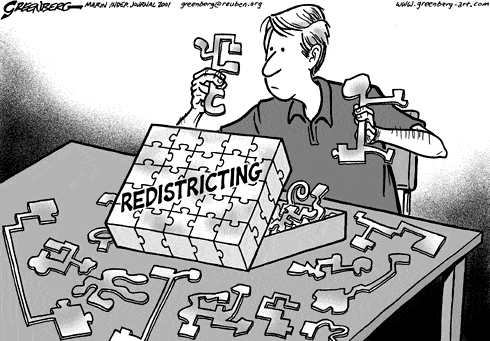
Gerrymandering affects:
The House of Representatives
The Senate
The Presidency
Congress as a whole
In most states (but not all), who usually draws district boundaries?
The House of Representatives
The Senate
The Supreme Court
State legislatures
What do we call the official count of the population?
Reapportionment
Census
Century
Redistricting
How often does the census occur?
Every 4 years
Every 8 years
Every 10 years
Every 25 years
Only the ____ is reapportioned based on population changes.
Senate
House of Representatives
The original gerrymander was likened to which animal?
Ox
Spider
Reptile
Turtle
What is gerrymandering?
a federally governed process designed to ensure equal representation.
a system of checks and balances used to ensure fairness in the House of Representatives.
a legal process that helps parties keep power.
the use of redistricting to unfairly disenfranchise specific groups of people.
Redistricting is important because:
it can benefit the party in power and help it stay in power.
the seats in House of Representatives can only be determined when new districts are developed.
district boundaries should be changed periodically to reflect changes in population.
It is the only way to accurately measurement the US population.
What house of Congress introduces bills?
House of Representatives
Senate
Either house can introduce bills
The House Judiciary Committee
Which branch of government has the power to approve treaties?
Legislative
Executive
Judicial
Which branch of government has the power to veto bills?
Legislative
Executive
Judicial
Which branch of government has the power to tax and spend for the general welfare?
Legislative
Executive
Judicial
Which branch of government has the power to command the military?
Legislative
Executive
Judicial
Which branch of government has the power to apply judicial review?
Legislative
Executive
Judicial
Which branch of government has the power to appoint judges?
Legislative
Executive
Judicial
What is a filibuster?
When a senator stalls legislation by preventing a bill from going to a vote
When a president vetoes a bill more than once
When Congress passes a bill in only one house.
When there is a tie in the Electoral College
The only procedure by which the Senate can vote to place a time limit on the consideration of a bill or other matter, and thereby overcome a filibuster.
Cloture
casework
fillibuster
gerrymanering
The Senate tradition of unlimited debate. An action designed to prolong debate and delay or prevent a vote on a bill, resolution, amendment, or other debatable question.
Fillibuster
cloture
casework
discharge petition

