
 Worksheets
Early Astronomy
Total questions: 16
Worksheet time: 8mins
Kepler's 2nd Law of Planetary Motion states that planets revolve around the sun at varying ___________.
apogee.
times.
distances.
speeds.
The area where a planet is closest to the Sun as it orbits the Sun is called the
perihelion
aphelion
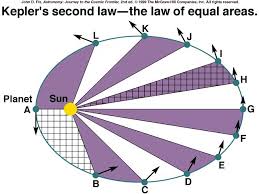
Where is the planet moving faster?
Position A to B
Position B to C
Position H to I
Position I to J

Built an observatory and made the most accurate astronomical observations and calculations for more than 20 yrs.
Galileo Galilei
Tycho Brahe
Copernicus
Isaac Newton
His laws of gravity explained why planets rotated around the object with the most mass in the solar system.
Copernicus
Kepler
Newton
Brahe
Kepler was an assistant to this early astronomer.
Tycho Brahe
Ptolemy
Copernicus
Aristotle
Which term describes the time it takes for Earth to complete one circle around the sun.
Rotation
Revolution
Kepler's 1st Law
Ellipse
Planets further from the sun have an orbit that lasts MUCH longer than planets that are close to the sun.
Pluto's orbit lasts over over 90,000 days.
Mercury's orbit lasts 88 days.
Kepler's 1st law
Kepler's 2nd law
Kepler's 3rd law
Retrograde
In astronomy, actual or apparent motion of a body in a direction opposite to that of the (direct) motions of most members of the solar system.
apogee
ellipse
perogee
retrograde

