
NEW
Font size
 Worksheets
Ecology Unit Review
Total questions: 17
Worksheet time: 15mins
Sunlight, water, soil, & air are all examples of
Biotic factors
Abiotic factors
Rabbits, fish, trees, grass and a log are all examples of
Biotic factors
Abiotic factors
The deer population in an ecosystem has reached a point where it cannot get any larger because there is not enough food or shelter. The deer population has reached its...
minimum size
biotic maximum
limiting factor
carrying capacity
What is NOT an example of limiting factors?
Predation
Food Source
Space
Migration

If a population of gazelle decrease, the population of cheetahs will...
Decrease
Increase
Stay the same
Cheetahs don't eat gazelle


What would happen to the bird if the green fish died out?
the bird population would grow
the bird population would die out
the smaller fish will die out


What would happen if their were no producers?
Every population would grow larger
Everything would die out
The animals would make their own food

What is a fitting description for this diagram?
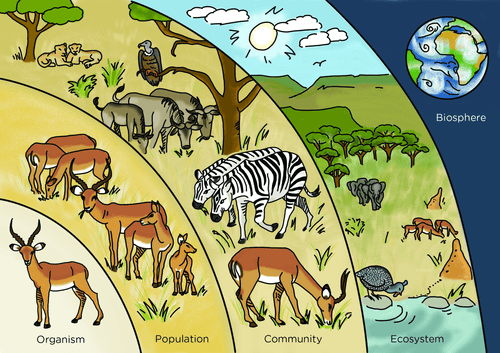
The living world is organized in levels. Biotic and abiotic factors also can be arranged into levels of biological organization. Put the words below in order from the least complex to the most complex
Community, Organism, Biome, Population, Biosphere, Ecosystem
Organism, Population, Community, Ecosystem, Biome, Biosphere
Organism, Biome, Population, Community Biosphere, Ecosystem
If the squirrel population increases then animals that are predators of squirrels, such as owls and foxes, will ___________________.
increase
decrease
stay the same
go extinct

