wayground logo

Free Printable Worksheets

Font size

S
M
L
XL
Worksheets

BIG BEAST Review

Total questions: 100

Worksheet time: 33mins

Name
Class
Date
1.
What is meant by “judicial review?"
a)
the power of a governor or the President to pardon criminals
b)
the power of a court to determine whether a law is constitutional
c)
the power of a state governor to remove an unpopular state judge
d)
an annual ranking of federal judges by the U.S. Department of Justice
2.
The diagram below shows the powers of a government official. Which official completes the diagram?
a)

Governor

b)

President

c)

Chief Justice

d)

Speaker of the House

3.
Which of the following is a true statement of an executive branch process?
a)
The president declares a new law unconstitutional.
b)
The president creates a new constitutional amendment.
c)
The president appoints a new Speaker of the House of Representatives.
d)
The president issues an order declaring a state of emergency after a hurricane
4.
Which belief did the colonists hold based on rights granted by Magna Carta?
a)
All human beings are entitled to certain natural rights.
b)
The king only rules over his subjects by their consent.
c)
New taxes cannot be imposed on subjects without their approval.
d)
All criminals must be tried in England rather than in the colonies.
5.
How does an executive order differ from a law?
a)
An executive order is not passed by Congress
b)
An executive order does not apply to the states.
c)
An executive order does not have the force of law.
d)
An executive order is not subject to the Constitution.
6.
How did the English government respond to colonial protests against the Stamp Act?
a)
It kept the Stamp Act and arrested protestors
b)
It ended the Stamp Tax but imposed new taxes.
c)
It ended the Stamp Tax and granted the colonists independence.
d)
It ended the Stamp Tax and added colonial representatives to Parliament.
7.
According to the Declaration of Independence, which are examples of natural rights?
a)
freedom of speech and of the press
b)
the right to free health care and education
c)
the right to life, liberty, and the pursuit of happiness
d)
the right to use the resources of nature, including air and water
8.
In the Constitution, how do the two houses of Congress check one another?
a)
The Senate must confirm all appointments made by the House of Representatives.
b)
The House of Representatives can annul treaties ratified by the Senate.
c)
Both houses must approve any bill for it to become a law.
d)
One house can veto a bill submitted by the other house
9.
Why did the Anti-Federalists urge the addition of a bill of rights to the Constitution?
a)
to abolish slavery
b)
to protect individual liberties
c)
to lower the costs of government
d)
to check the power of state governments
10.
What is a characteristic of a society under the rule of law?
a)
Citizens are at liberty to act without any restraint.
b)
All citizens and officials are subject to the same rules.
c)
Officials are free to follow their own private judgment.
d)
The ruler can take whatever steps he or she feels are necessary
11.
Which act fulfills a responsibility rather than an obligation of citizenship?
a)
pay taxes
b)
obey the law
c)
join a political party
d)
serve on jury if summoned
12.
Which example demonstrates fulfilling a citizenship responsibility, rather than an obligation, at the state level?
a)
enlisting in the armed services
b)
paying local sales tax when making purchases
c)
petitioning the state legislature to change a law
d)
working as an employee for the U.S. Postal Service
13.
What is the role of juries in the administration of justice?
a)
to decide which law to apply to a case
b)
to decide which evidence to admit at trial
c)
to determine the facts of a case after hearing the evidence
d)
to decide whether a decision should be overturned on appeal
14.
In Mexico, power is shared between the national government, 31 state governments, and Mexico City. Which type of government system does Mexico have?
a)
unitary
b)
federal
c)
confederal
d)
parliamentary
15.
What is the significance of the “Elastic Clause”?
a)
Congress is not subject to the Constitution
b)
Congress has additional unwritten powers it can exercise at any time.
c)
Congress can do anything that a majority of its members in both houses decide to do.
d)
Congress has the power to do anything necessary and proper to perform its delegated powers.
16.
Which power is delegated to Congress by the Constitution?
a)
the power to tax exports
b)
the power to coin money
c)
the power to issue pardons for federal crimes
d)
the power to determine the constitutionality of laws
17.
Which type of law permits citizens to sue each other for personal injuries or contract violations?
a)
civil
b)
military
c)
criminal
d)
constitutional
18.
Which type of law involves the enforcement of our most basic rights as citizens against unreasonable government interference?
a)
civil
b)
military
c)
criminal
d)
constitutional
19.
Which court can have a jury?
a)
U.S. District Court
b)
U.S. Supreme Court
c)
Florida Supreme Court
d)
U.S. Circuit Court of Appeals
20.
In which court case did the Court determine that "Separate but equal" was not equal in education?
a)
Plessy v. Ferguson
b)
Marbury v. Madison
c)
Hazelwood v. Kuhlmeier
d)
Brown v. Board of Education
21.
Which individual is a community public official elected by voters?
a)
mayor
b)
doctor
c)
school principal
d)
bank branch manager
22.
In which decision did the Supreme Court establish the power of judicial review?
a)
Brown v. Board of Education
b)
Gideon v. Wainwright
c)
Marbury v. Madison
d)
Miranda v. Arizona
23.
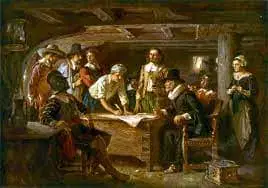
Which contains ideas from the Mayflower Compact?
a)

The colonists declared their independence from English rule.

b)

A group of early colonists declared their alliance with Parliament against the king.

c)

The king agreed not to collect new taxes without the approval of Parliament.

d)

A group of early colonists agreed to form their own community and to obey their own laws.

24.
Which colonial concern led to the writing of the Declaration of Independence?
a)
The king failed to tax the colonists.
b)
The king required the colonists to elect a monarch.
c)
The king denied the colonists the right to petition.
d)
The king denied the colonists representation in government.
25.
According to the Declaration of Independence, what was an “unalienable right” that all governments should protect
a)
The right to social equality
b)
The right to personal liberty
c)
The right to religious equality
d)
The right to elect government officials
26.
According to the Declaration of Independence, when do people have the right to abolish their government and establish a new one?
a)
Whenever a government passes a law that is disliked by people
b)
Whenever the government becomes tyrannical and oppressive
c)
Whenever the majority party in control of the government changes
d)
Whenever a king attempts to act without the approval of parliament
27.
Which weakness of the Articles of Confederation was corrected by the authors of the Constitution?
a)
no state governments
b)
no elected representatives
c)
no national court system
d)
no relations with foreign nations
28.
Montesquieu’s idea that no single branch of government should be more powerful than another influenced the founding of the United States. What characteristic of U.S. government was developed from this belief?
a)
natural law
b)
rule of law
c)
social contract
d)
checks and balances
29.
Why did the Anti-Federalists oppose ratification of the Constitution?
a)
They considered its income taxes to be too high.
b)
They feared the new government would threaten individual rights.
c)
They thought the nation needed a monarch to provide greater stability.
d)
They believed the new government would not be strong enough to overcome its challenges.
30.
What was the impact of John Locke’s views of natural law on the Founding Fathers?
a)
It enencouraged them to create a government based on a separation of powers.
b)
It encouraged them to compromise with the British Parliament.
c)
It encouraged them to preserve the system of trial by jury.
d)
It encouraged them to challenge British laws
31.
What influence did Thomas Paine’s Common Sense (1776) have on the colonists?
a)
It reconciled them with King George III of England.
b)
It established the framework for their later system of government.
c)
It persuaded them to declare their independence from Great Britain.
d)
It divided Northern and Southern colonists by calling for an end to slavery
32.
Which idea is from the Magna Carta?
a)
The people should be completely free from the government.
b)
The people should support a strong central government
c)
The government should give people a fair trial with due process.
d)
The government should give people a fair trial with due process.
33.
How were John Locke’s and Baron de Montesquieu’s thoughts on government similar?
a)
They both believed that a monarchical government is the best form of government
b)
They both believed that a government is created to protect the liberties of its citizens
c)
They both believed that a strong legislative branch was the only way to protect the rights of citizens
d)
They both believed a strong central government could decide controversies between citizens
34.
What was the purpose of the Preamble to the Constitution?
a)
to identify the goals of the national government
b)
to overcome the threat posed by Shays’ Rebellion
c)
to help the national government raise more revenue
d)
to explain the colonists’ reasons for separating from England
35.
How would Congress check the power of a President who is discovered to have violated the rule of law?
a)
by looking the other way
b)
by impeaching the President
c)
by seizing emergency powers
d)
by invoking the 25th Amendment
36.
The diagram below lists several activities. Which phrase completes the diagram?
a)

How the media monitors government

b)

How lobbyists monitor government officials

c)

How elected officials influence public opinion

d)

How individuals can influence the government
37.
What is one way in which an individual citizen can influence the government?
a)
Save money from extra earnings
b)
Help a neighbor solve a problem
c)
Sign a petition to state legislators
d)
Watch T.V. to become better informed
38.
What are newspapers, television shows, and online articles examples of?
a)
Lobbyists
b)
Interest groups
c)
Forms of media
d)
Political parties
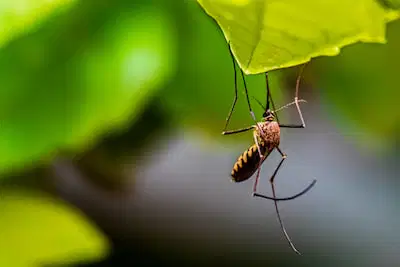
39.
A pond in Orange County has become a breeding ground for mosquitoes. Which government agency should citizens address to resolve the problem?
a)

U.S. Department of Agriculture

b)

U. S. Environmental Protection Agency

c)

Orange County Mosquito Control

d)

Florida Department of Agriculture and Consumer Services

40.
To resolve a local problem, how should citizens decide between various public policy alternatives?
a)
select the alternative with the lowest cost
b)
choose the alternative most residents prefer
c)
weigh the advantages and disadvantages of each alternative
d)
delay reaching any decision until the problem resolves itself
41.
There were 3 minor traffic accidents last year near Jessica's home where Main Street crossed Palm Drive. What is the first step Jessica should take for resolving the problem?
a)

propose the installation of a traffic light to her City Council

b)

write a letter to the Governor of Florida asking for his help

c)

start a petition to close down Main Street and Palm Drive

d)

research different ways of reducing traffic accidents

42.
The information below summarizes the main beliefs of a political party
a)

Socialist

b)

Republican

c)

Communist

d)

Libertarian

43.
The passage below is taken from a historical document. Based on the passage, which of the following would be permitted under the Constitution?
a)

Florida declares war on a foreign country.

b)

Florida follows a law signed by the president.

c)

Florida enacts a law striking down a law passed by the U.S. Congress.

d)

Florida amends the state constitution to eliminate the right to free speech.
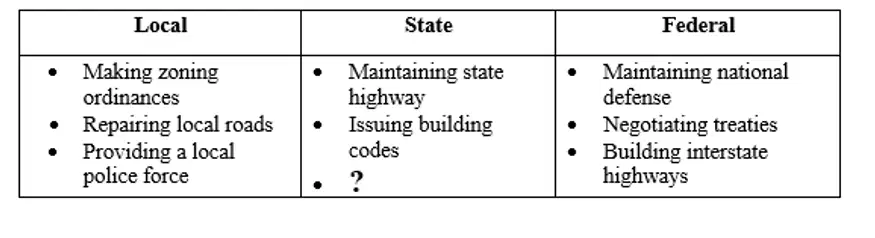
44.
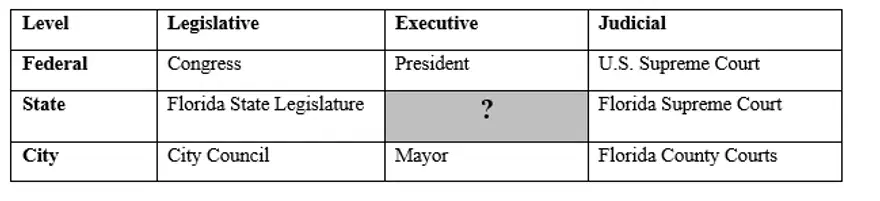
The chart below shows some of the services provided by different levels of government. Which phrase completes the diagram?
a)

Coining and printing money

b)

Organizing a street sweeping schedule

c)

Determining qualifications for teaching licenses

d)

Regulating a curbside recycling program
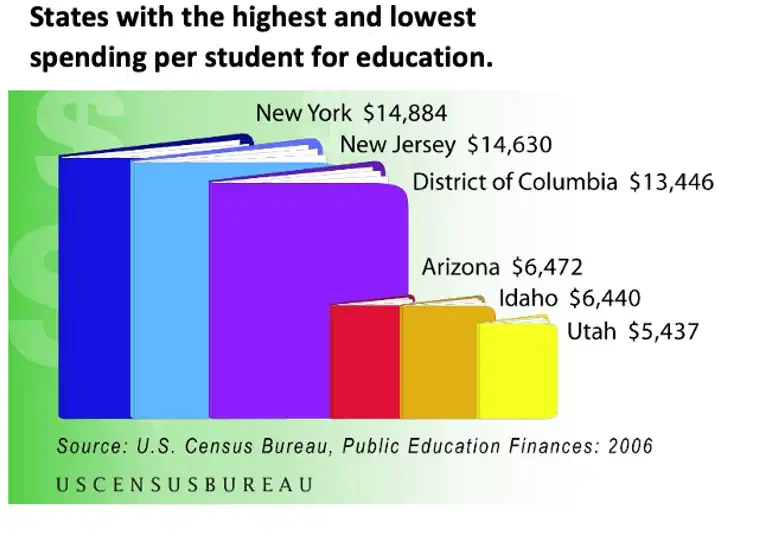
45.
The graph illustrates a constitutional power. What constitutional relationship does the map illustrate?
a)

Enumerate powers

b)

Concurrent powers

c)

Delegated powers

d)

Reserved Powers

46.
The box relates a situation in a Florida city. Read and then answer the question. What important factor was missed in this situation as outlined in the Florida Constitution?
a)

Not enough council members were present.

b)

The issue was not brought up by the mayor.

c)

The citizens did not have a signed petition.

d)

Local businesses were not present.

47.
The table below compares different levels of government. Which phrase completes the table?
a)

Mayor

b)

Governor

c)

Chief Justice

d)

County Commissioner

48.
What major impact have third political parties historically played in the American political system?
a)
Third parties have put more candidates in the White House
b)
Third parties have put more candidates in Congress
c)
Third parties have brought about sweeping social, cultural and political reform
d)
Third parties have more seats in state legislatures
49.
The phrases below summarize the primary goals of a political partyWhich political party has these primary goals?.
a)

Socialist Party

b)

Democratic Party

c)

Republican Party

d)

Communist Party

50.
The chart below lists the primary goals of a political party. Which political party has these primary goals?
a)

Democratic Party

b)

Republican Party

c)

Libertarian Party

d)

Socialist Party

51.
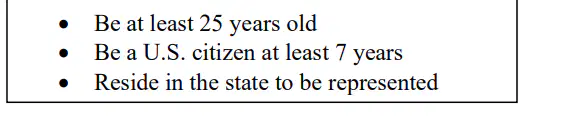
The statement below lists the qualifications for holding a public office. Which government office has these requirements?
a)

U.S. Senator

b)

Governor of Florida

c)

President of the United States

d)

Member of the U.S. House of Representatives
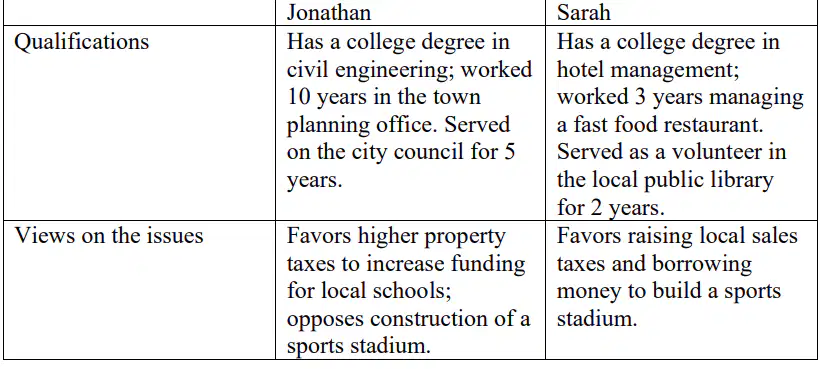
52.
Jonathan and Sarah are running for the office of city mayor. Their experience and views are summarized in the table below.What is the best reason for a local voter to vote for Jonathan, over Sarah?
a)

The voter supports building a local sports stadium.

b)

The voter thinks property taxes are already too high.

c)

The voter prefers someone with experience in local government.

d)

The voter disagrees with the past actions of the city council.

53.
The information below summarizes the main beliefs of a political party. Which political party holds these views?
a)

Socialist Party

b)

Republican Party

c)

Libertarian Party

d)

Communist Party

54.
The diagram below depicts the beliefs of a political party. Which party completes the diagram?
a)

Democratic Party

b)

Communist Party

c)

Libertarian Party

d)

Socialist Party

55.
Jocelyn is running for the U.S Senate. What is one of the qualifications for office she must meet?
a)
Be at least 21 years old
b)
Reside in the state she will represent
c)
Be a “natural born” citizen
d)
Have resided in the United States for the last 14 years
56.
Which is a constitutional requirement to run for Congress?
a)
U.S. permanent resident
b)
Be at least 25 years old
c)
Be at least 30 years old
d)
U.S. citizen
57.
In the modern political system, which issue best represents a basic disagreement between Republicans and Democrats?
a)
the responsibilities of government
b)
the frequency of national elections
c)
the legality of the US Constitution
d)
the support for the US military soldier
58.
How do the major parties select their candidates for President of the United States?
a)
Party members select their party’s candidate in a single run-off election.
b)
Party “bosses” choose their party’s candidate at their party’s nominating convention
c)
All registered voters decide on the candidate for any political party in a national primary election
d)
After a series of caucuses and primary elections, delegates at each party’s nominating convention choose their candidates.
59.
What are the names of the two major political parties in the United States today?
a)
Socialist and Libertarian
b)
Socialist and Republican
c)
Democratic and Republican
d)
Democratic and Libertarian
60.
What was an important outcome of the U.S. Supreme Court's decision in United States v. Nixon (1974)?
a)
Richard Nixon became the first President to resign from office
b)
Richard Nixon decided not to run for another term as President
c)
A manual recount of votes challenged Richard Nixon's re-election
d)
Richard Nixon was removed from office through impeachment proceedings
61.
The diagram below shows the powers of a government official. Which official completes the diagram?
a)

Governor

b)

President

c)

Chief Justice

d)

Speaker of the House

62.
How does an executive order differ from a law?
a)
An executive order is not passed by Congress
b)
An executive order does not apply to the states.
c)
An executive order does not have the force of law.
d)
An executive order is not subject to the Constitution.
63.
Which of the following is a true statement of an executive branch process?
a)
The president declares a new law unconstitutional.
b)
The president creates a new constitutional amendment.
c)
The president appoints a new Speaker of the House of Representatives.
d)
The president issues an order declaring a state of emergency after a hurricane
64.
Which belief did the colonists hold based on rights granted by Magna Carta?
a)
All human beings are entitled to certain natural rights.
b)
The king only rules over his subjects by their consent.
c)
New taxes cannot be imposed on subjects without their approval.
d)
All criminals must be tried in England rather than in the colonies.
65.
How did the English government respond to colonial protests against the Stamp Act?
a)
It kept the Stamp Act and arrested protestors
b)
It ended the Stamp Tax but imposed new taxes.
c)
It ended the Stamp Tax and granted the colonists independence.
d)
It ended the Stamp Tax and added colonial representatives to Parliament.
66.
In the Constitution, how do the two houses of Congress check one another?
a)
The Senate must confirm all appointments made by the House of Representatives.
b)
The House of Representatives can annul treaties ratified by the Senate.
c)
Both houses must approve any bill for it to become a law.
d)
One house can veto a bill submitted by the other house
67.
Why did the Anti-Federalists urge the addition of a bill of rights to the Constitution?
a)
to abolish slavery
b)
to protect individual liberties
c)
to lower the costs of government
d)
to check the power of state governments
68.
What is a characteristic of a society under the rule of law?
a)
Citizens are at liberty to act without any restraint.
b)
All citizens and officials are subject to the same rules.
c)
Officials are free to follow their own private judgment.
d)
The ruler can take whatever steps he or she feels are necessary
69.
Which act fulfills a responsibility rather than an obligation of citizenship?
a)
pay taxes
b)
obey the law
c)
join a political party
d)
serve on jury if summoned
70.
Which example demonstrates fulfilling a citizenship responsibility, rather than an obligation, at the state level?
a)
enlisting in the armed services
b)
paying local sales tax when making purchases
c)
petitioning the state legislature to change a law
d)
working as an employee for the U.S. Postal Service
71.
What is the role of juries in the administration of justice?
a)
to decide which law to apply to a case
b)
to decide which evidence to admit at trial
c)
to determine the facts of a case after hearing the evidence
d)
to decide whether a decision should be overturned on appeal
72.
Which colonial concern led to the writing of the Declaration of Independence?
a)
The king failed to tax the colonists.
b)
The king required the colonists to elect a monarch.
c)
The king denied the colonists the right to petition.
d)
The king denied the colonists representation in government.
73.
What was the impact of John Locke’s views of natural law on the Founding Fathers?
a)
It enencouraged them to create a government based on a separation of powers.
b)
It encouraged them to compromise with the British Parliament.
c)
It encouraged them to preserve the system of trial by jury.
d)
It encouraged them to challenge British laws
74.
According to the Declaration of Independence, when do people have the right to abolish their government and establish a new one?
a)
Whenever a government passes a law that is disliked by people
b)
Whenever the government becomes tyrannical and oppressive
c)
Whenever the majority party in control of the government changes
d)
Whenever a king attempts to act without the approval of parliament
75.
Why did the Anti-Federalists oppose ratification of the Constitution?
a)
They considered its income taxes to be too high.
b)
They feared the new government would threaten individual rights.
c)
They thought the nation needed a monarch to provide greater stability.
d)
They believed the new government would not be strong enough to overcome its challenges.
76.
Which weakness of the Articles of Confederation was corrected by the authors of the Constitution?
a)
no state governments
b)
no elected representatives
c)
no national court system
d)
no relations with foreign nations
77.
How can the U.S. Senate check the actions of the President?
a)
by vetoing a proposed bill
b)
by refusing to ratify a treaty
c)
by adjourning a congressional session
d)
by holding a law to be unconstitutional
78.
Which shows the correct sequence for amending the Constitution?
a)
a majority of the state legislatures approves it - a majority of both houses of Congress ratify it
b)
2/3s of both houses of Congress approve it - 3/4 of state legislatures ratify it
c)
A majority of both houses of Congress approve it - 2/3 of both houses of Congress ratify it
d)
3/4 of the state legislatures approve it - 2/3 of both houses of Congress ratify it.
79.
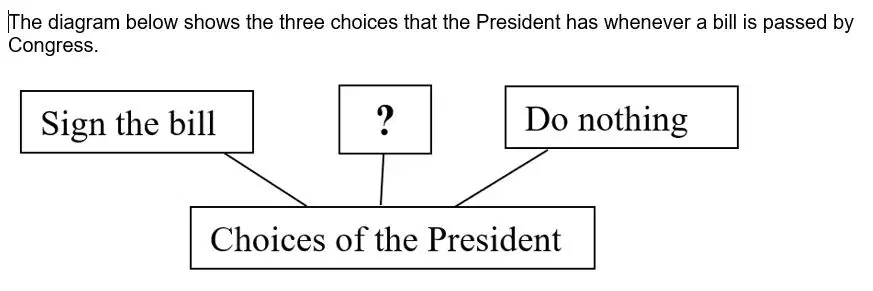
The diagram below shows the 3 choices that the President has whenever a bill is passed by Congress. Which phrase completes the diagram?
a)

Veto the bill

b)

Amend the bill

c)

Pocket Veto the bill

d)

Refer to a public referendum

80.
Between 1870 and 1913, one amendment was added to the U.S. Constitution. Based on this information, what can be inferred about the constitutional amendment process?
a)
Ratification of an amendment requires 50 percent of Congress's approval
b)
Ratification of an amendment requires 50 percent of the state governor's approval
c)
Amending the U.S. Constitution is long a difficult process that does not allow changes to happen easily
d)
Amending the U.S. Constitution is relatively quick and simple process that allows change to happen easily
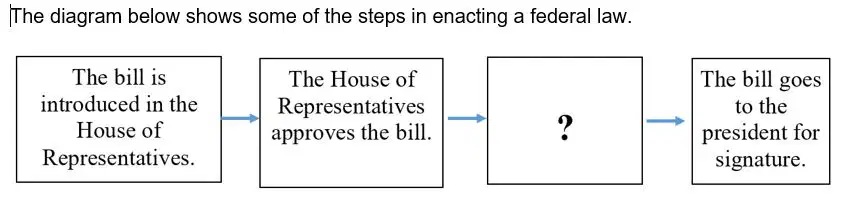
81.
The diagram below shows some of the steps in enacting a federal law. What is the next step in the lawmaking process?
a)

The bill goes to the people for a vote

b)

The bill moves to the states for debate and ratification

c)

The bill moves to the Senate for debate, discussion, and vote

d)

The bill goes to a joint House/Senate committee for discussion.

82.
John eats a bowl of cornflakes and becomes sick. Later he discovers that the box of cornflakes was accidentally contaminated. He seeks payment from the manufacturer for his pain and suffering. Which type of law is used t
a)
civil
b)
military
c)
criminal
d)
constitutional
83.
A newspaper headline reads: THE SUPREME COURT HAS OVERTURNED DOZENS OF CASES IN THE PAST 60 YEARS What might the article be about?
a)
The Supreme Court has amended the U.S. Constitution many times.
b)
The Supreme Court has changed its mind on a previously settled issue.
c)
The Supreme Court has pardoned a dangerous convicted criminal
d)
The Supreme Court has impeached corrupt elected officials.
84.
The table below describes a possible scenario of the powers of the U.S. government. Which of the following would correctly complete the table?
a)

Supreme Court hears cases between states

b)

Supreme Court impeaches president

c)

Supreme Court approves treaties

d)

Supreme Court proposes laws

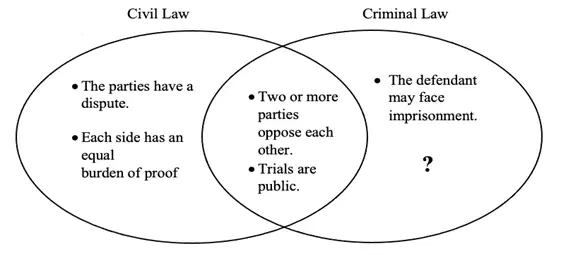
85.
The Venn diagram below shows some characteristics of civil and criminal law. Which statement completes the Venn diagram?
a)

Trials never require a jury

b)

There are no rules of evidence

c)

The losing side pays all court costs

d)

The accused are innocent until proven guilty
86.
What roles does a jury play in a criminal case?
a)
It reviews the case when it is heard on appeal.
b)
It decides which law should be applied to the case
c)
It determines which evidence should be admissible at trial.
d)
It determines the facts based on evidence presented in court
87.
The flowchart below depicts the organization of the federal court system. U.S. DISTRICT COURT --> ? --> U.S. SUPREME COURT Which court completes the diagram?
a)
. U.S. Circuit Court
b)
Florida District Court
c)
U.S. Circuit Court of Appeals
d)
Florida District Court of Appeals
88.
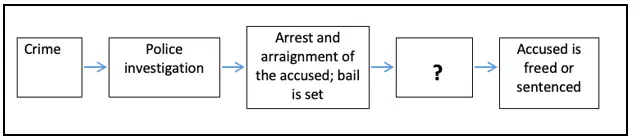
The diagram below shows the steps in the administration of justice when a crime is committed. Which step completes the timeline?
a)

The Court of Appeals decides the main facts the case

b)

The accused receives a public trial before a jury of peers

c)

A legislative body decides if the accused should be punished.

d)

An attorney determines the innocence or guilt of the accused
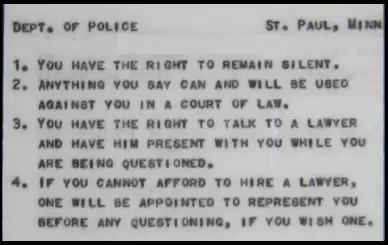
89.
Use the image to answer the question. A landmark Supreme Court Case led to the creation of the document below. Which case resulted in the creation of the document?
a)

Tinker v. Des Moines

b)

Gideon v. Wainright

c)

Marbury v. Madison

d)

Miranda v. Arizona

90.
What was the impact of the Supreme Court’s decision in the case of Gideon v. Wainwright (1963)?
a)
Juveniles must be given similar due process rights as adults when arrested for crimes
b)
Poor defendants accused of serious crimes had to be provided with a state-sponsored public defender.
c)
Students retain their freedom of speech within public schools unless their speech disrupts learning.
d)
Suspects had to be told of their right to have an attorney present or to remain silent during police interrogations
91.
Why did the Federalists believe individual liberties were not threatened by the Constitution?
a)
State governments would protect individual liberties
b)
Elected officials could be trusted to protect individual liberties.
c)
The federal government was given only limited powers by the Constitution
d)
The federal government would use its powers to protect, not threaten, individual liberties
92.
Why did the Anti-Federalists oppose ratification of the Constitution?
a)
They considered its income taxes to be too high
b)
They feared the new government would threaten individual rights.
c)
They thought the nation needed a monarch to provide greater stability
d)
They believed the new government would not be strong enough to overcome its challenges
93.
Which argument supported the Federalist view that adoption of the Constitution would not threaten individual liberties?
a)
Government power was to be separated into three branches and divided between the national and state governments
b)
State governments would continue to hold the most power and would safeguard individual freedom.
c)
The federal government would use its new powers to protect, not threaten, individual rights.
d)
Elected government officials would never take steps against individual rights
94.
How does the rule of law protect citizens from arbitrary and abusive acts of government power?
a)
Officials must treat all citizens fairly and equally, based on known rules.
b)
Officials are free to follow their own views in emergency situations
c)
Citizens can vote unpopular officials out of office at election times
d)
Citizens can refuse to follow any laws they believe to be unjust
95.
How does the Constitution enable the President to check the actions of Congress?
a)
by refusing to provide funding
b)
by adjourning a congressional session
c)
by holding a law to be unconstitutional
d)
by vetoing a bill approved by both houses
96.
How does the system of checks and balances restrain the power of the government?
a)
by requiring the cooperation of two branches for many government actions
b)
by requiring the government actions be approved by a popular vote
c)
by allowing Congress to make amendments to the Constitution
d)
by allowing voters to overturn prior government decisions
97.
The diagram below depicts relations between two branches of the federal government. What is the best title for this diagram?
a)

Federalism

b)

Popular Sovereignty

c)

Limited Government

d)

Checks and Balances

98.
Why did the authors of the Constitution make it more difficult to amend the Constitution than to pass ordinary law?
a)
They believed the system of government should only be changed with overwhelming support
b)
They wanted to make the system of government more responsive to popular needs.
c)
They did not want any one branch of the government to become too powerful.
d)
They borrowed this practice from the historical traditions of Great Britain.
99.
Under the 14th Amendment, state governments cannot deny citizens the “equal protection of the laws.” What is the meaning of this phrase?
a)
An accused citizen is innocent until proven guilty
b)
Each citizen is entitled to the same wages as every other citizen
c)
Every citizen should receive the same benefits, regardless of income
d)
All citizens should be treated the same under the law regardless of race, ethnicity, religion or gender
100.
What is an important function of the Governor of Florida?
a)
to give advisory opinions on the constitutionality of proposed laws
b)
to act as chief executive of Florida’s state government
c)
to act as Commander-in-Chief of U.S. armed forces
d)
to appoint and receive ambassadors