
 Worksheets
chap 35 pe nha
Total questions: 137
Worksheet time: 1hrs 9mins
Closely watched indicators such as the inflation rate and unemployment are released each month by the
a.Bureau of the Budget.
b.Bureau of Labor Statistics.
c.Department of the Treasury.
d.President's Council of Economic Advisors.
a
b
c
d
The misery index is calculated as the
a.inflation rate plus the unemployment rate.
b.unemployment rate minus the inflation rate.
c.actual inflation rate minus the expected inflation rate.
d.natural unemployment rate times the inflation rate
a
b
c
d
One determinant of the natural rate of unemployment is the
a.rate of growth of the money supply.
b.minimum wage rate.
c.expected inflation rate.
d.All of the above are correct.
a
b
c
d
In the long run,
a.the natural rate of unemployment depends primarily on the level of aggregate demand.
b.inflation depends primarily upon the money supply growth rate.
c.there is a tradeoff between the inflation rate and the natural rate of unemployment.
d.All of the above are correct.
a
b
c
d
A basis for the slope of the short-run Phillips curve is that when unemployment is high there are
a.downward pressures on prices and wages.
b.downward pressures on prices and upward pressures on wages.
c.upward pressures on prices and downward pressures on wages.
d. upward pressures on prices and wages.
a
b
c
d
When monetary and fiscal policymakers expand aggregate demand, which of the following costs is incurred in the short run?
a.Short-run aggregate supply decreases.
b.The natural rate of unemployment increases.
c.The price level increases more rapidly.
d.The money supply increases less rapidly.
a
b
c
d
The short-run relationship between inflation and unemployment is often called
a.the Classical Dichotomy.
b.Money Neutrality.
c.the Phillips curve.
d.None of the above is correct.
a
b
c
d
A. W. Phillips' findings were based on data
a.from 1861-1957 for the United Kingdom.
b.from 1861-1957 for the United States.
c.mostly from the post-World War II period in the United Kingdom.
d.mostly from the post-World War II period in the United States.
a
b
c
d
A.W. Phillips’s discovery of a particular relationship between unemployment and inflation for the United Kingdom
a.could not be extended to other countries, despite many researchers’ attempts to provide that extension.
b.was quickly extended to other countries by researchers.
c.was extended to only one other country — the United States.
d.was harshly criticized by the American economists Paul Samuelson and Robert Solow on the grounds that Phillips’s study was fundamentally flawed.
a
b
c
d
Samuelson and Solow reasoned that when aggregate demand was low, unemployment was
a.high, so there was upward pressure on wages and prices.
b.high, so there was downward pressure on wages and prices.
c.low, so there was upward pressure on wages and prices.
d.low, so there was downward pressure on wages and prices.
a
b
c
d
Samuelson and Solow argued that a combination of low unemployment and low inflation
a.was impossible given the historical data as summarized by the Phillips curve.
b.could be achieved with an “appropriate” fiscal policy.
c.could be achieved with an “appropriate” monetary policy.
d.could be achieved with an “appropriate” mix of monetary and fiscal policies.
a
b
c
d
There is a
a.short-run tradeoff between inflation and unemployment.
b.short-run tradeoff between the actual unemployment rate and the natural rate of unemployment.
c.long-run tradeoff between inflation and unemployment.
d.long-run tradeoff between the actual unemployment rate and the natural rate of unemployment.
a
b
c
d
Unemployment would decrease and prices would increase if
a.aggregate demand shifted right.
b.aggregate demand shifted left.
c.aggregate supply shifted right.
d.aggregate supply shifted left.
a
b
c
d
Suppose that the money supply increases. In the short run, this increases prices according to
a.both the short-run Phillips curve and the aggregate demand and aggregate supply model.
b.neither the short-run Phillips curve nor the aggregate demand and aggregate supply model.
c.the short-run Phillips curve, but not according to the aggregate demand and aggregate supply model.
d.the aggregate demand and aggregate supply model but not according to the short-run Phillips curve.
a
b
c
d
If policymakers expand aggregate demand, then in the long run
a.prices will be higher and unemployment will be lower.
b.prices will be higher and unemployment will be unchanged.
c.prices and unemployment will be unchanged.
d.None of the above is correct.
a
b
c
d
In 2001, Congress and President Bush instituted tax cuts. According to the short-run Phillips curve, in the short run this change should have
a.reduced inflation and unemployment.
b.raised inflation and unemployment.
c.reduce inflation and raised unemployment.
d. raised inflation and reduced unemployment.
a
b
c
d
Which of the following would we not expect if government policy moved the economy up along a given short-run Phillips curve?
a.Teresa reads in the newspaper that the central bank recently raised the money supply.
b.Jackie gets fewer job offers.
c.Miguel makes larger increases in the prices at his health food store.
d.Julie's nominal wage increase is larger.
a
b
c
d
The government of Blenova considers two policies. Policy A would shift AD right by 500 units while policy B would shift AD right by 300 units. According to the short-run Phillips curve, policy A will lead
a.to a lower unemployment rate and a lower inflation rate than policy B.
b.to a lower unemployment rate and a higher inflation rate than policy B.
c.to a higher unemployment rate and lower inflation rate than policy B.
d.to a higher unemployment rate and higher inflation rate than policy B.
a
b
c
d
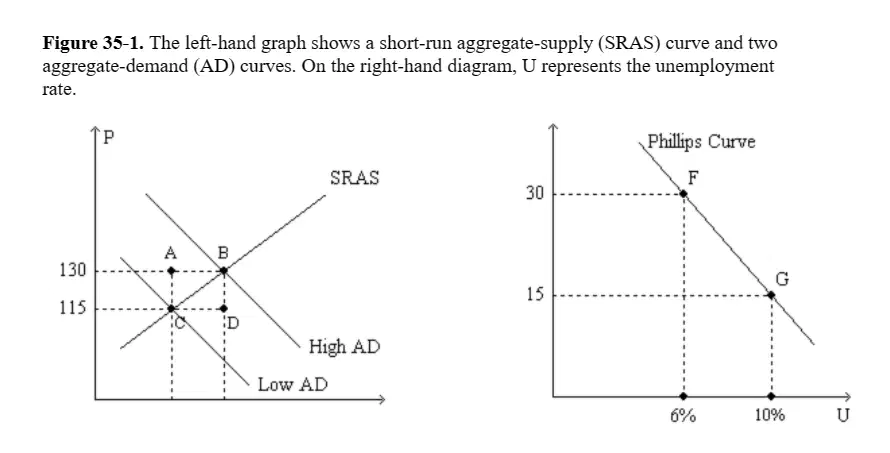
Refer to Figure 35-1. What is measured along the horizontal axis of the left-hand graph?
a.the wage rate
b.the inflation rate
c.employment
d.output
a
b
c
d
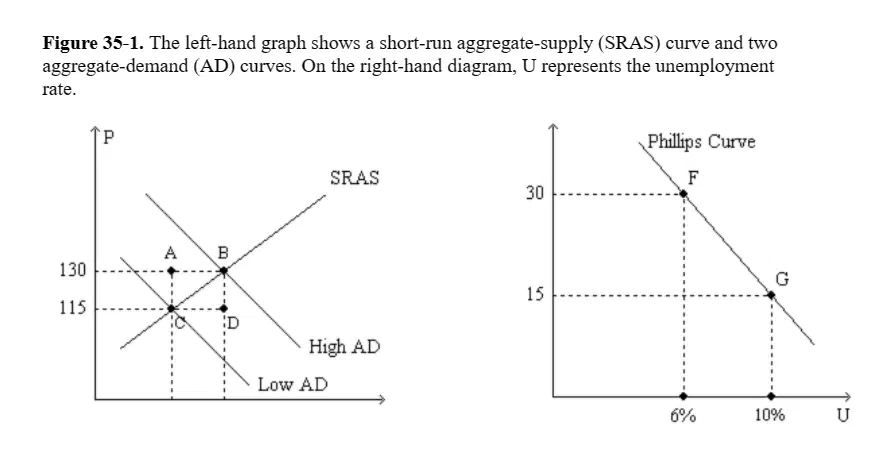
Refer to Figure 35-1. Assuming the price level in the previous year was 100, point F on the right-hand graph corresponds to
a.point A on the left-hand graph.
b.point B on the left-hand graph.
c.point C on the left-hand graph.
d.point D on the left-hand graph.
a
b
c
d
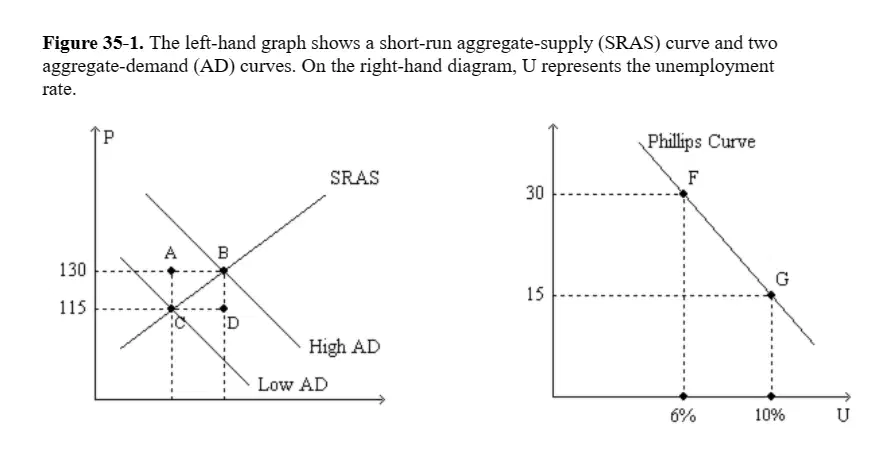
Refer to Figure 35-1. Suppose points F and G on the right-hand graph represent two possible outcomes for an imaginary economy in the year 2012, and those two points correspond to points B and C, respectively, on the left- hand graph. Then it is apparent that the price index equaled
a. 130 in 2011.
b. 115 in 2011.
c. 110 in 2011.
d. 100 in 2011.
a
b
c
d
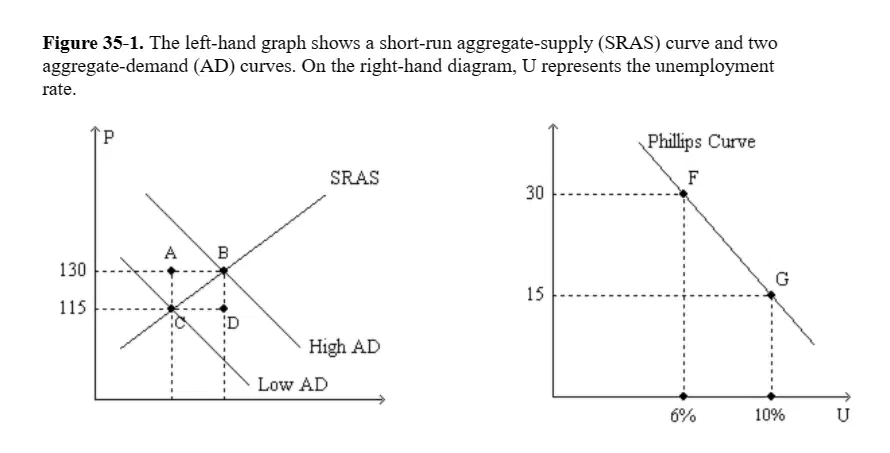
Refer to Figure 35-1. The curve that is depicted on the righthand graph offers policymakers a “menu” of combinations
a.that applies both in the short run and in the long run.
b.that is relevant to choices involving fiscal policy, but not to choices involving monetary policy.
c.of inflation and unemployment.
d.All of the above are correct.
a
b
c
d
If consumption expenditures fall, then in the short run
a.inflation and unemployment rise.
b.inflation rises and unemployment falls.
c.inflation falls and unemployment rises.
d.inflation and unemployment fall.
a
b
c
d
Which of the following would we not expect if government policy moves the economy up along a given short-run Phillips curve?
a.Mark gets an increase in his nominal wage.
b.Bob gets more job offers.
c.Susan reduces prices at her pizza restaurant.
d.Tom reads that the central bank recently raised the money supply
a
b
c
d
Other things constant, which of the following would reduce unemployment and raise inflation?
a.businesses become more optimistic about the future of the economy
b.because of high growth abroad, net exports rise
c.the government cuts taxes
d.All of the above are correct.
a
b
c
d
If more firms chose to pay efficiency wages, which of the following would shift to the right?
a.both the long-run Phillips curve and the long-run aggregate supply curve
b.the long-run Phillips curve but not the long-run aggregate supply curve
c.the long-run aggregate supply curve but not the long-run Phillips curve
d.neither the long-run Phillips curve nor the long-run aggregate supply curve
a
b
c
d
Which of the following increases inflation and reduces unemployment in the short run?
a.either an increase in government expenditures by itself or an increase in the money supply growth rate by itself
b.an increase in government expenditures, but not an increase in the money supply growth rate
c.an increase in the money supply growth rate, but not an increase in government expenditures
d.neither an increase in government expenditures nor an increase in the money supply
a
b
c
d
In 1968, economist Milton Friedman published a paper criticizing the Phillips curve on the grounds that
a.it seemed to work for wages but not for inflation.
b.monetary policy was ineffective in combating inflation.
c.the Phillips curve did not apply in the long run.
d.Phillips had made errors in collecting his data.
a
b
c
d
In the late 1960s, economist Edmund Phelps published a paper that
a.argued that there was no long-run tradeoff between inflation and unemployment.
b.disproved Friedman's claim that monetary policy was effective in controlling inflation.
c.showed the optimal point on the Phillips curve was at an unemployment rate of 5 percent and an inflation rate of 2 percent.
d.argued that the Phillips curve was stable and that it would not shift.
a
b
c
d
According to classical macroeconomic theory, in the long run
a.monetary growth affects both real and nominal variables.
b.the only real variable affected by monetary growth is the unemployment rate.
c.a number of factors that affect unemployment are influenced by monetary growth.
d.monetary growth affects nominal but not real variables.
a
b
c
d
Friedman argued that the Fed could use monetary policy to peg
a.nominal exchange rates.
b.the level of real GDP.
c.the rate of unemployment.
d.None of the above is correct.
a
b
c
d
One way to express the classical idea of monetary neutrality is to draw
a.a downward-sloping short-run Phillips curve.
b.an upward-sloping short-run Phillips curve.
c.a downward-sloping long-run Phillips curve.
d.a vertical long-run Phillips curve.
a
b
c
d
By raising aggregate demand more than anticipated, policymakers
a.reduce unemployment for awhile.
b.raise unemployment for awhile.
c.reduce unemployment permanently.
d.None of the above is correct.
a
b
c
d
Which of the following is correct according to the long-run Phillips curve?
a.No government policy, including changes in the money supply growth rate, can change the natural rate of unemployment.
b.Changes in the money supply growth rate are the only means by which government policy can change the natural rate of unemployment.
c.Monetary policy cannot change the natural rate of unemployment, but other government policies can.
d.Monetary policy and other government policies can shift the long-run Phillips curve.
a
b
c
d
Any policy change that reduced the natural rate of unemployment
a.would shift the long-run Phillips curve to the right.
b.would shift the long-run aggregate-supply curve to the right.
c.would be a policy change that impeded the functioning of the labor market.
d.All of the above are correct.
a
b
c
d
Which of the following would shift the long-run Phillips curve to the right?
a.expansionary fiscal policy
b.an increase in the inflation rate
c.increases in unemployment compensation
d.None of the above is correct.
a
b
c
d
For a number of years Canada and many European countries have had higher average unemployment rates than the United States. The Phillips curve suggests that these countries
a.have higher average inflation rates than the United States.
b.have longrun Phillips curves to the right of the United States’.
c.may have less generous unemployment compensation or lower minimum wages.
d.All of the above are consistent with the evidence on unemployment rates.
a
b
c
d
Sticky wages leads to a positive relationship between the actual price level and the quantity of output supplied in
a.both the short and long run.
b.the short run, but not the long run.
c.the long run, but not the short run.
d.neither the short nor the long run.
a
b
c
d
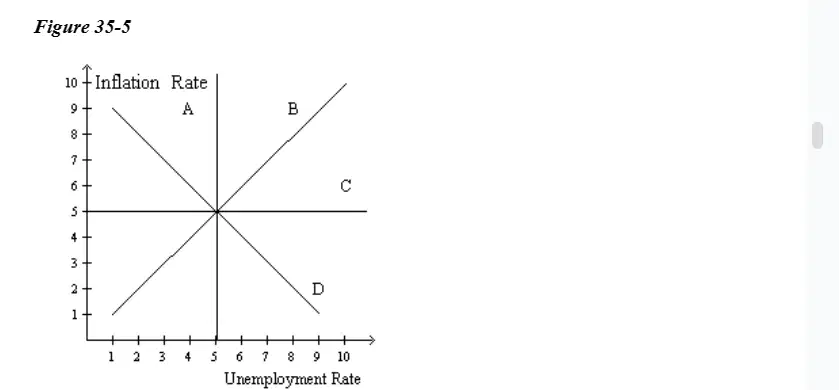
Refer to figure 35-5. In this order, which curve is a long-run Phillips curve and which is a short-run Phillips curve?
a.A, B
b.A, D
c.C, B
d.None of the above is correct.
a
b
c
d
Which of the following is downward-sloping?
a.both the long-run Phillips curve and the short-run Phillips curve
b.neither the long-run Phillips curve nor the short-run Phillips curve
c.the long-run Phillips curve, but not the short-run Phillips curve
d.the short-run Phillips curve, but not the long-run Phillips curve
a
b
c
d
Suppose the central bank pursues an unexpectedly tight monetary policy. In the short-run the effects of this are shown by
a.moving to the left along the short-run Phillips curve.
b.moving to the right along the short-run Phillips curve.
c.shifting the short-run Phillips curve to the right.
d.shifting the short-run Phillips curve to the left.
a
b
c
đ
A movement to the left along a given short-run Phillips curve could be caused by
a.a reduction in the natural rate of unemployment or expansionary monetary policy.
b.expansionary monetary policy, but not a reduction in the natural rate of unemployment.
c.either a reduction in the natural rate of unemployment or a contractionary monetary policy.
d.contractionary monetary policy, but not a reduction in the natural rate of unemployment.
a
b
c
d
More flexible labor markets will shift
a.both the long-run Phillips curve and the long-run aggregate supply curve to the right.
b.both the long-run Phillips curve and the long-run aggregate supply curve to the left.
c.the long-run Phillips curve to the right and the long-run aggregate supply curve to the left.
d.the long-run Phillips curve to the left and the long-run aggregate supply curve to the right.
a
b
c
d
The position of the long-run Phillips curve and the long-run aggregate supply curve both depend on
a.the natural rate of unemployment and monetary growth.
b.the natural rate of unemployment, but not monetary growth.
c.monetary growth, but not the natural rate of unemployment.
d.neither monetary growth nor the natural rate of unemployment.
a
b
c
d
The position of the long-run Phillips curve and the long-run aggregate supply curve both depend on
a. the natural rate of unemployment and monetary growth.
b. the natural rate of unemployment, but not monetary growth.
c. monetary growth, but not the natural rate of unemployment.
d. neither monetary growth nor the natural rate of unemployment.
a
b
c
d
If inflation expectations decline, then the short-run Phillips curve shifts
A.left, so that at any inflation rate unemployment is lower in the short run than before.
B.right, so that at any inflation rate unemployment is lower in the short run than before.
C.right, so that at any inflation rate unemployment is higher in the short run than before.
D.left, so that at any inflation rate unemployment is higher in the short run than before.
A
B
C
D
The analysis of Friedman and Phelps can be summarized in the following equation where a is a positive number:
a.Unemployment Rate = Natural Rate of Unemployment - a(Actual Inflation - Expected Inflation).
b.Unemployment Rate = Natural Rate of Unemployment - a(Expected Inflation - Actual Inflation).
c.Unemployment Rate = Expected Rate of Inflation - a(Actual Inflation - Expected Inflation).
d.Unemployment Rate = Actual Rate of Inflation - a(Actual Unemployment - Expected Unemployment).
a
b
c
d
A policy intended to reduce unemployment by taking advantage of a tradeoff between inflation and unemployment leads to
a.both higher inflation and higher unemployment in the long run.
b.higher inflation and no change in unemployment in the long run.
c.the same inflation rate and lower unemployment in the long run.
d.higher inflation and lower unemployment in the long run
a
b
c
d
A central bank sets out to reduce unemployment by changing the money supply growth rate. The long-run Phillips curve shows that in comparison to their original rates, this policy will eventually lead to
a.an increase in both the inflation rate and the unemployment rate.
b.an increase in the inflation rate and a reduction in the unemployment rate.
c.no change in either the inflation rate or the unemployment rate.
d.an increase in the inflation rate and no change in the unemployment rate.
a
b
c
d
Suppose the Fed decreased the growth rate of the money supply. Which of the following would be lower in the long run?
a.both the natural rate of unemployment and the inflation rate
b.the natural rate of unemployment, but not the inflation rate
c.the inflation rate, but not the natural rate of unemployment
d.neither the natural unemployment rate nor the inflation rate
a
b
c
d
The economy is in long-run equilibrium when Senator Soldout argues that the Fed should do more to fight unemployment. He argues that if the Fed increased the money supply faster, more workers would find jobs. The Senator's argument
a.is completely correct.
b.is completely wrong.
c.is true for the short run but not the long run.
d.is true for the long run but not the short run
a
b
c
d
Data for the United States traced out an almost perfect Phillips curve for much of the
a. 1960s.
b. 1970s.
c. 1980s.
d. 1990s.
a
b
c
d
By about 1973, U.S. policymakers had learned that
a.there is no trade-off between inflation and unemployment in the short run.
b.there is no trade-off between inflation and unemployment in the long run.
c.Friedman’s analysis of inflation and unemployment had been correct, and Phelps’s analysis of inflation and unemployment had been incorrect.
d.Phelps’s analysis of inflation and unemployment had been correct, and Friedman’s analysis of inflation and unemployment had been incorrect.
a
b
c
d
A politician blames the Federal Reserve for being “soft on unemployment” and claims that a permanently higher money supply growth rate will lead to a permanent reduction in the unemployment rate. The politician’s argument is
a.consistent with the long-run Phillips curve. Further, the long-run Phillips curve implies that such a policy would not increase inflation.
b.consistent with the long-run Phillips curve. However, the long-run Phillips curve implies that such a policy would increase inflation.
c.inconsistent with the long-run Phillips curve. However, the long-run Phillips curve implies that such a policy would not increase inflation.
d.inconsistent with the long-run Phillips curve. Further, the long-run Phillips curve implies that such a policy would increase inflation.
a
b
c
d
If people correctly anticipate that inflation will fall by 1%, then
a.the short-run Phillips curve shifts right and unemployment is unchanged.
b.the short-run Phillips curve shifts right and unemployment rises.
c.the short-run Phillips curve shifts left and unemployment is unchanged.
d.the short-run Phillips curve would shift left and unemployment falls.
a
b
c
d
Consider two countries: Eastland and Westland. Eastland’s longrun Phillips curve sits further to the right than does Westland’s longrun Phillips curve. Eastland and Westland are identical in all other ways. In particular, they have the same money supply growth rates. In the long run, compared to Westland, which of the following will we observe in Eastland?
a.higher unemployment and higher inflation.
b.higher unemployment and the same rate of inflation.
c.lower unemployment and higher inflation.
d.None of the above is correct.
a
b
c
d
Country A has a higher money supply growth rate and a long-run Phillips curve that is farther to the left than country B’s. In the long run as compared to country B, country A will have
a.lower unemployment and higher inflation
b.higher unemployment and higher inflation
c.lower unemployment and lower inflation
d.None of the above is necessarily correct.
a
b
c
d
If inflation is greater than expected, then the unemployment rate is
a.above the natural rate. In the long run the short-run Phillips curve will shift right.
b.above the natural rate. In the long run the short-run Phillips curve will shift left.
c.below the natural rate. In the long run the short-run Phillips curve will shift right.
d.below the natural rate. In the long run the short-run Phillips curve will shift left.
a
b
c
d
Other things the same, in the long run a country that reduces the minimum wage from very high levels will have
a.higher unemployment and lower inflation
b.lower unemployment and higher inflation
c.higher unemployment and the same level of inflation
d.lower unemployment and the same level of inflation
a
b
c
d
Prime Minister Emma Bigshot urges passage of a bill to reduce unemployment benefits from very generous levels in her country. She also urges her country’s central bank to raise the rate at which the money supply is increasing. In the long run which, if either, of these policies will reduce the unemployment rate?
a.both reducing the generosity of unemployment benefits and raising the rate at which the money supply is increasing
b.reducing the generosity of unemployment benefits but not raising the rate at which the money supply is increasing
c.raising the rate at which the money supply is increasing, but not reducing the generosity of unemployment benefits
d.neither reducing the generosity of unemployment benefits nor raising the rate at which the money supply is increasing
a
b
c
d
The idea that the long-run Phillips curve is
a.vertical stems from the analysis of Samuelson and Solow.
b.vertical stems from the analysis of Friedman and Phelps.
c.vertical was disproved by the experiment that monetary and fiscal policymakers inadvertently created in the 1970s.
d.downward-sloping can be correct if unemployment responds very quickly to unexpected inflation.
a
b
c
d
For a given level of inflation expectations, if the central bank increases the money supply growth rate, then in the short run
a.the economy moves down along the short-run Phillips curve.
b.the economy moves up along the short-run Phillips curve.
c.the Phillips curve shifts right.
d.the Phillips curve shifts left.
a
b
c
d
An event that directly affects firms’ costs of production and thus the prices they charge is called
a.a Phillips contraction.
b.an inflationary spiral.
c.a demand shock.
d.a supply shock.
a
b
c
d
Which of the following is an example of an adverse supply shock?
a.a decrease in the money supply
b.a tax cut
c.a worldwide drought
d.decreased government spending
a
b
c
d
An adverse supply shock will shift short-run aggregate supply
a.right, making prices rise.
b.left, making prices rise.
c.right, making prices fall.
d.left, making prices fall.
a
b
c
d
Which of the following results in higher inflation and higher unemployment in the short run?
a.a more expansionary monetary policy
b.a more contractionary monetary policy
c.a decrease in the minimum wage
d.an adverse supply shock such as an increase in the price of oil
a
b
c
d
Which of the following is not associated with an adverse supply shock?
a.the short-run Phillips curve shifts left
b.unemployment rises
c.the price level rises
d.output falls
a
b
c
d
If there is an adverse supply shock, then
a.unemployment rises and the short-run Phillips curve shifts right.
b.unemployment rises and the short-run Phillips curve shifts left.
c.unemployment falls and the short-run Phillips curve shifts right.
d.unemployment falls and the short-run Phillips curve shifts left.
a
b
c
d
An adverse supply shock causes inflation to
a.rise and the short-run Phillips curve to shift right.
b.rise and the short-run Phillips curve to shift left.
c.fall and the short-run Phillips curve to shift right.
d.fall and the short-run Phillips curve to shift left.
a
b
c
d
Which of the following is correct if there is an adverse supply shock?
a.The short-run aggregate supply curve and the short-run Phillips curve both shift right.
b.The short-run aggregate supply curve and the short-run Phillips curve both shift left.
c.The short-run aggregate supply curve shifts right and the short-run Phillips curve shifts left.
d.The short-run aggregate supply curve shifts left and the short-run Phillips curve shifts right.
a
b
c
d
When they are confronted with an adverse shock to aggregate supply, policymakers face a difficult choice in that
a.if they contract aggregate demand, the unemployment rate will increase further.
b.if they expand aggregate demand, the inflation rate will increase further.
c.they face a less favorable trade-off between inflation and unemployment than they did before the shock.
d.All of the above are correct.
a
b
c
d
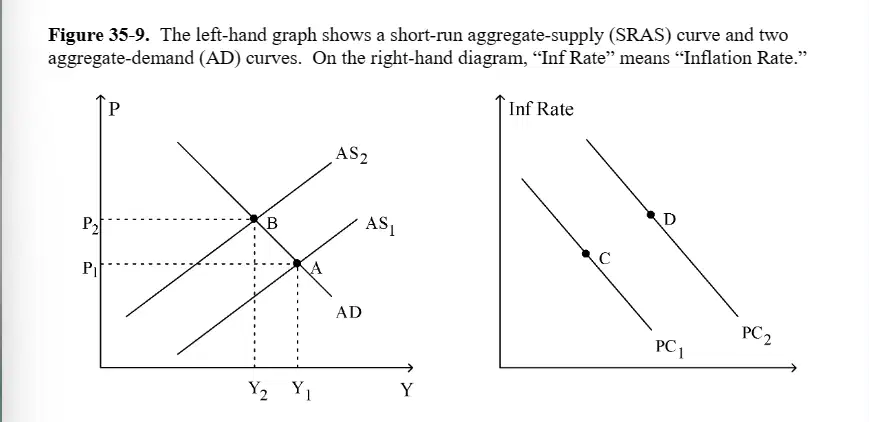
Refer to Figure 35-9. What is measured along the horizontal axis of the right-hand graph?
a.time
b.the unemployment rate
c.real GDP
d.the growth rate of real GDP
a
b
c
d
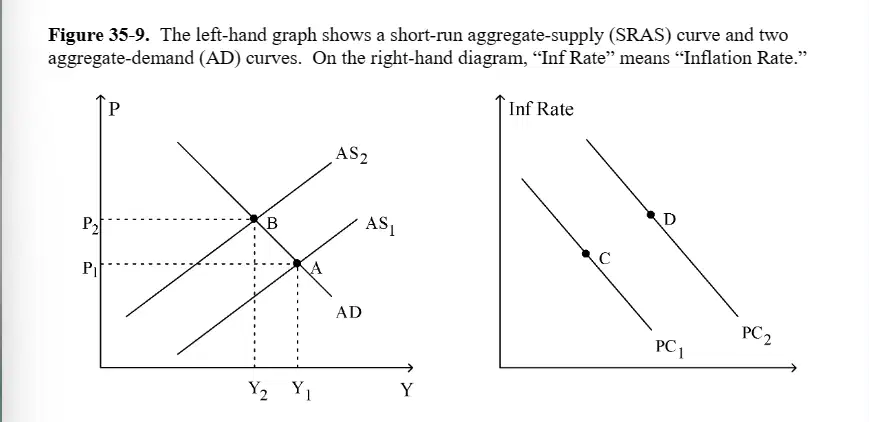
Refer to Figure 35-9. The shift of the aggregate-supply curve from AS1 to AS2
a.results in a more favorable trade-off between inflation and unemployment.
b.results in a more favorable trade-off between inflation and the growth rate of real GDP.
c.represents an adverse shock to aggregate supply.
d.represents a favorable shock to aggregate supply.
a
b
c
d
A favorable supply shock causes the price level to
a.rise. To counter this a central bank would increase the money supply.
b.rise. To counter this a central bank would decrease the money supply.
c.fall. To counter this a central bank would increase the money supply.
d.fall. To counter this a central bank would decrease the money supply.
a
b
c
d
If a central bank wants to counter the change in the price level caused by an adverse supply shock, it could change the money supply to shift
a.aggregate demand right.
b.aggregate demand left.
c.aggregate supply right.
d.aggregate supply left.
a
b
c
d
If a central bank increases the money supply in response to an adverse supply shock, then which of the following quantities moves closer to its pre-shock value as a result?
a.both the price level and output
b.the price level but not output
c.output but not the price level
d.neither output nor the price level
a
b
c
d
A central bank that accommodates an aggregate supply shock
a.increases the money supply, making the inflation rate rise.
b.increases the money supply, making the inflation rate fall.
c.decreases the money supply, making the inflation rate rise.
d.decreases the money supply, making the inflation rate fall.
a
b
c
d
Which of the following shifts aggregate supply to the right?
a.a decline in the price of imported natural resources
b.a technological advance
c.an older labor force that leaves jobs less frequently
d.All of the above are correct.
a
b
c
d
Which of the following would cause the price level to fall and output to rise in the short run?
a.an increase in the money supply
b.a decrease in the money supply
c.an adverse supply shock
d.a favorable supply shock
a
b
c
d
The large increase in oil prices in the 1970s was caused primarily by a(n)
a.increase in demand for oil.
b.decrease in demand for oil.
c.decrease in the supply of oil.
d.increase in the supply of oil.
a
b
c
d
In the United States during the 1970s, expected inflation
a.rose substantially.
b.rose slightly.
c.fell slightly.
d.fell substantially.
a
b
c
d
In 1980, the U.S. misery index was
a.much higher than average.
b.slightly higher than average.
c.about average.
d.below average.
a
b
c
d
In the 1970s, the Fed accommodated a(n)
a.adverse supply shock and so contributed to higher inflation.
b.adverse supply shock and so contributed to lower inflation.
c.favorable supply shock and so contributed to higher inflation.
d.favorable supply shock and so contributed to lower inflation.
a
b
c
d
In 1980, the U.S. economy had an inflation rate of
a.about 1 percent and an unemployment rate of about 7 percent.
b.less than 4 percent and an unemployment rate of less than 6 percent.
c.less than 7 percent and an unemployment rate of about 9 percent.
d.more than 9 percent and an unemployment rate of about 7 percent.
a
b
c
d
In 1980, the combination of inflation and unemployment the U.S. was experiencing
a.resulted from a leftward shift of the short-run Phillips curve.
b.was consistent with feasible inflation-unemployment combinations provided by the Phillips curve of the 1960s.
c.followed two supply shocks that were triggered by the Organization of Petroleum Exporting Countries.
d.All of the above are correct.
a
b
c
d
There is an adverse supply shock. In response the Federal Reserve pursues an expansionary monetary policy. Taking into account both the shock and the Federal Reserve’s policy, which of the following are we sure of?
a.unemployment will be higher
b.unemployment will be lower
c.inflation will be higher
d.inflation will be lower
a
b
c
d
An increase in the price of oil shifts the
a.short-run Phillips curve right and the unemployment rate rises.
b.short-run Phillips curve right and the unemployment rate falls.
c.short-run Phillips curve left and the unemployment rate rises.
d.short-run Phillips curve left and the unemployment rate falls.
a
b
c
d
After an oil price shock, which of the following would move unemployment back towards its natural rate?
a.the Fed sells bonds
b.the government raises taxes
c.the government increases expenditures
d.All of the above are correct.
a
b
c
d
Soon after he became the chairman of the Federal Reserve System in 1979, Paul Volcker embarked on a course
a.of accommodative monetary policy.
b.of disinflation.
c.that was designed to reduce the unemployment rate.
d.that produced results that were clearly consistent with those predicted by rational-expectations theorists.
a
b
c
d
Disinflation is defined as a
a.zero rate of inflation.
b.constant rate of inflation.
c.reduction in the rate of inflation.
d.negative rate of inflation.
a
b
c
d
Disinflation is like
a.slowing a car down, whereas deflation is like putting the car into reverse gear.
b.maintaining a car’s speed, whereas deflation is like slowing the car down.
c.putting a car into reverse gear, whereas deflation is like slowing the car down.
d.maintaining a car’s speed, whereas deflation is like putting the car into reverse gear.
a
b
c
d
Contractionary monetary policy
a.leads to disinflation and makes the short-run Phillips curve shift right.
b.leads to disinflation and makes the short-run Phillips curve shift left.
c.does not lead to disinflation but makes the short-run Phillips curve shift right.
d.does not lead to disinflation but makes the short-run Phillips curve shift left.
a
b
c
d
The sacrifice ratio is the
a.sum of the inflation and unemployment rates.
b.inflation rate divided by the unemployment rate.
c.number of percentage points annual output falls for each percentage point reduction in inflation.
d.number of percentage points unemployment rises for each percentage point reduction in inflation.
a
b
c
d
If the Fed reduces inflation 1 percentage point and this makes output fall 5 percentage points and unemployment rises 2 percentage points for one year, the sacrifice ratio is
a.1/5.
b.2.
c.5/2.
d.5.
a
b
c
d
If a central bank reduced inflation by 2 percentage points and that made output fall by 1 percentage points for 2 years and the unemployment rate rise from 3 percent to 5 percent for 2 years, the sacrifice ratio is
a.1/2.
b.1.
c.2.
d.4.
a
b
c
đ
Typical estimates of the sacrifice ratio suggest that a one-percentage-point reduction in the inflation rate requires
a.a sacrifice of 5 percent of annual output.
b.a sacrifice of 5 percent of government spending.
c.an increase in the unemployment rate of 5 percentage points.
d.a 5 percent increase in the government budget deficit.
a
b
c
d
Suppose that reducing inflation by 2 percentage points would cost a country 5 percent of its annual output. This country's sacrifice ratio is
a.0.4.
b.1.5.
c.2.5.
d.5.0.
a
b
c
d
An economy has a current inflation rate of 7%. If the central bank wants to reduce inflation to 4% and the sacrifice ratio is 2, then how much annual output must be sacrificed in the transition?
a.10%
b.8%
c.6%
d.None of the above is correct.
a
b
c
d
A country is likely to have a higher sacrifice ratio if
a.contracts are shorter, and people believe the central bank will reduce inflation.
b.contracts are longer, and people believe the central bank will not reduce inflation
c.contracts are longer, and people believe the central bank will reduce inflation.
d.contracts are shorter, and people believe the central bank will not reduce inflation.
a
b
c
d
Which of the following would tend to shorten recessions associated with anti-inflation policies by central banks?
a.People adjust their expectations of inflation rapidly.
b.People believe policy announcements made by central bank officials.
c.The short-run Phillips shifts rapidly.
d.All of the above are correct.
a
b
c
d
In 1979, Fed Chair Paul Volcker
a.instituted an accommodative monetary policy to address adverse supply shocks.
b.believed that inflation had not yet reached unacceptable levels.
c.believed decreasing inflation would temporarily decrease output growth.
d.All of the above are correct.
a
b
c
d
The theory by which people optimally use all available information when forecasting the future is known as
a.rational expectations.
b.perfect expectations.
c.credible expectations.
d.predictive expectations.
a
b
c
d
If the Fed announced a policy to reduce inflation and people found it credible, the short-run Phillips curve would shift
a.right and the sacrifice ratio would fall.
b.right and the sacrifice ratio would rise.
c.left and the sacrifice ratio would fall.
d.left and the sacrifice ratio would rise.
a
b
c
d
Proponents of rational expectations argued that the sacrifice ratio
a.could be high because it was rational for people not to immediately change their expectations.
b.could be high because people might adjust their expectations quickly if they found anti-inflation policy credible.
c.could be low because it was rational for people not to immediately change their expectations.
d.could be low because people might adjust their expectations quickly if they found anti-inflation policy credible.
a
b
c
d
The restrictive monetary policy followed by the Fed in the early 1980s
a.reduced both unemployment and inflation.
b.reduced inflation significantly, but at the cost of a severe recession.
c.reduced unemployment significantly, but at the cost of higher inflation.
d.raised both unemployment and inflation.
a
b
c
d
The Volcker disinflation
a.had virtually no impact on output, just as the classical dichotomy suggested.
b.was associated with rising output, perhaps due to expansionary fiscal policy.
c.caused output to fall, but by less than the typical estimate of the sacrifice ratio suggested.
d.None of the above is correct.
a
b
c
d
Suppose a central bank announced that it was going to make a serious effort to fight inflation. A few years later the inflation rate is lower, but there had been a serious recession. We could conclude with certainty that
a.the rational expectations hypothesis is false.
b.the rational expectations hypothesis is true.
c.the policymakers lacked credibility.
d.None of the above is certain.
a
b
c
d
The experience of the Volcker disinflation of the early 1980s
a.generally increased estimates of the sacrifice ratio.
b.generally decreased estimates of the sacrifice ratio.
c.clearly refuted the predictions of the proponents of rational expectations.
d.clearly refuted the predictions of the opponents of rational expectations.
a
b
c
d
Over the long run the Volcker disinflation
a.shifted the short-run and long-run Phillips curves left.
b.shifted the short-run, but not the long-run Phillips curve left.
c.shifted the long-run, but not the short-run Phillips curve left.
d.None of the above is correct.
a
b
c
d
Which of the following describes the Volcker disinflation most accurately?
a.Almost all of the public believed that the Fed would keep money growth low, so unemployment rose less than it would have otherwise.
b.Almost all of the public believed that the Fed would keep money growth low, so unemployment rose more than it would have otherwise.
c.Much of the public did not believe that the Fed would keep money growth low, so unemployment rose less than it would have otherwise.
d.Much of the public did not believe that the Fed would keep money growth low, so unemployment rose more than it would have otherwise.
a
b
c
d
Between 1993 and 2001 the U.S. economy experienced
a.relatively low inflation and unemployment rates.
b.relatively high inflation and unemployment rates.
c.relatively low inflation rates and relatively high unemployment rates.
d.relatively high inflation rates and relatively low unemployment rates.
a
b
c
d
The Economy in 2008
In the first half of June 2008 the effects of a housing and financial crisis and an increase in world prices of oil and foodstuffs were affecting the economy.
Refer to The Economy in 2008. The effects of the housing and financial crises could be shown by shifting
a.aggregate demand to the right.
b.aggregate demand to the left.
c.aggregate supply to the right.
d.aggregate supply to the left.
a
b
c
d
Other things the same, a country that decides to reduce inflation will
a.have a higher unemployment rate in the short run and the long run.
b.have a higher unemployment rate only in the long run.
c.have a higher unemployment rate only in the short run.
d.not have a higher unemployment rate in either the short run or the long run.
a
b
c
d
The monetary-policy framework called inflation targeting is used explicitly by
a.no major country.
b.most major countries except the United States and Japan.
c.the United States, but it is not used by other major countries.
d.most major countries, including the United States and Japan.
a
b
c
d
Monetary Policy in Flosserland: In Flosserland, the Department of Finance is responsible for monetary policy. Flosserland has had an inflation rate of 25% for many years. Suppose that the Flosserland Department of Finance has run a public relations campaign claiming it will reduce inflation to 12.5% and that it actually reduces inflation to that level. Suppose that the public had expected that the Department of Finance would reduce inflation but only to 22%. Then
a.unemployment falls, but it would have fallen more if people had been expecting 12.5% inflation.
b.unemployment falls, but it would have fallen more if people had been expecting 25% inflation.
c.unemployment rises, but it would have risen more if people had been expecting 12.5% inflation.
d.unemployment rises, but it would have risen more if people had been expecting 25% inflation.
a
b
c
d
Which of the following is not correct?
a.In the short run, policymakers face a tradeoff between inflation and unemployment.
b.Events that shift the long-run Phillips curve right shift the long-run aggregate supply curve left.
c.Unemployment can be changed only by the use of government policy.
d.The decrease in output associated with reducing inflation is less if the policy change is announced ahead of time and is credible.
a
b
c
d
Which of the following played a role in depressing aggregate demand in 2001?
a.the end of a stock-market bubble
b.corporate accounting scandals
c.the terrorist attacks on September 11 of that year
d.All of the above are correct.
a
b
c
d
According to the Philips curve diagram, if a central bank takes action to reduce the inflation rate, unemployment is
a.higher in the short-run and the long-run.
b.higher in the short-run only.
c.lower in the short-run and the long-run.
d.lower in the short-run only.
a
b
c
d
In the long run, the natural rate of unemployment depends primarily on the growth rate of the money supply.
t
f
Other things the same, an increase in aggregate demand reduces unemployment and raises inflation in the short run.
t
f
The logic behind the tradeoff between inflation and unemployment is that high aggregate demand puts upward pressure on wages and prices while raising output.
t
f
Fiscal policy cannot be used to move the economy along the short-run Phillips curve.
t
f
Samuelson and Solow believed that the Phillips curve offered policymakers a menu of possible economic outcomes.
t
f
The classical notion of monetary neutrality is consistent both with a vertical long-run aggregate-supply curve and with a vertical long-run Phillips curve.
t
f
An increase in the natural rate of unemployment shifts the long-run Phillips curve to the right.
t
f
Just as the aggregate-supply curve slopes upward only in the short run, the trade-off between inflation and unemployment holds only in the short run.
t
f
The analysis of Friedman and Phelps argues that an expected change in inflation has no impact on the unemployment rate.
t
f
A decrease in government expenditures serves as an example of an adverse supply shock.
t
f
If prices and wages adjusted rapidly and producers could quickly distinguish the difference between a change in the price level and a change in the relative price of their products, then an increase in the money supply growth rate would have at most a very short-lived affect on unemployment.
t
f
An adverse supply shock shifts the short-run Phillips curve right and the short-run aggregate-supply curve left.
t
f
In most of the 1970s, the Fed's policy created expectations of high inflation.
t
f
A low sacrifice ratio would make a central bank less willing to reduce the inflation rate.
t
f
U.S. monetary policy in the early 1980s reduced the inflation rate by more than half.
t
f
A central bank can reduce inflation by reducing money supply growth, but it necessarily does so at the cost of permanently raising the unemployment rate.
t
f

