
Font size
 Worksheets
Midterm in Linear Algebra
Total questions: 48
Worksheet time: 2hrs 17mins

A system of linear equations can be consistent and independent. This is a system of linear equations having infinitely many solution. The slopes of the lines defined by the equations are equal, their y-intercepts are also equal.
System of linear equation in two variables
Consistent and Independent
Consistent and Dependent
Inconsistent
This is a system of linear equations having no solution. The slopes of the lines defined by the equations are equal but their y-intercepts are not equal.
System of linear equation in two variables
Consistent and Independent
Consistent and Dependent
Inconsistent
Which statement are true regarding the following system of linear equation?
x1 − 2x2 −x3 +3x4=0
−2x1+4x2+5x3−5x4=3
3x1−6x2−6x3+8x4=2
The system is inconsistent
The system has no free variables
The system has infinitely many solution
The system has 3 basic variables
Which statement are true regarding the following system of linear equation?
x1 + 2x2 + 4x3 = 5
2x1 + 4x2 + 5x3 = 4
4x1 + 5x2 + 4x3 = 2
The system is inconsistent.
The system has one unique solution
The system has free variables
The system has infinitely many general solution
The system has 3 basic variables.

17 12
8 -10
-15 -8
-1 -3

9 5
42 35
7 1

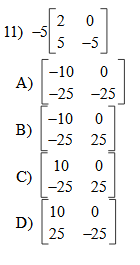


7 -1
1 -4
-6 0

8 1
7 1
0 1
x+2y+z=2
3x+8y+z=12
4y+z=2
for the system of equations above:
x=-2,y=1,z=-2
x=2,y=1,z=2
x=2,y=1,z=-2
x=-2,y=-1,z=-2

Find V + X


Does Not Exist
Find Z - W


Does Not Exist
Find (W + Y) - V


Does Not Exist

Perform the matrix multiplication, if possible.


Cannot be multiplied, dimensions not compatible.

Perform the matrix multiplication, if possible.


Cannot be multiplied, dimensions not compatible.
What is a Matrix?
An equation of over 5 numbers or symbols
A set of numbers in rows and columns
A method of finding the nth value of a series
A complicated number system
In matrices (AB)t equals to
B
A
At Bt
Bt At
If A is a 3×3 non-singular matrix such that AAT=ATA and B=A−1AT , then BBT =
A
B
I3
BT


IfATA−1 is symmetric, then A2=
A−1
(AT)2
AT
(A−1)2
•Determinant of a skew-symmetric matrix of odd order is always
1
0
-1
May be any number
•Determinant of an orthogonal matrix of any order is always
1 or-1
0
2 or -2
may be any number
•For a system of n linear homogeneous equations to be have non-trivial solution must have
|A| must be negative
•|A| must be positive
•|A| must be equal to zero.
•No condition on |A|.

1
2
3
0

⌊⅖ −⅕⌋ ?
*det = -5
⌊3 4⌋
⌊2 4⌋
⌊2 3⌋
⌊2 −1⌋
By solving Simultaneous linear algebraic equation in which method we have to use back substitution concept.
Gauss Jacobi method
Gauss Seidal Method
Gauss elimination method
Gauss Jordan Method

This is an example of
Row Echelon Form
Reduced Row Echelon Form
Really Reduced Echelon Form
Really Really Easy Form
Reduced Row Echelon Form is where ______________________
Zeroes in the first column of my matrix
The last column has all zeroes
One's are in a diagonal pattern of my matrix with zeroes underneath the one's.before the augmented portion
One's are in a diagonal pattern of my matrix with zeroes above and below the ones before the augmented portion
Gauss Elimination Method & Gauss Jordan Methods are _______ methods
Direct
Indirect.
Self- correcting
Step by step

This is an example of a/an
System of Quadratic Equations
Reduced Row Echelon Form
Augmented Matrix
A Canine Doing a Backflip

Aina is simplifying the matrix using Gaussian Elimination. Did she complete the step correctly?
No, she should have changed the 2 to a zero and multiplied -2 by R2 and added R1
No, she wanted to change the 3 to a zero so she should have multiplied R2 and added it to R3
Yes. When you need a zero you multiply by the number's reciprocal.
No. Just punch in the calculator. Who cares about Carl Gauss

Farah solved the matrix on the left. Ibrahim solved the matrix on the right. Who is correct?
Farah, because she multiplied by the reciprocal.
Ibrahim, because he got the top left number to be a one.
Neither. They needed to take care of the one and make it a zero first.
Both. Each step is legal and takes care of the top left term
In Gauss Jordan method which of the following transformations are allowed?
Diagonal transformation
Square transformation
Row transformation
Column transformation


1
0
a + b + c
3abc

0
1
-1
23
If A and B are invertible matrix then (AB)-1 =
A-1B-1
AB
B-1A-1
none of these
Which of the following is not true
If any two rows / columns of a determinant are identical then the value of determinant is zero.
If each element of a row / column of a determinant is multiplied by the same number k , then value of the new determinant is k times the value of original determinant.
If A and B are square matrices of same order then |AB| = |A|.|B|
If A is a square matrix then |A| = the sum of the products elements of any row/column with the cofactors of the corresponding elements of some other row/column
Which of the following is true
If any two rows / columns are interchanged then value of the determinant remains unchanged.
If any two rows/ columns are interchanged then value of the determinant becomes two times.
If any two rows / columns are interchanged then value of the determinant changes by minus sign.
If any two rows/ columns are interchanged then value of the determinant becomes zero.

What is the cofactor of the entry a3,1 of the given determinant ?



